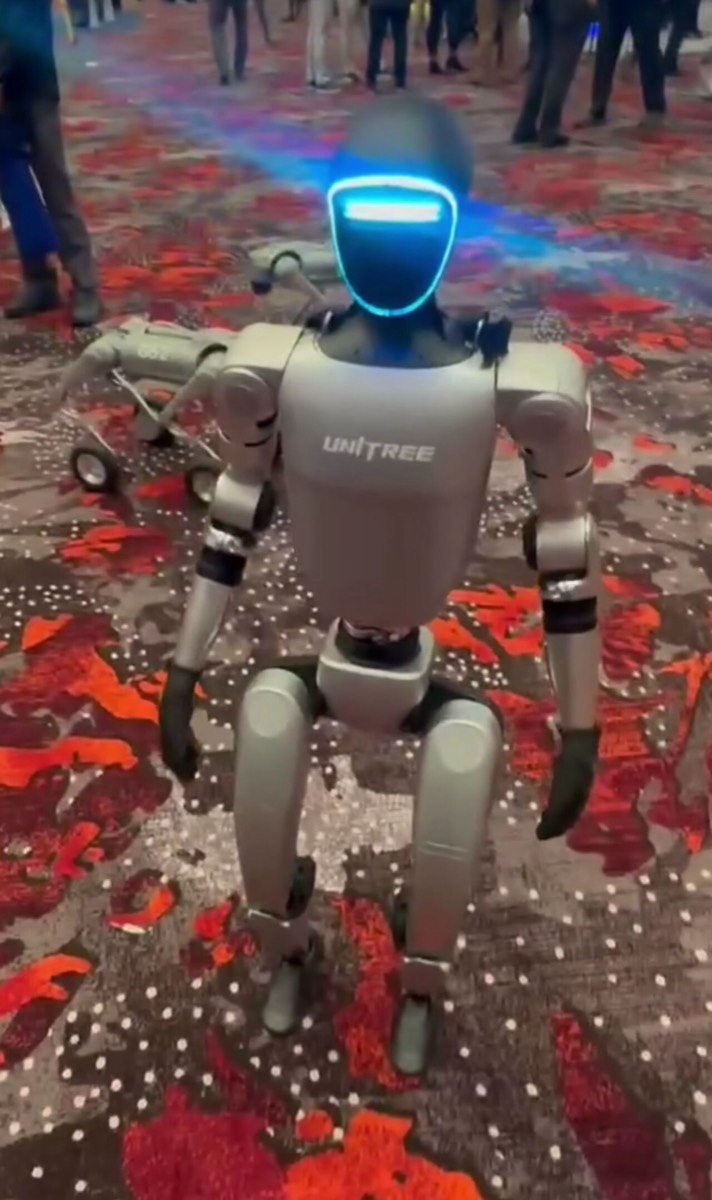
Unitree Robotics · Compact research humanoid
Unitree G1
The cheapest full-size-capable humanoid you can actually order: 1.32m tall, 23 degrees of freedom and a published $16,000 starting price.
- Height
- 1.32 m
- Weight
- ≈35 kg
- Degrees of freedom
- 23-43 DOF
- Battery life
- ≈2 hours
Availability
Orderable direct from Unitree and through robotics distributors. Lead times are typically measured in weeks, and EDU configurations are sold to institutions and businesses rather than consumers.
Pricing and availability verified July 23, 2026. Robot pricing moves faster than the hardware does — confirm on the manufacturer's own page before ordering.
Where to buy
| Seller | What you get | Price | Regions | |
|---|---|---|---|---|
| Unitree official store | G1 base unitConfiguration and shipping quoted per order; EDU variants require an institutional buyer. | $16,000 | Global, subject to export rules | Visit |
| RobotShop | G1 EDU via distributorUseful if you need local invoicing, warranty handling or import paperwork done for you. | Quote | US, EU, CA | Visit |
Base G1 with 23 DOF. The G1 EDU variants with more joints, dexterous hands and higher-end compute run substantially more.
Strengths and limitations
What works
- By far the lowest entry price of any orderable humanoid
- Genuinely available rather than waitlist-only
- Open SDK with ROS support and a large published research base
- Folds down small enough to transport in a car boot
What does not
- Small stature limits real-world manipulation work
- Base configuration ships without dexterous hands
- Roughly two hours of runtime per battery
- Sold as a development platform, not a finished consumer product
Watch the Unitree G1
“Unitree Introducing | Unitree G1 Humanoid Agent | AI Avatar” — official video from Unitree Robotics on YouTube.
Full specifications
Overview
| Type | Bipedal humanoid |
|---|---|
| Maker | Unitree Robotics (Hangzhou, China) |
| Announced | May 2024 |
| Intended use | Research, education, developer platform |
| Variants | G1, G1 EDU, G1 Comp |
Body
| Height | 1.32 m standing |
|---|---|
| Folded size | ≈690 × 450 × 300 mm |
| Weight | ≈35 kg |
| Arm span | ≈1.2 m |
| Materials | Aluminium alloy and engineering plastics |
Actuation
| Degrees of freedom | 23 base, up to 43 with dexterous hands |
|---|---|
| Joint torque (knee) | Up to 120 N·m |
| Waist | 3 DOF on higher configurations |
| Hands | Three-finger Dex3-1 optional |
| Walking speed | ≈2 m/s |
Compute
| Onboard compute | 8-core CPU; NVIDIA Jetson Orin on EDU |
|---|---|
| Connectivity | Wi-Fi 6, Bluetooth 5.2, Gigabit Ethernet |
| Expansion | USB-C and Ethernet payload ports |
Sensors
| Depth camera | Intel RealSense D435 |
|---|---|
| LiDAR | Livox MID-360 3D LiDAR |
| Audio | Microphone array and speaker |
| Proprioception | Per-joint encoders and IMU |
Power
| Battery | 9,000 mAh hot-swappable pack |
|---|---|
| Runtime | ≈2 hours typical |
| Charging | Dock or external charger |
Software
| SDK | unitree_sdk2 (C++ and Python) |
|---|---|
| Simulation | Isaac Sim and MuJoCo models published |
| Middleware | ROS 2 support |
| Teleoperation | VR-based teleop reference implementation |
Unitree G1 news and updates
Unitree adds a cheaper R1 below the G1
Unitree introduced the R1 at roughly $5,900, a smaller and lighter humanoid that undercuts the G1 and pushes the entry price for a walking humanoid down again.
Source: Unitree ↗G1 becomes the default platform in humanoid research papers
Its price and open SDK made the G1 the most common hardware target for published locomotion and whole-body-control work, which in turn means more reusable code for new buyers.
Source: Unitree ↗
Frequently asked questions
How much does the Unitree G1 cost?
The base G1 starts at $16,000. EDU configurations with extra joints, dexterous hands and Jetson-class compute are quoted individually and cost considerably more.
Can an individual buy a Unitree G1?
The base unit is sold direct and to distributors, but Unitree treats it as a development platform. EDU variants are generally sold to universities and companies, and export rules apply in some countries.
How long does the G1 run on a charge?
About two hours of typical use from its 9,000 mAh pack. The battery is hot-swappable, so continuous operation means keeping spare packs charged.