iPhone 11 vs Nothing Phone (2a) (2026): Old iPhone or New Android?

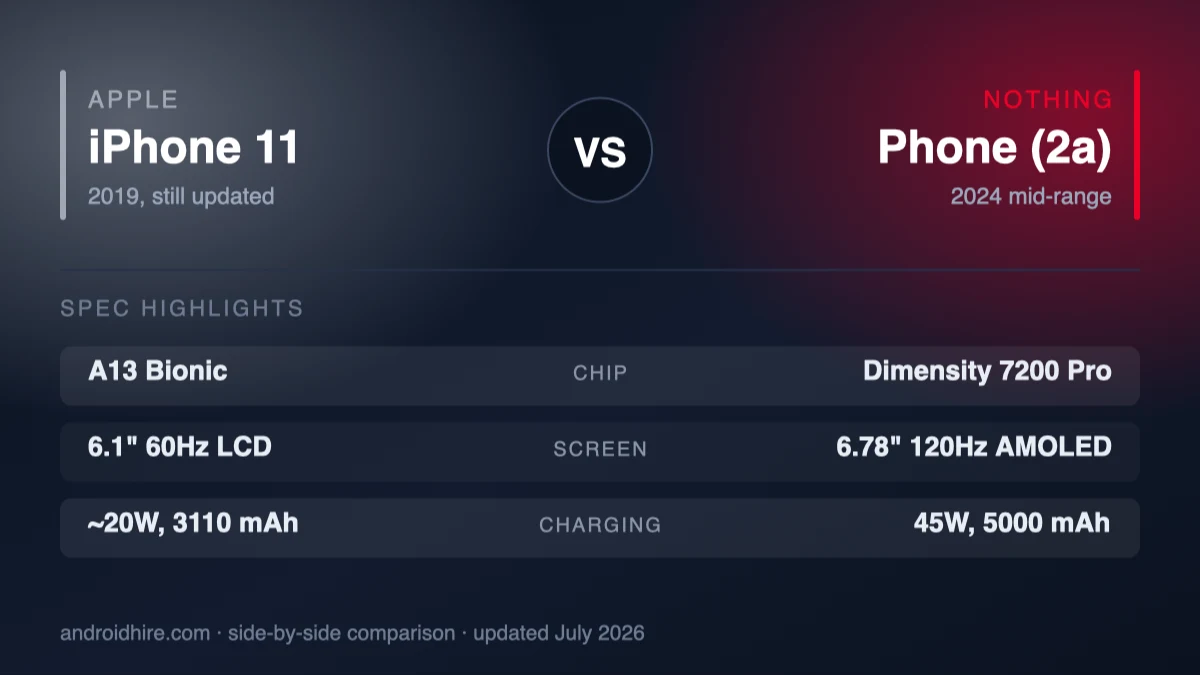
Buy the Nothing Phone (2a) if you want the better phone: a 6.78-inch 120Hz AMOLED, dual 50MP cameras, a 5,000mAh battery and 45W charging, all new and warrantied. Buy a used iPhone 11 if you want iOS, Apple's repair network and stronger resale value — and it is genuinely still supported, being the oldest iPhone that runs iOS 26. On hardware this is a rout. On longevity it is closer than you would expect from a 2019 phone.
In a hurry? Jump to → Quick verdict · Full spec comparison · Display · Performance · Cameras · Battery & charging · Updates · Buying gotchas · How we compared · FAQ
What makes this comparison worth having is one surprising fact: when Apple released iOS 26, it dropped the iPhone XR, XS and XS Max but kept the iPhone 11. That single decision turned the iPhone 11 from "old phone" into the cheapest iPhone still on Apple's update list — which is why people now weigh it against brand-new Android phones like the Phone (2a) instead of dismissing it. So the real question is not which has better specs. It is whether iOS support is worth accepting 2019 hardware.
Quick verdict: iPhone 11 vs Nothing Phone (2a)
Choose the Nothing Phone (2a) if you care how the phone feels to use. A 120Hz AMOLED against a 60Hz LCD is the single most noticeable difference between these two, and the battery and charging gaps are almost as large. You also get a warranty and an undegraded battery.
Choose the iPhone 11 if you want iOS specifically, you own an iPad, Mac or Apple Watch, you value the resale price, or you want repairs available almost anywhere.
Plainly: the Phone (2a) is the better product. The iPhone 11 is the better choice only if the ecosystem is the point.
Who wins what, category by category
| Category | Winner | Why it wins |
|---|---|---|
| Display | Nothing Phone (2a) | 120Hz AMOLED, ~1,300 nits vs 60Hz LCD, ~625 |
| Battery | Nothing Phone (2a) | 5,000mAh new vs 3,110mAh degraded |
| Charging | Nothing Phone (2a) | 45W (~60 min) vs ~20W (~100 min) |
| Camera resolution | Nothing Phone (2a) | Two 50MP lenses vs two 12MP |
| Video | iPhone 11 | Apple's stabilisation and colour still lead |
| Performance | Nothing Phone (2a) | Dimensity 7200 Pro edges the A13 in multi-core |
| Software runway | iPhone 11 | Runs iOS 26; oldest iPhone still supported |
| Design | Nothing Phone (2a) | Glyph lights, transparent back, 190g |
| Resale and repairs | iPhone 11 | Holds value; serviceable almost anywhere |
Score: Nothing Phone (2a) 6 – iPhone 11 3. The iPhone's three wins are all about ownership rather than use.
iPhone 11 vs Nothing Phone (2a): full spec comparison
| Specification | Apple iPhone 11 | Nothing Phone (2a) |
|---|---|---|
| Released | September 2019 | March 2024 |
| Typical 2026 price | ~$250–290 used | ~$300 new |
| Display | 6.1" Liquid Retina LCD | 6.78" AMOLED (10-bit) |
| Resolution | 828 x 1792 | 1084 x 2412 |
| Refresh rate | 60Hz fixed | 30–120Hz adaptive |
| Peak brightness | ~625 nits | ~1,300 nits |
| Processor | A13 Bionic (7nm) | Dimensity 7200 Pro (4nm) |
| RAM | 4GB | 8 / 12GB |
| Storage | 64 / 128 / 256GB | 128 / 256GB |
| Main camera | 12MP with OIS | 50MP with OIS |
| Ultrawide | 12MP (120°) | 50MP fixed focus |
| Front camera | 12MP with Face ID | 32MP |
| Max video | 4K at 60fps | 4K at 30fps |
| Battery | 3,110 mAh (6+ years old) | 5,000 mAh |
| Wired charging | ~20W | 45W |
| Wireless charging | ✔ 7.5W Qi | ✖ No |
| Water resistance | IP68 | IP54 |
| Port | Lightning | USB-C |
| Launched on | iOS 13 | Nothing OS 2.5 / Android 14 |
| Update status | Runs iOS 26 | 3 OS / 4 yrs security |
| Weight | ~194 g | ~190 g |
Apple does not publish battery capacity or charging wattage; those come from teardowns and third-party tests.
Display: the gap you notice in five seconds
The iPhone 11's screen is the weakest part of the phone today. It is an LCD, so blacks are grey; it is 828 x 1792, which is lower resolution than almost any current budget Android; and it is locked to 60Hz at roughly 625 nits.
The Phone (2a) counters with a 6.78-inch 10-bit AMOLED, 1084 x 2412, 30–120Hz adaptive refresh and about 1,300 nits peak — roughly double the brightness with true blacks and much smoother scrolling.
- Scrolling and animation: Phone (2a), by a wide margin.
- Outdoor visibility: Phone (2a).
- One-handed use: iPhone 11, at 6.1 inches.
- Colour accuracy: close — Apple's calibration is good, but the AMOLED has more range.
Performance: closer than the years suggest
Apple's A13 Bionic was extraordinary in 2019 and still handles everything, especially single-threaded work. The Dimensity 7200 Pro is a modern 4nm mid-range chip with far more RAM alongside it.
| Benchmark (approximate) | iPhone 11 | Nothing Phone (2a) |
|---|---|---|
| Geekbench 6 single-core | ~1,330 | ~1,100 |
| Geekbench 6 multi-core | ~3,450 | ~2,600 |
| AnTuTu v10 total | ~800,000 | ~700,000 |
| Sustained gaming | Good, but 4GB RAM limits multitasking | Good, more headroom for apps |
Benchmark figures are typical published ranges from public test databases rather than our own runs — read them as a class gap, not an exact score for your unit.
The A13 still wins raw benchmarks — an impressive result for a 2019 chip. What it cannot fix is 4GB of RAM, which is why an iPhone 11 reloads background apps and browser tabs more often than an 8GB Android does. Cross-platform scores are indicative only; in daily use the 120Hz screen makes the Phone (2a) *feel* quicker regardless.
Also Read: iPhone XS vs Moto G Power (2025)
Cameras: resolution vs processing
iPhone 11 camera
- 12MP main with OIS and Night mode
- 12MP ultrawide (no night mode on this lens)
- 12MP Face ID selfie camera
- 4K/60 video — still better stabilised than most budget Androids
Nothing Phone (2a) camera
- 50MP main with OIS (f/1.88)
- 50MP ultrawide, fixed focus
- 32MP selfie camera
- 4K/30 video, TrueLens processing engine
The Phone (2a) has more sensor to work with and produces sharper, more detailed stills, especially when you crop. The iPhone 11 holds two advantages that matter: video (stabilisation and audio remain better) and consistency — its colour science is predictable in a way budget Android processing often isn't. For photos of people in mixed lighting, they are surprisingly close.
Battery and charging: no contest
5,000mAh against a nominal 3,110mAh is a 61% capacity advantage, and the real gap is wider because a 2019 iPhone's battery has been through hundreds of cycles. Check Battery Health before buying one; below 85% you should assume a replacement is due.
Charging is just as lopsided: 45W fills the Phone (2a) to 50% in about 23 minutes and full in roughly an hour, while the iPhone 11 needs about 100 minutes at 20W. Apple's counter is 7.5W wireless charging, which the Phone (2a) lacks entirely — convenient, but slow.
Software and updates: the iPhone's real argument
This is why the comparison exists. The iPhone 11 launched on iOS 13 and runs iOS 26 — seven years of major updates, and it survived the cut that removed the XR and XS. It does miss the Apple Intelligence features that need newer silicon, and it is late in its life, so check Apple's current support list before buying.
The Phone (2a) launched on Nothing OS 2.5 over Android 14 with three OS upgrades and four years of patches promised, running to roughly 2028. Nothing OS deserves credit here: it is one of the cleanest Android skins available, with no preinstalled bloatware and no promotional notifications — closer to a Pixel than to a typical budget phone.
Net result: the Phone (2a) has the longer remaining runway; the iPhone 11 has the better track record.
Which one should you buy?
Buy the Nothing Phone (2a) if: you want a new phone with a warranty, a 120Hz screen, real battery life and fast charging; you like clean Android; or you simply want the most phone for around $300.
Buy the iPhone 11 if: you want iOS, you already own Apple devices, you shoot a lot of handheld video, you value IP68 water resistance and wireless charging, or resale value matters to you.
Better idea if you can stretch: a used iPhone 12 or 13 gets you iOS with a proper OLED screen and a newer chip — see how a 2020 iPhone flagship compares to a modern mid-ranger.
What the spec-comparison sites won't tell you
- The iPhone 11's screen resolution is genuinely low. 828 x 1792 is below almost every Android at this price. Spec tables list "Liquid Retina" and move on; you will see the difference on text.
- The Phone (2a) is only IP54. Splash resistance, not immersion — the iPhone 11's IP68 is a real advantage if you are around water.
- Check Battery Health on any used iPhone 11. Settings → Battery → Battery Health. Six-year-old cells are often under 80%, and replacement is a paid Apple service.
- Nothing's repair network is thin. Outside major cities, service can mean shipping the phone away. Apple service is available almost everywhere — worth weighing if you cannot be without a phone.
How we compared these phones
We used Apple's technical specifications and Nothing's published sheet, filling Apple's deliberate gaps — battery capacity and charging wattage are not published, so those figures come from teardown data and third-party charging tests and are marked approximate. Display and charging claims were checked against independent lab measurements including GSMArena's Phone (2a) review, and iOS support against Apple's own compatibility list, which confirms the iPhone 11 as the oldest model running iOS 26. Because one device is second-hand, we treated battery degradation as a specification rather than a footnote: a nominal 3,110mAh cell after six years is not a 3,110mAh cell, and no automated comparison page accounts for that.
Related reading
Bottom line
iPhone 11 vs Nothing Phone (2a) is 2019 hardware with 2026 software against 2024 hardware with clean Android. The Nothing Phone (2a) wins nearly everything you touch: a 120Hz AMOLED at double the brightness, a 5,000mAh battery against a degraded 3,110mAh one, 45W charging instead of 20W, and two 50MP cameras — all new, warrantied and around $300. The iPhone 11 wins on video, IP68 sealing, wireless charging, repairability, resale value and the remarkable fact that it still runs iOS 26. Want iOS? Buy the iPhone. Want the better phone? Buy the Nothing.
Specifications, software versions and street prices in this comparison were checked in July 2026. We revisit head-to-head guides whenever either phone gets a major OS update or a lasting price change.
Next step: browse every matchup on our phone comparisons hub, or open full spec sheets in the phone specifications directory.
Frequently Asked Questions
Is the iPhone 11 still getting updates in 2026?
Yes. The iPhone 11 is the oldest iPhone supported by iOS 26 — Apple dropped the iPhone XR, XS and XS Max instead. That gives it a longer software runway than most seven-year-old phones, though it misses newer Apple Intelligence features.
Which has the better screen?
The Nothing Phone (2a), decisively. It uses a 6.78-inch AMOLED with a 30–120Hz refresh rate and about 1,300 nits peak. The iPhone 11 has a 6.1-inch LCD locked to 60Hz at around 625 nits, with lower resolution than most current budget phones.
How different is the battery life?
Substantially. The Phone (2a) has a 5,000mAh battery and charges at 45W; the iPhone 11 has 3,110mAh when new and charges at roughly 20W. A used iPhone 11's battery will also have degraded after six or seven years.
Which takes better photos?
It splits. The Phone (2a) has two 50MP cameras (main with OIS, plus ultrawide) and more resolution to work with. The iPhone 11's 12MP pair still produces excellent, natural-looking results and is better for video, where Apple's stabilisation remains ahead.
Does the Nothing Phone (2a) get long software support?
Reasonable for its class: three years of Android upgrades and four years of security patches from its March 2024 launch, so patches run to around 2028. Nothing OS is also unusually clean, with no preinstalled junk.
Which one holds its value better?
The iPhone 11, clearly. iPhones depreciate more slowly and are easier to resell, and Apple's repair network is far wider than Nothing's — a real consideration outside major cities.
Which should I buy in 2026?
The Nothing Phone (2a) for almost everyone — you get a new phone, a fresh battery, a much better screen and fast charging for similar money. Choose the iPhone 11 only if you specifically want iOS, already own Apple devices, or value resale and repairability.