Asus Zenfone 11 Ultra vs Apple iPhone 14 (2026): Big Android or Simple iPhone?

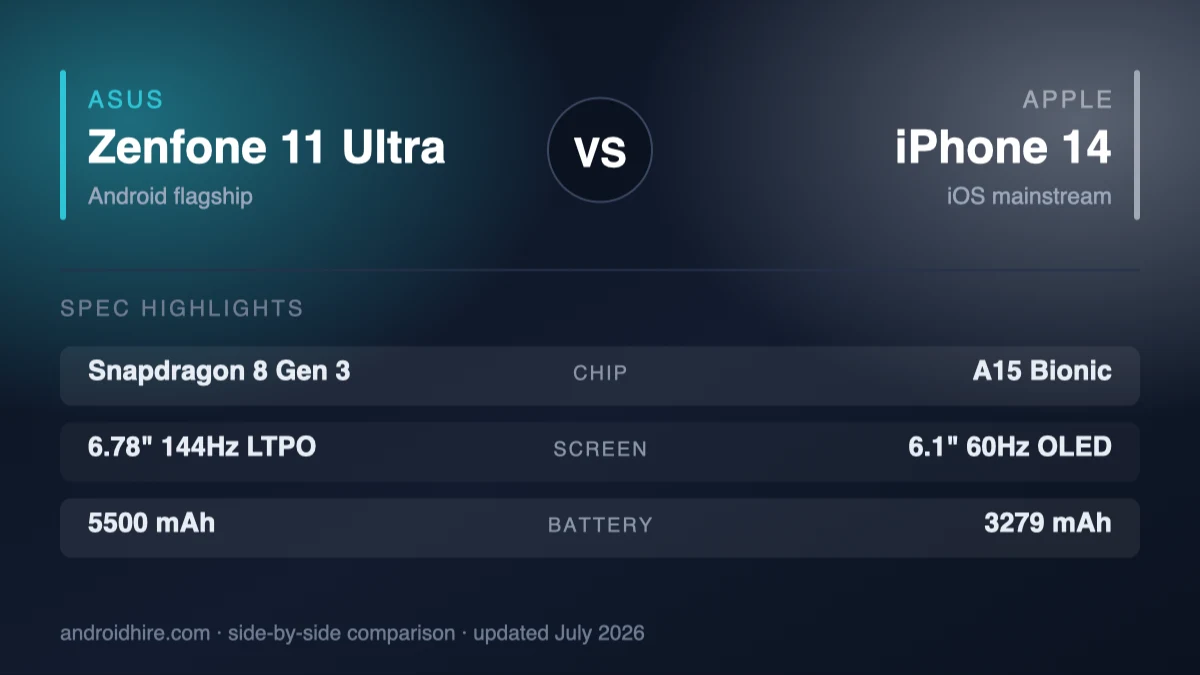
Buy the Asus Zenfone 11 Ultra if you want more phone for the money: a 6.78-inch 144Hz LTPO screen, Snapdragon 8 Gen 3 speed, a 5,500mAh battery, 65W charging, a 3x telephoto and a headphone-friendly feature set. Buy the Apple iPhone 14 if you want a compact phone, class-leading video and years more software support. On raw hardware this is not a fair fight — the Zenfone wins almost every line. What Apple sells here is longevity and simplicity.
In a hurry? Jump to → Quick verdict · Full spec comparison · Display · Performance · Cameras · Battery & charging · Updates · Buying gotchas · How we compared · FAQ
People search this pairing for a specific reason: both phones sit around the same used and discounted price in 2026, and they represent opposite philosophies. The Zenfone 11 Ultra (March 2024) is a large flagship stuffed with hardware — 144Hz, gimbal stabilisation, 16GB of RAM at the top end. The iPhone 14 (September 2022) is deliberately modest hardware wrapped in software that will outlive it. If you have been comparing spec tables and wondering why anyone picks the iPhone, the update timeline is the answer.
Quick verdict: Zenfone 11 Ultra vs iPhone 14
Choose the Zenfone 11 Ultra if you want the better display, far more performance, much better battery life and fast charging, plus a real 3x optical zoom the iPhone 14 simply does not have. It is also the only one of the two with a 6.78-inch screen, which matters if you read, game or watch video on your phone.
Choose the iPhone 14 if you value a phone that fits one hand, the best point-and-shoot video in this price bracket, tight integration with a Mac, iPad or Apple Watch, and iOS updates for years to come. Resale value is also considerably stronger.
Put bluntly: the Zenfone is the better device; the iPhone 14 is the better investment. Which one wins depends on whether you replace phones every two years or every five.
Who wins what, category by category
| Category | Winner | Why it wins |
|---|---|---|
| Display | Zenfone 11 Ultra | 144Hz LTPO and ~2,500 nits vs 60Hz |
| Performance | Zenfone 11 Ultra | Snapdragon 8 Gen 3 vs a 2021 A15 |
| Battery life | Zenfone 11 Ultra | 5,500mAh vs 3,279mAh |
| Charging | Zenfone 11 Ultra | 65W wired fills in ~40 min vs ~90 min |
| Zoom | Zenfone 11 Ultra | 3x optical telephoto; the iPhone 14 has none |
| Video | iPhone 14 | Action mode, Cinematic mode, consistent colour |
| Size and weight | iPhone 14 | 172g and 6.1in — genuinely one-handed |
| Software runway | iPhone 14 | Years more iOS vs 2 Android upgrades |
| Resale value | iPhone 14 | Holds price far better second-hand |
Score: Zenfone 11 Ultra 5 – iPhone 14 4. The Zenfone wins the hardware; the iPhone wins the long game.
Zenfone 11 Ultra vs iPhone 14: full spec comparison
| Specification | Asus Zenfone 11 Ultra | Apple iPhone 14 |
|---|---|---|
| Released | March 2024 | September 2022 |
| Launch price | $899 / €999 | $799 (now ~$599 refurb) |
| Display | 6.78" LTPO AMOLED | 6.1" Super Retina XDR OLED |
| Resolution | 1080 x 2400 (FHD+) | 1170 x 2532 |
| Refresh rate | Up to 144Hz adaptive | 60Hz fixed |
| Peak brightness | ~2,500 nits | ~1,200 nits (HDR) |
| Processor | Snapdragon 8 Gen 3 | A15 Bionic (5-core GPU) |
| RAM | 12 / 16GB LPDDR5X | 6GB |
| Storage | 256 / 512GB UFS 4.0 | 128 / 256 / 512GB |
| Main camera | 50MP with 6-axis gimbal OIS | 12MP with sensor-shift OIS |
| Ultrawide | 13MP (120°) | 12MP (120°) |
| Telephoto | 32MP, 3x optical, OIS | ✖ None |
| Front camera | 32MP (no autofocus) | 12MP with autofocus |
| Battery | 5,500 mAh | 3,279 mAh |
| Wired charging | 65W | ~20W |
| Wireless charging | ✔ 15W Qi | ✔ 15W MagSafe / 7.5W Qi |
| Water resistance | IP68 | IP68 |
| Headphone jack | ✔ Yes | ✖ No |
| Port | USB-C | Lightning |
| Launched on | Android 14 | iOS 16 |
| Update commitment | 2 OS / 4 yrs security | Typically 5–7 years of iOS |
| Weight | ~224 g | ~172 g |
The iPhone 14 uses Lightning, not USB-C — worth checking if everything else you own has moved on.
Display: 144Hz vs 60Hz is the biggest single gap
The Zenfone 11 Ultra's 6.78-inch LTPO AMOLED ramps up to 144Hz and peaks around 2,500 nits. The iPhone 14's 6.1-inch OLED is excellent for colour accuracy but locked to 60Hz and about 1,200 nits in HDR. In 2026, a 60Hz phone at this price is hard to defend — scrolling, animations and gaming all feel visibly less fluid.
Two caveats favour Apple. First, size: at 172g and 6.1 inches, the iPhone 14 is genuinely usable one-handed, while the 224g Zenfone is a two-hand phone. Second, calibration: Apple's colour accuracy out of the box is still among the best, and its Dynamic Island-free notch design keeps Face ID working reliably in the dark, which no Android face unlock at this price matches.
Performance: a 2024 flagship chip against a 2021 one
The Zenfone runs Qualcomm's Snapdragon 8 Gen 3 with up to 16GB of RAM; the iPhone 14 runs the A15 Bionic with 6GB. Apple's chips punch above their spec, so single-core responsiveness is close, and both open apps instantly. Where they separate is sustained GPU load and multitasking: the Zenfone holds higher frame rates for longer in demanding games and keeps far more apps in memory.
| Benchmark (approximate) | Zenfone 11 Ultra | iPhone 14 |
|---|---|---|
| Geekbench 6 single-core | ~2,200 | ~1,730 |
| Geekbench 6 multi-core | ~6,900 | ~4,600 |
| AnTuTu v10 total | ~2,000,000 | ~1,200,000 |
| Sustained gaming | Excellent, vapour chamber | Good, but throttles and warms |
Cross-platform benchmarks are indicative only — iOS and Android score differently for reasons unrelated to how fast the phone feels. Treat the multi-core gap as the meaningful number.
The Zenfone also handles on-device AI features — call translation, transcript summaries — that the A15 is not designed for. Against that, iOS remains smoother in long-term feel; a four-year-old iPhone typically behaves better than a four-year-old Android phone once both are loaded with apps.
Also Read: iPhone 14 Pro Max vs iPhone 15 Pro Max
Cameras: more lenses vs better video
Asus Zenfone 11 Ultra camera
- 50MP main with a six-axis hybrid gimbal stabiliser — unusually steady handheld footage
- 32MP telephoto with 3x optical zoom and OIS
- 13MP fixed-focus ultrawide (the weakest lens of the three)
- 32MP selfie camera without autofocus
Apple iPhone 14 camera
- 12MP main with sensor-shift OIS and a larger sensor than the iPhone 13's
- 12MP ultrawide
- No telephoto — zoom is digital only
- 12MP autofocus selfie camera, Action mode and Cinematic mode video
For stills, the Zenfone wins on flexibility: it has an optical 3x, so portraits and distant subjects hold real detail while the iPhone crops. For video, Apple still leads — colour is consistent between lenses, audio handling is better, and Action mode remains the most reliable way to shoot while moving. The Zenfone's gimbal is genuinely impressive and closes much of that gap for walking shots.
Battery and charging: no contest
5,500mAh versus 3,279mAh is a 68% capacity advantage, and even Apple's efficiency cannot erase it. The Zenfone comfortably clears a heavy day; the iPhone 14 gets through a normal day but needs a top-up if you shoot a lot of video or use navigation.
Charging is just as one-sided: 65W HyperCharge fills the Zenfone in roughly 40 minutes, while the iPhone 14 takes about 90 minutes at around 20W. Both support 15W wireless charging, with Apple's MagSafe magnets making alignment easier. And by 2026 an iPhone 14's battery may already have degraded — check its Battery Health percentage before buying used, and factor in Apple's replacement cost.
Software and updates: Apple's whole argument
The iPhone 14 launched on iOS 16 and has since received iOS 26, with Apple's history suggesting at least one or two more major releases. That is the case for buying it: a phone bought today that still gets features and security patches near the end of the decade.
Asus commits to two Android OS upgrades and four years of security patches for the Zenfone 11 Ultra, so a March 2024 phone reaches Android 16 and patches into roughly 2028. That is thin for a $899 launch price, and it is the Zenfone's real weakness — not its hardware. ZenUI itself is clean, light on bloat and full of useful extras like Edge Tool and a genuine one-handed mode.
Which one should you buy?
Buy the Zenfone 11 Ultra if: you want the largest, smoothest screen, the longest battery life, fast wired charging, optical zoom, a headphone jack via the included adapter path and top-tier gaming performance — and you upgrade every two to three years anyway.
Buy the iPhone 14 if: you want a phone that fits your pocket and your hand, you shoot mostly video, you own other Apple devices, or you plan to keep this phone until 2029 and want it still supported.
Skip both if: you want flagship hardware and long support. That combination lives in the current Pixel and Galaxy S lines with their seven-year promises — see Galaxy S26 Ultra vs Pixel 10 Pro XL.
What the spec-comparison sites won't tell you
The template comparison pages list these two and stop. Four things that actually shape the decision:
- The iPhone 14 still uses Lightning. If your laptop, tablet, earbuds and car have all moved to USB-C, this is a daily annoyance and an extra cable forever.
- Check Battery Health before buying a used iPhone 14. Settings → Battery → Battery Health. Anything under 85% means a service battery is due, which Apple charges for.
- Zenfone accessory support is thin. Asus sells far fewer cases, and third-party makers rarely cover it. For the iPhone 14 you have thousands of options at every price.
- The Zenfone's ultrawide is fixed-focus. That means no macro photography from it, unlike most rivals at this price — a small omission the spec line "13MP ultrawide" hides completely.
How we compared these phones
We used Asus's and Apple's published specifications, then cross-checked display brightness, charging times and battery endurance against independent lab testing, including GSMArena's review measurements. Because Apple does not publish battery capacities or charging wattage, those figures come from teardown data and third-party charging tests rather than a spec sheet, and we have labelled them as approximate. We also treated software support as a hard specification rather than a footnote: Asus's two-OS-upgrade policy and Apple's multi-year iOS record are the clearest long-term difference between these phones, and they matter more to total value than any benchmark. Prices reflect July 2026, when both devices sell well below launch.
Related reading
Bottom line
Asus Zenfone 11 Ultra vs iPhone 14 is hardware versus lifespan. The Zenfone 11 Ultra wins the display (144Hz against 60Hz), performance, battery (5,500mAh against 3,279mAh), charging speed and camera versatility with its 3x optical zoom — it is simply more phone. The iPhone 14 wins portability, video quality, ecosystem fit, resale value and, most importantly, years of remaining iOS updates. If you keep a phone two or three years, take the Zenfone. If you keep one for five, take the iPhone.
Specifications, iOS and Android versions and street prices were verified in July 2026. We update this page when either phone receives a major OS release or a significant price change.
Compare more matchups on our phone comparisons hub, or dig into full spec sheets in the phone directory.
Frequently Asked Questions
Is the Zenfone 11 Ultra faster than the iPhone 14?
Yes, clearly. The Zenfone 11 Ultra uses the Snapdragon 8 Gen 3, a 2024 flagship chip, against the iPhone 14's A15 Bionic from 2021. In GPU-heavy games and sustained workloads the Zenfone is well ahead; for everyday app launching both feel instant.
Does the iPhone 14 have a 120Hz screen?
No. The iPhone 14 is locked to 60Hz — Apple reserved ProMotion for the Pro models. The Zenfone 11 Ultra runs an LTPO panel up to 144Hz, so scrolling and gaming look noticeably smoother.
Which has better battery life?
The Zenfone 11 Ultra. Its 5,500mAh battery is roughly 68% larger than the iPhone 14's 3,279mAh cell. Apple's efficiency narrows the gap, but the Zenfone still lasts longer in mixed use and charges much faster at 65W versus about 20W.
Will the iPhone 14 keep getting updates longer?
Almost certainly. Apple typically supports iPhones with new iOS releases for five to seven years — the iPhone 14 received iOS 26 and should get at least one or two more. Asus commits to two OS upgrades and four years of security patches for the Zenfone 11 Ultra.
Which one is better for video recording?
The iPhone 14, still. Apple's Action mode, Cinematic mode and colour consistency across lenses remain ahead of most Android phones. The Zenfone counters with a six-axis gimbal stabiliser on the main camera, which is excellent for handheld walking shots.
Is the Zenfone 11 Ultra worth buying in 2026?
Yes, if you buy it discounted and accept that its Android update runway ends around 2028. The hardware — 144Hz LTPO screen, Snapdragon 8 Gen 3, 5,500mAh battery, 3x telephoto — still competes with far newer mid-range flagships.
Does the iPhone 14 have USB-C?
No. The iPhone 14 uses Lightning; Apple only moved the standard iPhone to USB-C with the iPhone 15. The Zenfone 11 Ultra uses USB-C, so it shares cables with most modern laptops and accessories.