Galaxy S26 Ultra vs Pixel 10 Pro XL: Which Should You Buy in 2026?

Buy the Samsung Galaxy S26 Ultra ($1,399.99 list) if you want the most powerful all-rounder: it wins on raw performance, real-world battery endurance, charging speed, video, zoom and the S Pen, and it ships with the world's first built-in Privacy Display. Buy the Google Pixel 10 Pro XL ($1,199) if you want the smartest, cleanest phone for less money: it has the brighter screen, deeper Gemini AI, day-one Android updates and true magnetic Qi2 charging with no case required. After months of testing both since launch, the Galaxy is the better hardware package and the Pixel is the better software experience — and both now run Android 17, though the Pixel got it first and still gets every update on day one.
Also in this topic: Pixel 10 hub.
In a hurry? Jump to: Full specs table · Display · Performance · Cameras · Battery & charging · AI features · Verdict · FAQ
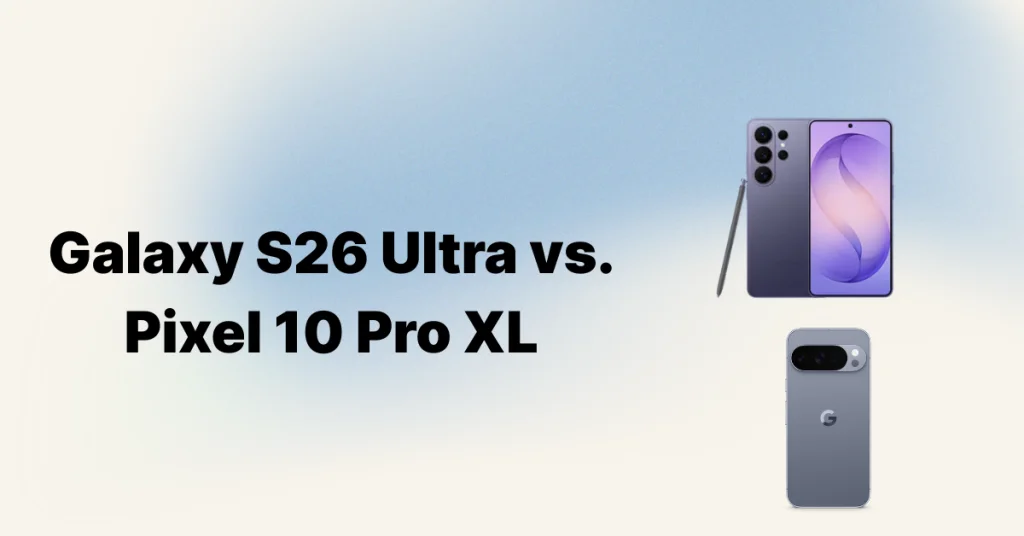
The Galaxy S26 Ultra launched on March 11, 2026; the Pixel 10 Pro XL has been on sale since August 2025. Both now run Android 17 (One UI 9 on the Galaxy), both cost over $1,000, and both are built by companies with opposite philosophies. Samsung says "more is more" and packs in every hardware feature it can. Google says "smart beats specs" and makes fewer features work brilliantly. Below we compare design, display, performance, cameras, video, battery, AI, software, connectivity and value, using published lab testing from outlets like GSMArena and PhoneArena alongside our own hands-on time.
Galaxy S26 Ultra vs Pixel 10 Pro XL: full specs comparison
Skim the table for the big picture, then read the section-by-section breakdown below.
| Specification | Galaxy S26 Ultra | Pixel 10 Pro XL |
| US list price (256GB) | $1,399.99 (launched at $1,299.99; raised October 1, 2026) | $1,199 |
| Release date | March 11, 2026 | August 28, 2025 |
| Display | 6.9" QHD+ LTPO AMOLED, 120Hz | 6.8" QHD+ LTPO OLED, 120Hz |
| Peak brightness (spec) | 2,600 nits | 3,300 nits |
| Privacy Display | Yes (world's first) | No |
| Glass protection | Gorilla Armor 2 (anti-glare) | Gorilla Glass Victus 2 |
| Processor | Snapdragon 8 Elite Gen 5 | Google Tensor G5 (TSMC) |
| RAM | 12GB (16GB on 1TB) | 16GB (all models) |
| Storage | 256GB / 512GB / 1TB | 256GB / 512GB / 1TB |
| Main camera | 200MP f/1.4 | 50MP f/1.7 |
| Ultrawide | 50MP f/1.9 (AF) | 48MP (macro) |
| Telephoto 1 | 50MP 5x periscope | 48MP 5x periscope |
| Telephoto 2 | 10MP 3x optical | None |
| Max zoom | 100x Space Zoom | 100x Pro Res Zoom (AI) |
| Selfie camera | 12MP | 42MP |
| Video | 8K@30fps, 4K@120fps, APV codec | 4K@60fps, Video Boost (AI) |
| Battery | 5,000 mAh | 5,200 mAh |
| Wired charging | 60W | 45W |
| Wireless charging | 25W, Qi2.2 ready (case needed for magnets) | 25W Qi2.2 Pixelsnap (magnets built in) |
| S Pen / stylus | Yes (built-in) | No |
| Weight / thickness | 214g / 7.9mm | 232g / 8.5mm |
| Water resistance | IP68 | IP68 |
| Wi-Fi / Bluetooth | Wi-Fi 7 / BT 5.4 | Wi-Fi 7 / BT 6.0 |
| Satellite messaging | Yes | Yes (emergency SOS) |
| Thermometer | No | Yes (built-in) |
| Software (Oct 2026) | One UI 9 / Android 17 (US rollout began with T-Mobile units on September 23) | Stock Android 17 |
| Update promise | 7 years OS + security | 7 years OS + security |
Design and build: which phone feels better in the hand?
The Galaxy S26 Ultra is 7.9mm thin and 214 grams — remarkably light for a 6.9-inch phone that hides an S Pen inside. Samsung softened the corners this year, so it is more comfortable for long sessions than the boxy S25 Ultra. Colors include Cobalt Violet, Sky Blue, White and Black, plus Samsung.com exclusives.
The Pixel 10 Pro XL is heavier at 232 grams and 8.5mm thick, and some of that weight is a feature: built-in Qi2 magnets (Pixelsnap). Chargers, wallets, stands and car mounts snap straight onto the back with no special case. Samsung's S26 Ultra is only "Qi2.2 ready," so you still need a magnetic case to get the same alignment and accessory support. After years of rumors, Samsung leaving the magnets out remains a genuine miss. Both phones carry IP68 water resistance; the Galaxy adds Gorilla Armor 2's anti-reflective coating versus the Pixel's standard Victus 2.
Winner: tie. Samsung is slimmer, lighter and better-protected; Google has native magnetic charging. Pick the trait that matters more to you.
Also Read: Galaxy S26 Ultra weight and charging: what the pre-launch leaks got right
Display: Privacy Display vs the brightest screen on a phone
Samsung's Privacy Display
The Galaxy S26 Ultra introduces a hardware feature no other phone has: a built-in privacy screen called Flex Magic Pixel. Individual OLED pixels dim directionally, so the screen looks clear head-on but appears dark from the side. The person next to you on a plane or in a meeting genuinely cannot read your display. You can set it to activate automatically when typing passwords or opening banking and messaging apps, or toggle it manually. It is the kind of feature you stop thinking about until you go back to a phone without it.
Pixel's answer: raw brightness
On paper the Pixel 10 Pro XL hits 3,300 nits peak against the Galaxy's 2,600 nits, and independent testing backs the Pixel up: GSMArena measured the Pixel beyond 2,200 nits on a 75% white window, well ahead of the S26 Ultra in the same test. If you spend a lot of time outdoors, the Pixel is easier to read in direct sun. Samsung narrows the gap with its anti-reflective coating, which cuts glare rather than overpowering it. Google also runs a higher PWM dimming rate, which can be gentler on eyes at very low brightness.
Winner: close, edge to Galaxy for daily impact. The Pixel is objectively brighter, but Privacy Display is a one-of-a-kind feature most people will use every day.
Performance and gaming: raw power vs smart efficiency
The Snapdragon 8 Elite Gen 5 in the Galaxy S26 Ultra is the fastest chip in any Android phone right now, and it is not close in benchmarks: in AnTuTu testing the S26 Ultra scores around 3.9 million versus roughly 1.45 million for the Pixel — well over double, and closer to a 140% lead. Samsung also redesigned the vapor chamber, so the phone holds peak clocks longer during marathon gaming.
Google's Tensor G5 is the first Tensor built by TSMC rather than Samsung Foundry, and it brought real gains in thermals and efficiency over the G4. It still cannot match the Snapdragon in raw or graphics-heavy benchmarks, but it was designed to run Google's AI models on-device, where it shines. One detail many comparisons miss: every Pixel 10 Pro XL ships with 16GB RAM regardless of storage, while the 256GB and 512GB Galaxy models have 12GB — you only get 16GB on the $1,799 1TB Galaxy.
In everyday use — scrolling social apps, texting, browsing — both feel instant. The gap appears at the extremes: the Galaxy loads demanding games faster and sustains higher frame rates, while the Pixel processes on-device AI tasks more quickly.
Winner: Galaxy S26 Ultra for gaming and benchmarks; Pixel 10 Pro XL for AI-heavy workflows.
Also Read: Pixel 10 Pro battery life and 120Hz display tips
Camera shootout: does 200MP actually beat 50MP?
The honest answer is no, not automatically. In side-by-side testing, 1x and 2x photos from the two phones are more similar than different — both are excellent. The differences are about character and reach.
Galaxy S26 Ultra (4 rear cameras)
- 200MP main, f/1.4 — the widest aperture on any Samsung phone; Samsung says it gathers roughly 47% more light than the S25 Ultra
- 50MP ultrawide, f/1.9 — with autofocus for sharper close-ups and landscapes
- 50MP 5x periscope telephoto — strong for distant subjects, plus 100x Space Zoom
- 10MP 3x telephoto — fills the mid-range gap the Pixel cannot
- 12MP selfie camera
Pixel 10 Pro XL (3 rear cameras)
- 50MP main, f/1.7 — Google's class-leading computational photography
- 48MP ultrawide — with macro mode
- 48MP 5x periscope telephoto — plus AI Pro Res Zoom up to 100x
- 42MP selfie camera — far ahead of Samsung's 12MP, with a wider field of view
Samsung's 200MP sensor pixel-bins 16-to-1, so it defaults to a 12.5MP image with punchier contrast and color; Google's tuning leans natural with better skin tones. Samsung's real edge is the fourth lens and superior 10x reach. Google's edge is selfies and AI tools like Camera Coach, a Gemini-powered guide that suggests framing and lighting before you shoot.
Winner: tie. Samsung for zoom range and versatility; Pixel for selfies, natural color and AI camera smarts.
Video recording: the section most comparisons skip
If you shoot video at all, the gap here is bigger than the photo gap.
- Galaxy S26 Ultra: 8K@30fps, 4K@120fps, and the APV (Advanced Professional Video) codec for near-lossless footage you can grade in post. Samsung remains the stronger on-device video phone.
- Pixel 10 Pro XL: tops out at 4K@60fps, but Video Boost (cloud AI) and gimbal-like stabilization make casual clips look great with zero effort.
Creators and anyone who edits footage should take the Galaxy. If you just want vacation clips that look good automatically, the Pixel's processing does the work for you.
Winner: Galaxy S26 Ultra, decisively.
Battery and charging: the spec sheet lies here
This is the section where the numbers mislead. On paper the Pixel 10 Pro XL has the bigger cell — 5,200 mAh vs the Galaxy's 5,000 mAh — so you would expect it to last longer. In published endurance testing it does not. GSMArena's battery runs put the Galaxy S26 Ultra ahead overall, with the Pixel trailing the field despite its larger battery, thanks to the Snapdragon 8 Elite Gen 5's strong efficiency and Samsung's tuning. If you saw older launch-day takes calling the Pixel the battery champ, the measured results since then have not borne that out.
Charging is no contest:
- Galaxy S26 Ultra: 60W wired (a full charge in roughly 43 minutes in testing), 25W wireless
- Pixel 10 Pro XL: 45W wired (a full charge in roughly 80+ minutes — nearly twice as long), 25W Qi2.2 with built-in Pixelsnap magnets
Samsung wins endurance and speed; Google wins convenience with drop-and-snap magnetic charging that needs no cable or case.
Winner: Galaxy S26 Ultra for longevity and charging speed; Pixel 10 Pro XL for charging convenience.
AI: Galaxy AI vs Google Gemini
The real difference is structural: Google built its phone around AI; Samsung added AI to its phone.
Samsung Galaxy AI highlights
- Now Brief / Now Bar — proactive, glanceable suggestions through your day
- Photo Assist — add or remove objects, restore detail, reframe shots
- Audio Eraser — strip unwanted sound from video
- Drawing Assist and Creative Studio — turn sketches and photos into stickers, art and designs
Google Gemini highlights
- Gemini Live — natural voice conversations; point the camera for live visual help
- Magic Cue — surfaces relevant info from your emails, messages and notes right when you need it
- Camera Coach — a real-time photography mentor
- Cross-app actions — Gemini can complete multi-step tasks across apps for you
Gemini on the Pixel does not just answer questions; it works across apps, anticipates needs and runs more on-device thanks to the Tensor G5. Samsung's tools are individually impressive but feel more like a toolbox you open one drawer at a time, and several lean on the cloud.
Winner: Pixel 10 Pro XL.
Software and updates: clean Android vs the kitchen sink
The Galaxy runs One UI 9 over Android 17: hugely customizable, with split-screen, floating windows and Samsung's full app suite — but also duplicate apps (Samsung Internet vs Chrome, Samsung Notes vs Keep) some users find cluttered. The Pixel runs near-stock Android with Material 3 Expressive: bouncy animations, deep color theming and effectively no bloat.
Both promise 7 years of OS and security updates, but the timing gap is real. The Pixel 10 Pro XL got Android 17 months before the Galaxy. Samsung began rolling out stable One UI 9 (Android 17) to the S26 series in South Korea on September 16, 2026, and US T-Mobile units started getting it on September 23, with other US carrier and unlocked models following later. The Pixel gets new Android versions, security patches and quarterly feature drops first, often months ahead of Samsung. If having the latest software on day one matters, the Pixel is the clear pick.
Also Read: Android 17 August 2026 update: what's new for Pixel 10
Winner: Pixel 10 Pro XL for clean software and fastest updates; Samsung if you love customization and the S Pen.
Also Read: One UI 9 beta on Galaxy S26
Connectivity: Wi-Fi 7, Bluetooth, 5G and satellite
- Wi-Fi: both support Wi-Fi 7 across 2.4/5/6GHz bands.
- Bluetooth: the Pixel edges ahead with Bluetooth 6.0 vs Samsung's 5.4.
- 5G: both cover Sub-6 and mmWave on every major US carrier.
- Satellite: both offer satellite messaging for emergencies off-grid.
- Thermometer: only the Pixel has a built-in temperature sensor.
Winner: Pixel 10 Pro XL (slightly), on Bluetooth 6.0 and the thermometer.
Price and value in October 2026
The Pixel 10 Pro XL launched at $1,199. Samsung raised the Galaxy S26 Ultra's US list price from $1,299.99 to $1,399.99 on October 1, 2026, which widens the gap. Retailers rarely charge list price for either phone, though. In mid-October, Amazon had the 256GB S26 Ultra at $1,049.99, so compare current prices before you buy.
One timing note: the Pixel 11 series is now out. Google announced it at Made by Google on August 12, 2026, so the Pixel 10 Pro XL is the previous generation. Look for clearance pricing on it. On the Samsung side, the Galaxy S27 Ultra is not due until early 2027, so the S26 Ultra has a long shelf life ahead.
Also Read: Pixel 11 specs and price
How we compared these phones
We spent hands-on time with both the Galaxy S26 Ultra and Pixel 10 Pro XL and cross-checked every claim in this guide against independent lab testing. We used Samsung's and Google's official specification pages for hardware figures; we relied on measured results from outlets such as GSMArena and PhoneArena for screen brightness, charging times, benchmark scores and battery endurance rather than marketing numbers; and we deliberately corrected the launch-day narrative on battery, where the larger-capacity Pixel actually trails the Galaxy in real-world endurance. We weighted categories by how much they affect daily use, and we flag ties honestly instead of forcing a winner where the two phones are genuinely even.
Final scorecard
| Category | S26 Ultra | Pixel 10 Pro XL | Winner |
| Design | 9 | 8.5 | Tie |
| Display | 9.5 | 9 | Galaxy |
| Performance | 9.5 | 8 | Galaxy |
| Photo camera | 9 | 9 | Tie |
| Video | 9.5 | 7.5 | Galaxy |
| Battery life | 9 | 8 | Galaxy |
| Charging | 9 | 8.5 | Galaxy |
| AI features | 8 | 9.5 | Pixel |
| Software / updates | 7.5 | 9.5 | Pixel |
| Connectivity | 8.5 | 9 | Pixel |
| Value | 8.5 | 9 | Pixel |
The verdict: which phone should you buy?
The Galaxy S26 Ultra is the more complete phone. It wins performance, video, real-world battery and charging, display innovation and zoom, and it is the only one with an S Pen and a Privacy Display. If you want everything maxed out and do not mind Samsung's heavier software, it is the 2026 phone to beat.
The Pixel 10 Pro XL is the smarter, cleaner, cheaper phone. It costs $100 less, has the brightest screen, the deepest Gemini integration, day-one Android updates (it is already on Android 17) and true magnetic charging. If you live in Google's ecosystem and value simplicity over spec-sheet maximalism, it is the better buy — though now that the Pixel 11 is out, compare it with the Pixel 11 Pro, which is now on sale, before you decide.
Our ratings: Galaxy S26 Ultra — 9.2 / 10, "the ultimate Android powerhouse." Pixel 10 Pro XL — 9.0 / 10, "the smartest phone you can buy."
Buy the Galaxy S26 Ultra at samsung.com, or the Pixel 10 Pro XL at the Google Store.
Frequently Asked Questions
Is the Galaxy S26 Ultra worth the extra money over the Pixel 10 Pro XL?
Yes, if you value the S Pen, Privacy Display, 8K video, faster 60W charging or raw benchmark performance, where the Galaxy scores well over double the Pixel in AnTuTu testing (around 3.9 million vs 1.45 million). No, if you prefer cleaner software, day-one Android updates and deeper Gemini AI for less money. Both are exceptional phones at their price points.
Which has better battery life, the Galaxy S26 Ultra or Pixel 10 Pro XL?
Counter to the spec sheet, the Galaxy S26 Ultra wins. Even though the Pixel has a larger 5,200 mAh cell versus 5,000 mAh, independent endurance testing since launch shows the Snapdragon 8 Elite Gen 5 is efficient enough that the Galaxy lasts longer in real-world use. The Galaxy also charges far faster at 60W (about 43 minutes for a full charge) versus the Pixel's 45W (over 80 minutes).
Which phone takes better photos?
It depends on the shot. Samsung has four rear cameras, a wider f/1.4 aperture and stronger long-range zoom, while the Pixel takes more natural-looking photos and far better selfies with its 42MP front camera versus Samsung's 12MP. At 1x and 2x the two are very close; the Galaxy pulls ahead at 10x and beyond.
Does the Galaxy S26 Ultra support Qi2 magnetic wireless charging?
Only partially. Samsung calls it 'Qi2.2 ready' but includes no built-in magnets, so you need a compatible magnetic case for proper alignment and accessory snapping. The Pixel 10 Pro XL has true Qi2.2 with Pixelsnap magnets built directly into the phone, so chargers, stands and wallets attach with no case required.
What is Samsung's Privacy Display and does any other phone have it?
Privacy Display, branded Flex Magic Pixel, is a hardware feature exclusive to the Galaxy S26 Ultra that limits your screen's viewing angle so it looks dark from the side but clear head-on. You can set it to trigger automatically for passwords or sensitive apps, or toggle it manually. As of October 2026 no other phone offers a built-in privacy screen like it.
Which phone gets Android updates faster?
The Pixel 10 Pro XL. Google ships new Android versions, monthly patches and quarterly Pixel Drops on day one. The Galaxy S26 Ultra got Android 17 with One UI 9 months later: the stable rollout started in South Korea on September 16, 2026, and US T-Mobile units started getting it on September 23. Both promise 7 years of support.
Which is better for video recording?
The Galaxy S26 Ultra, clearly. It records 8K at 30fps, 4K at 120fps and supports the APV professional video codec for high-quality footage you can edit. The Pixel maxes out at 4K at 60fps but offers excellent AI Video Boost and gimbal-like stabilization for effortless casual clips.
Should I buy the Pixel 11 Pro instead of the Pixel 10 Pro XL?
The Pixel 11 series launched at Made by Google on August 12, 2026, with the Tensor G6 chip. If the price difference is small, the newer phone gets you a longer support window. If the Pixel 10 Pro XL is on deep clearance, it still gets 7 years of updates and is a strong value.