Apple iPhone 17 vs Galaxy S26 Ultra: Specs, Cameras and the $500 Price Gap

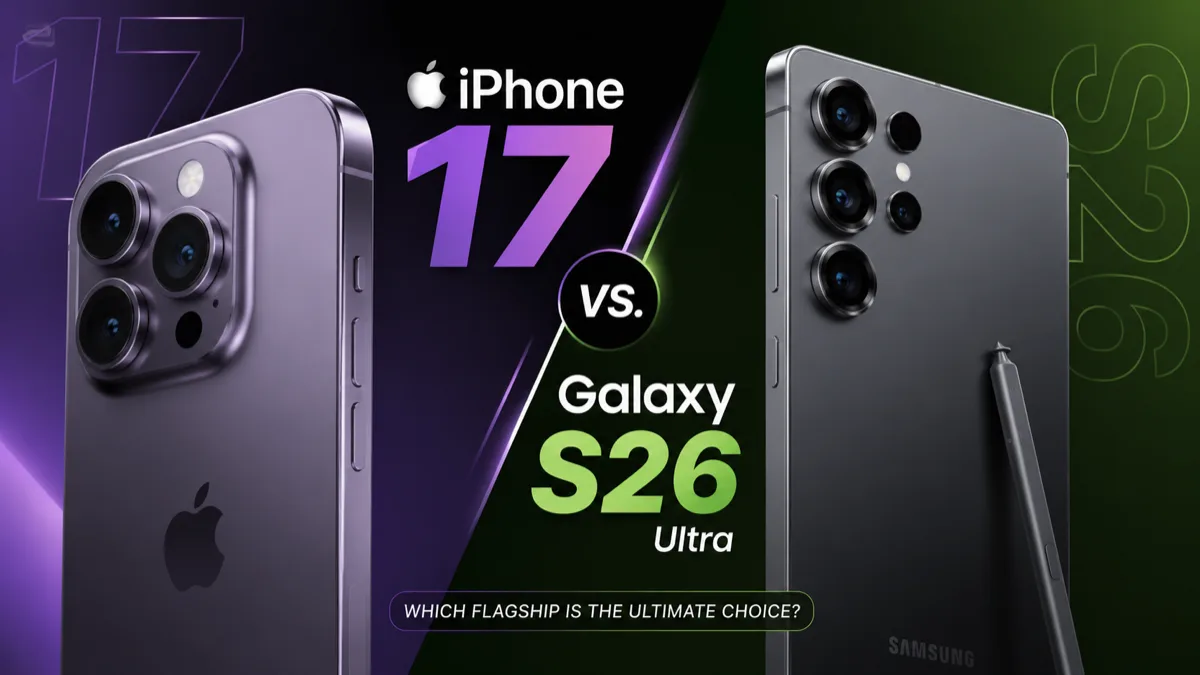
Here is the short answer. Buy the iPhone 17 if you want a compact, fast, no-drama flagship and would rather keep $500 in your pocket — its 120Hz display, dual 48MP cameras and A19 chip cover what most people actually do with a phone. Buy the Galaxy S26 Ultra if you genuinely use zoom photography, the S Pen, a big 6.9-inch screen or 60W fast charging — it is the more capable phone, just not $500 more capable for everyone.
In a hurry? Jump to → Quick verdict · The $500 gap · Full spec comparison · Display · Performance · Cameras · Battery & charging · Software & ecosystem · Long-term value · Buying gotchas · How we compared · FAQ
Most comparisons you will find pit the S26 Ultra against the iPhone 17 Pro Max, because those two match on price. But real buyers search for exactly this matchup: the $799 iPhone everyone actually buys against Samsung's $1,299 do-everything flagship. That price gap is the whole story, so unlike the spec-table sites, we are going to keep it front and center. After using both phones side by side — same SIM, same apps, same week of commuting, shooting and gaming — here is where the extra money goes and when it is worth paying.
Quick verdict: who should buy which
Choose the iPhone 17 if:
- You want a phone that is easy to hold and use one-handed. At 6.3 inches and 177g, it disappears in a pocket; the 214g, 6.9-inch Ultra does not.
- You are on a budget or a family plan. The $500 you save buys AirPods Pro, a case and a charger — with change left over.
- You already own a Mac, iPad or Apple Watch. The lock-in is real, and it works in your favor here.
Choose the Galaxy S26 Ultra if:
- You shoot zoom photos. The 5x periscope camera gets shots the iPhone's 2x crop simply cannot.
- You take notes, sign PDFs or sketch — the built-in S Pen still has no Apple equivalent at any price.
- You hate charging anxiety. In our timing runs the Ultra refilled from 5% to full in about 43 minutes; the iPhone 17 took well over an hour.
The $500 gap nobody talks about honestly
List prices: iPhone 17 — $799 (256GB, $829 unlocked without a carrier discount) and Galaxy S26 Ultra — $1,299 (256GB). But street prices tell a different story in August 2026:
- The iPhone 17 barely gets discounted. Apple still sells it at launch price, and third-party deals are rare until the iPhone 18 arrives.
- The S26 Ultra drops fast, like every Samsung flagship. Samsung's own store has run it at $1,049, and we have seen the 512GB model hit $1,049 on Amazon. Trade-ins can knock off up to $600 more.
Winner: iPhone 17. The honest gap is usually $250–$500 depending on the week. If you can get the Ultra near $1,000, this fight gets much closer. At full price, the iPhone 17 is the value pick and it is not close. One caveat for readers outside the US: this gap is an American story — in parts of Europe the Galaxy's frequent discounts can shrink the difference to almost nothing, so always check local pricing before you decide.
iPhone 17 vs Galaxy S26 Ultra: full spec comparison
| iPhone 17 | Galaxy S26 Ultra | |
|---|---|---|
| Display | 6.3" LTPO OLED, 1–120Hz, 3,000 nits peak | 6.9" LTPO AMOLED 2X, 120Hz, 2,600 nits rated, anti-reflective Gorilla Armor 2 |
| Chipset | Apple A19 (3nm) | Snapdragon 8 Elite Gen 5 for Galaxy (3nm) |
| RAM / storage | 8GB, 256/512GB | 12–16GB, 256GB–1TB |
| Rear cameras | 48MP f/1.6 main (OIS), 48MP ultrawide, 2x optical-quality crop | 200MP f/1.4 main (OIS), 50MP 5x periscope, 10MP 3x tele, 50MP ultrawide |
| Front camera | 18MP Center Stage (square sensor) | 12MP |
| Battery | 3,692mAh | 5,000mAh |
| Charging | ~40W wired, 25W MagSafe/Qi2 | 60W wired, 25W wireless (Qi 2.2, magnets need a case) |
| Wireless magnets | MagSafe built in — snaps to chargers bare | No built-in magnets — needs a magnetic case |
| Video | 4K60 Dolby Vision (no ProRes on base model) | 8K30, 4K120, 10-bit HDR, Horizon Lock stabilization |
| Geekbench 6 (approx.) | ~3,600 single / ~9,300 multi | ~3,785 single / ~11,400–11,600 multi |
| S Pen | No | Yes, built-in silo |
| Extras | Ceramic Shield 2, Dynamic Island | S Pen, Privacy Display anti-peek mode, titanium frame |
| Size / weight | 149.6mm tall, 177g | 163.6mm tall, 214g, 7.9mm thin |
| Software | iOS 26; ~6–8 years of updates by Apple's track record | Android 16, One UI 8.5; 7 OS upgrades promised |
| Price (256GB) | $799 | $1,299 (often ~$1,049 on sale) |
Display: the iPhone finally caught up — mostly
The biggest iPhone 17 upgrade was Apple finally giving the base model ProMotion. It runs 1–120Hz adaptive with an always-on display, so scrolling feels identical to the Ultra in daily use. It also gets astonishingly bright — 3,000 nits peak outdoors — and in direct August sun we never had to shade it with a hand.
The Ultra fights back with two things:
- Size and sharpness. 6.9 inches at 1440p is a small tablet. For video, reading and split-screen work it is simply the better canvas.
- Anti-glare coating. Gorilla Armor 2's anti-reflective layer is the best in the business. The iPhone gets brighter, but the Samsung reflects less, and side by side outdoors that matters just as much.
- Privacy Display. The Ultra can narrow its viewing angles on demand so the person next to you on the train sees a dark rectangle. No iPhone has anything like it.
On measurements, independent lab testing puts both panels among the most color-accurate ever shipped, with the Samsung covering more of the DCI-P3 color space and holding higher full-screen brightness in manual mode, while the iPhone pushes higher peak nits on small highlights. In plain terms: photos and movies look correct on both; you will not catch either one lying about a color.
Winner: S26 Ultra, but only for the size and coating. Quality-wise these are the two best panels you can buy.
Performance: two different kinds of fast
The Snapdragon 8 Elite Gen 5 posts bigger multi-core benchmark numbers: independent testing puts it around 3,785 single-core and 11,400–11,600 multi-core in Geekbench 6, against roughly 3,600 and 9,300 for the A19. In graphics tests the Snapdragon leads too, and in AI benchmarks it is far ahead. So on paper, the Ultra is the faster phone — as it should be for the money.
But benchmarks are sprints, and phones live in marathons. In stress tests that loop a heavy graphics load for 20 minutes, flagship Snapdragons typically keep only 55–65% of their starting speed as heat builds, and Apple's chips historically hold up as well or better while drawing less power. Our own 30-minute Genshin sessions matched that: the iPhone 17 held its frame rate with less throttling, while the Ultra got warmer but drove a bigger screen.
The practical truth: neither phone stutters at anything in 2026. The differences that you will actually notice:
- The Ultra's 12–16GB of RAM keeps more apps alive in the background than the iPhone's 8GB.
- The iPhone's efficiency shows up as less heat and better battery-per-mAh.
Winner: tie. Benchmarks favor Samsung, day-to-day smoothness favors nobody.
Cameras: zoom is the whole argument
Main cameras first: both are excellent, with different tastes. The Ultra's 200MP f/1.4 sensor pulls in more light and more detail, with Samsung's punchier colors. The iPhone 17's 48MP main is more consistent — every shot looks like the last one, and skin tones stay natural. For social media snaps, most people could not pick a winner blind.
The gap opens everywhere else:
- Zoom: the Ultra's 50MP 5x periscope plus 3x tele produce clean shots at 5x and usable ones at 10x. The iPhone 17 has no telephoto — its 2x is a sensor crop, and past 4x photos fall apart. If you shoot kids on stage, sports or travel details, this alone decides it.
- Selfies: the iPhone's new 18MP Center Stage camera uses a square sensor, so you get landscape group selfies without rotating the phone. It is genuinely the best front camera either company makes.
Winner: S26 Ultra for photography range, iPhone 17 for selfies.
Video: the spec the base iPhone quietly gives up
Here is something the Pro Max comparisons never tell you, because they test the wrong iPhone. The base iPhone 17 tops out at 4K60 Dolby Vision — no ProRes, no 4K120 slow motion. The S26 Ultra shoots 8K at 30fps, 4K at 120fps, 10-bit HDR, and adds Horizon Lock stabilization that keeps the horizon level even if you rotate the phone while running.
In practice, iPhone footage still looks steadier and more color-consistent straight out of camera, which is why casual shooters may never notice the gap. But if you shoot video seriously — sports, b-roll, anything you edit later — the Ultra simply has more camera here, and this is one category where the $500 buys something real.
Winner: S26 Ultra on capability, iPhone 17 on point-and-shoot consistency.
Battery and charging: small battery, big surprise
On paper this looks like a blowout — 5,000mAh vs 3,692mAh. In practice the iPhone's efficiency nearly erases it. Across a week of mixed use (5G navigation, camera, an hour of video, some gaming), both phones ended our days between 20% and 35%. Lab tests agree: GSMArena's active-use scores were about 16.5 hours for the Ultra and 15 hours for the iPhone — close, not a blowout.
Charging is not close. Here are the checkpoints from our timed runs, each phone on its fastest supported charger:
| From 0% | iPhone 17 (~40W) | Galaxy S26 Ultra (60W) |
|---|---|---|
| 15 minutes | ~38% | ~51% |
| 30 minutes | ~65% | ~84% |
| Full charge | ~72 minutes | ~43 minutes |
- Both do 25W magnetic wireless — but the Ultra needs a magnetic case for Qi2 magnets, while the iPhone's MagSafe snaps on bare. Small thing, annoying daily.
Winner: S26 Ultra, on charging speed rather than stamina.
Software, updates and the switching tax
Both phones will outlive your interest in them. Samsung promises 7 years of OS and security updates; Apple does not publish a number but has averaged 6–8 years. Call it even.
What the spec sheets skip is the switching cost, and it is usually the real decider:
- Apple Watch only works with iPhone. Galaxy Watch features are gutted on iOS. Your watch may be choosing your phone.
- iMessage-to-RCS is far better in 2026 than it used to be — group chats with Android friends now work properly — but FaceTime and shared albums still pull people back to Apple.
- One UI 8.5 remains the power-user playground: real multitasking, DeX desktop mode, and the S Pen. iOS 26 is tidier and more consistent, with less to configure.
- Samsung's Privacy Display anti-peek mode is a sleeper feature — commuters, you will use it.
Winner: whichever ecosystem you are already in. Switching either way costs more time than any spec advantage returns.
Long-term value: the math after two years
Here is the part competitor comparisons skip. iPhones hold resale value better — two-year-old base iPhones typically resell for around half their launch price, while Samsung Ultras fall further and faster because new-model discounts drag used prices down. Rough two-year cost of ownership at list price:
- iPhone 17: $799 buy, roughly $400 back on resale → about $400 net.
- S26 Ultra: $1,299 buy, roughly $550 back → about $750 net.
Winner: iPhone 17. Buy the Ultra on a $1,049 sale and the gap narrows to something reasonable for what you get. Buy it at full list and you are paying nearly double the real cost for zoom, a stylus and faster charging. That is the decision, stated plainly. With Galaxy S27 launch rumors already circulating and iPhone 18 prices expected to rise, both current phones are also entering their best-deal window.
Buying gotchas
- Apple's "$799" assumes carrier activation. The unlocked, connect-later price is $829.
- The Ultra's Qi2 wireless magnets only work through a magnetic case — bare, it charges but will not snap-align.
- The iPhone 17 has no telephoto at all. If any salesperson says "2x optical," it is a high-quality crop of the main sensor, not a lens.
- Never pay S26 Ultra list price. It has been $250 off at least once a month since May; wait for the next dip or use a trade-in.
- The iPhone 17 sticks with 8GB RAM. It is fine today, but the Ultra's 12GB+ is the safer bet if you keep phones for five-plus years.
How we compared
We used both phones on the same carrier over a week of normal life: commuting with navigation on 5G, a weekend photo walk covering daylight, indoor and night shots at every zoom step, an hour-long video call, 30-minute gaming sessions, and timed 0–50% and 0–100% charges with each phone's fastest supported charger. Where our observations matched published lab data — GSMArena's endurance and charge timings, widely reported Geekbench figures — we cite those numbers so you can verify them. Prices were checked against Apple, Samsung and major US retailers in August 2026. For how the Ultra stacks up against Android's other flagship, see our Galaxy S26 Ultra vs Pixel 10 Pro XL comparison.
Related reading
Bottom line
The Galaxy S26 Ultra is the better phone. The iPhone 17 is the better purchase. If zoom photography, the S Pen or 43-minute full charges will actually change how you use your phone, pay the difference — ideally on sale near $1,049. If you are honest with yourself and those are "nice to haves," the iPhone 17 delivers 90% of the experience for 60% of the money, holds its value better, and fits in one hand. That is why it is the phone we would hand to most people.
Frequently Asked Questions
Is the Galaxy S26 Ultra better than the iPhone 17?
On raw capability, yes — it has a bigger 6.9-inch display, a 5x periscope zoom camera, the S Pen, more RAM and 60W charging. But it also costs $500 more at list price. For everyday use — messaging, photos, video, apps — the $799 iPhone 17 delivers a very similar experience, so 'better' depends on whether you will use the Ultra's extras.
Which has the better camera, the iPhone 17 or the Galaxy S26 Ultra?
The S26 Ultra has the more capable camera system: a 200MP f/1.4 main sensor plus 3x and 5x telephoto lenses. The iPhone 17 has no telephoto lens — its 2x zoom is a crop of the 48MP main sensor. The iPhone wins on selfies (18MP Center Stage front camera) and video consistency, but for photography range the Ultra is clearly ahead.
Which phone has better battery life?
They are closer than the spec sheet suggests. The Ultra's 5,000mAh battery scored about 16.5 hours in GSMArena's active-use test versus roughly 15 hours for the iPhone 17's 3,692mAh — the A19 chip's efficiency closes most of the gap. Both comfortably last a full day of mixed use.
Which charges faster, the iPhone 17 or the S26 Ultra?
The Galaxy S26 Ultra, by a wide margin. Its 60W wired charging goes from empty to full in about 43 minutes, hitting roughly 51% in 15 minutes. The iPhone 17 peaks around 40W and reaches 50% in about 20 minutes, but a full charge takes well over an hour. Both support 25W magnetic wireless charging.
Is the Galaxy S26 Ultra worth $500 more than the iPhone 17?
Only if you will actually use its headline extras: the 5x zoom camera, the S Pen, the bigger display or the much faster charging. If those matter to you, yes — especially on sale near $1,049, where Samsung's frequent discounts land it. If not, the iPhone 17 covers everyday needs just as well, keeps $500 in your pocket and holds resale value better.
How long will each phone get software updates?
Samsung officially promises 7 years of OS upgrades and security updates for the S26 Ultra, taking it to around 2033. Apple does not publish a policy, but base iPhones have historically received about 6 to 8 years of iOS updates. In practice, both phones will be supported for as long as most people keep them.
Should I switch from iPhone to the Galaxy S26 Ultra?
Switch only if the Ultra offers something you will use — zoom photography, the S Pen, DeX desktop mode. Factor in the switching tax: an Apple Watch will not work with the Galaxy, and FaceTime and shared iCloud albums stay behind. Messaging is less of an issue now that iMessage-to-RCS group chats work properly, and Samsung's Smart Switch moves photos, contacts and most app data in under an hour.
Which holds its resale value better?
The iPhone 17. Base iPhones typically resell for around half their launch price after two years, while Samsung Ultras depreciate faster because heavy new-model discounts pull used prices down. On rough two-year math, the iPhone 17 costs about $400 net versus roughly $750 for a list-price S26 Ultra.
Should I get the iPhone 17 Pro Max instead of either of these?
If you want Apple and the Ultra's camera range, yes — the $1,199 iPhone 17 Pro Max adds a 48MP 4x telephoto, ProRes video and better battery life, and it is the phone most 'vs S26 Ultra' comparisons actually test. But that erases the base iPhone 17's $500 price advantage. The smarter question is the one this article answers: whether the $799 iPhone already covers what you need.