Poco F6 Pro vs Xiaomi 15 Ultra (2026): Do You Really Need the Ultra?

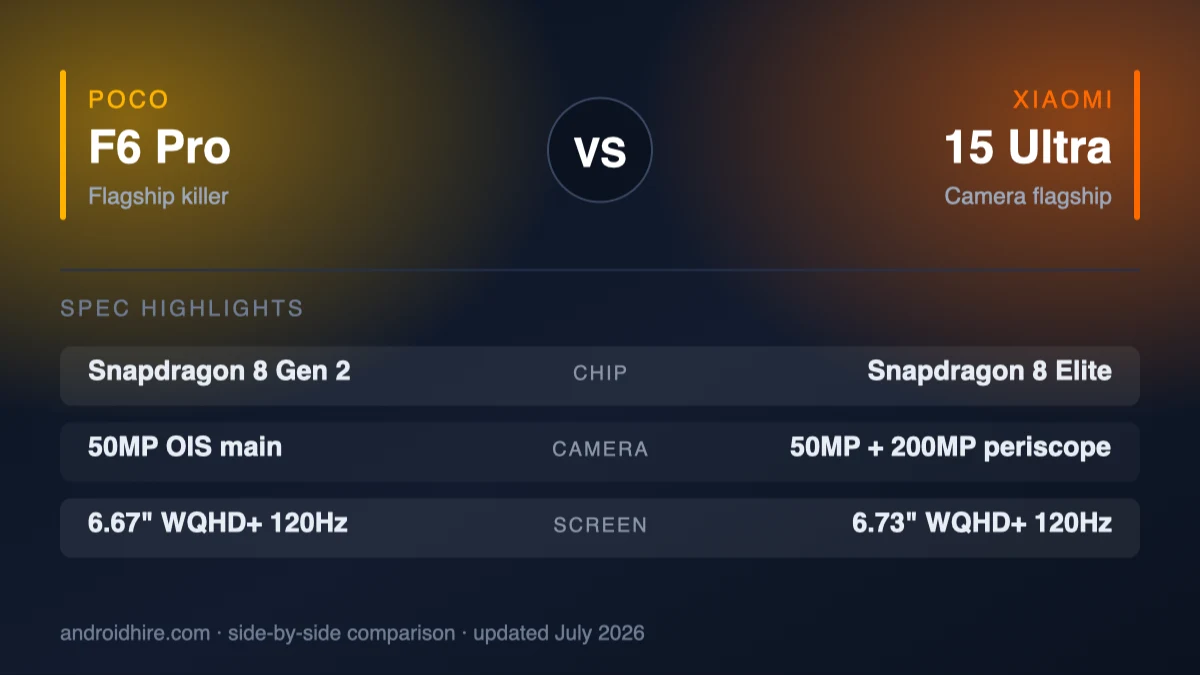
Buy the Poco F6 Pro if you want flagship speed on a budget: a 6.67-inch WQHD+ 120Hz screen, Snapdragon 8 Gen 2 performance and 120W charging that refills it in about 20 minutes. Buy the Xiaomi 15 Ultra if you take photography seriously — its four-lens Leica system with a 200MP periscope is one of the best camera setups on any phone. The screens are surprisingly close. The cameras are not close at all.
In a hurry? Jump to → Quick verdict · Full spec comparison · Display · Performance · Cameras · Battery & charging · Updates · Buying gotchas · How we compared · FAQ
This comparison usually starts with a suspicion: both phones come from Xiaomi, so how different can they really be? The answer is specific rather than general. On screen quality, raw responsiveness and charging speed, the Poco F6 Pro (May 2024) gets remarkably close to the Xiaomi 15 Ultra (February 2025) — in charging it actually wins. On cameras, durability and long-term support, the gap is exactly as wide as the price. Knowing which of those two lists you care about answers the question in seconds.
Quick verdict: Poco F6 Pro vs Xiaomi 15 Ultra
Choose the Poco F6 Pro if you want the most performance per dollar. A WQHD+ 120Hz AMOLED, Snapdragon 8 Gen 2 with up to 16GB of RAM, UFS 4.0 storage and 120W charging cover gaming, media and speed for a third of the Ultra's price.
Choose the Xiaomi 15 Ultra if the camera is the reason you buy phones. Four genuinely usable focal lengths — ultrawide, main, 3x floating telephoto and 200MP 4.3x periscope — plus Leica colour science, IP68 sealing, 80W wireless charging and the far faster Snapdragon 8 Elite.
Blunt version: the F6 Pro is the smarter buy for most people, and the 15 Ultra is the better phone for anyone who photographs.
Who wins what, category by category
| Category | Winner | Why it wins |
|---|---|---|
| Price | Poco F6 Pro | Roughly a third of the Ultra's cost |
| Wired charging | Poco F6 Pro | 120W (~20 min) vs 90W |
| Cameras | Xiaomi 15 Ultra | Four Leica lenses including a 200MP periscope |
| Performance | Xiaomi 15 Ultra | Snapdragon 8 Elite is ~75% faster multi-core |
| Display | Xiaomi 15 Ultra | Brighter, LTPO down to 1Hz — but it is close |
| Durability | Xiaomi 15 Ultra | IP68 immersion vs IP54 splash only |
| Wireless charging | Xiaomi 15 Ultra | 80W wireless; the F6 Pro has none |
| Video | Xiaomi 15 Ultra | 8K, Dolby Vision, far better stabilisation |
| Weight | Poco F6 Pro | 209g vs about 226g |
| Value for money | Poco F6 Pro | Most of the daily experience, a third of the price |
Score: Xiaomi 15 Ultra 6 – Poco F6 Pro 4. The Ultra wins more, but the F6 Pro wins the categories most buyers use every hour.
Poco F6 Pro vs Xiaomi 15 Ultra: full spec comparison
| Specification | Poco F6 Pro | Xiaomi 15 Ultra |
|---|---|---|
| Released | May 2024 | February 2025 |
| Launch price | ~$499 / €599 | ~$1,499 / €1,499 |
| Display | 6.67" AMOLED | 6.73" LTPO AMOLED |
| Resolution | 1440 x 3200 (WQHD+) | 1440 x 3200 (WQHD+) |
| Refresh rate | 120Hz | 1–120Hz adaptive LTPO |
| Peak brightness | ~4,000 nits (HDR peak) | ~3,200 nits |
| Processor | Snapdragon 8 Gen 2 | Snapdragon 8 Elite |
| RAM | 12 / 16GB LPDDR5X | 12 / 16GB LPDDR5X |
| Storage | 256GB / 512GB / 1TB UFS 4.0 | 256GB / 512GB / 1TB UFS 4.1 |
| Main camera | 50MP with OIS | 50MP 1-inch-type LYT-900, OIS |
| Ultrawide | 8MP | 50MP (115°) |
| Telephoto | ✖ None (2MP macro) | 50MP 3x floating + 200MP 4.3x periscope |
| Front camera | 16MP | 32MP |
| Max video | 8K at 24fps | 8K at 30fps, Dolby Vision |
| Battery | 5,000 mAh | 5,410 mAh (global) |
| Wired charging | 120W (~19 min) | 90W |
| Wireless charging | ✖ No | ✔ 80W |
| Water resistance | IP54 | IP68 |
| Camera tuning | Xiaomi imaging | Leica co-engineered |
| Launched on | HyperOS / Android 14 | HyperOS 2 / Android 15 |
| Weight | ~209 g | ~226 g |
The Xiaomi 15 Ultra's Chinese model uses a larger battery than the global version — reviews from either market are not interchangeable.
Display: closer than the price gap suggests
This is the F6 Pro's best trick. It uses a genuine WQHD+ (1440 x 3200) AMOLED at 526 ppi — the same resolution class as the 15 Ultra — with Dolby Vision, HDR10+ and an HDR peak around 4,000 nits. For a phone at this price that is remarkable.
The 15 Ultra still wins, but on refinement rather than headline numbers: LTPO lets it drop to 1Hz on static content to save power, its full-screen brightness is higher in sustained use, and its panel is slightly larger with better anti-reflective treatment. Side by side you notice it. Alone, the F6 Pro never feels cheap.
Performance: two years of silicon progress
The F6 Pro's Snapdragon 8 Gen 2 was 2022's flagship chip and remains fast enough for everything, especially paired with UFS 4.0 storage and up to 16GB of RAM. The 15 Ultra's Snapdragon 8 Elite is a generational leap with custom Oryon cores.
| Benchmark (approximate) | Poco F6 Pro | Xiaomi 15 Ultra |
|---|---|---|
| Geekbench 6 single-core | ~1,500 | ~3,000 |
| Geekbench 6 multi-core | ~5,400 | ~9,300 |
| AnTuTu v10 total | ~1,500,000 | ~2,900,000 |
| Sustained gaming | 60fps at high settings | 60fps+ with headroom to spare |
Benchmark figures are typical published ranges from public test databases rather than our own runs — read them as a class gap, not an exact score for your unit.
Real-world translation: both play every current game well. The Elite's advantages are sustained frame rates in long sessions, hardware ray tracing, faster video processing and the on-device AI features HyperOS 2 leans on. If you play for 20 minutes at a time, you will not feel it. If you play for two hours, you will.
Also Read: Best Snapdragon flagship phones compared
Cameras: the entire reason the Ultra exists
Poco F6 Pro camera
- 50MP main with OIS — good in daylight, decent at night
- 8MP ultrawide, noticeably softer than the main lens
- 2MP macro, effectively filler
- 16MP selfie camera, 8K/24 video
Xiaomi 15 Ultra camera
- 50MP 1-inch-type Sony LYT-900 main sensor with OIS
- 50MP ultrawide with autofocus, so it doubles as a macro lens
- 50MP 3x floating telephoto — excellent for portraits and close focus
- 200MP 4.3x periscope, the standout lens for distant detail
- Leica colour profiles, 8K/30 and Dolby Vision recording
There is no framing that makes this close. The F6 Pro has one camera you would choose and two you tolerate. The 15 Ultra has four you would choose, and its 200MP periscope holds real detail at zoom levels where the Poco is producing digital mush. Add the 1-inch-type main sensor for low light and Leica's tuning for colour, and you are comparing a good phone camera with a genuine camera replacement.
Battery and charging: the Poco's one clear win
The 15 Ultra's global model carries 5,410mAh against the F6 Pro's 5,000mAh, and its LTPO screen is more efficient, so it lasts longer per charge. But the F6 Pro charges faster — 120W HyperCharge does 0 to 100% in roughly 19–20 minutes, against about 30 minutes at 90W on the Ultra.
The Ultra takes back the category overall with 80W wireless charging, which the F6 Pro does not offer at all. If you use a charging pad at a desk, that is a bigger daily convenience than shaving ten minutes off a wired charge.
Software and updates
The F6 Pro launched on HyperOS over Android 14, the 15 Ultra on HyperOS 2 over Android 15. Both are polished, both include more preinstalled apps than most people want, and both let you remove most of that.
The difference is runway. Xiaomi's flagship line gets the longer commitment — the 15 Ultra is slated for more OS upgrades and more years of patches than a Poco F-series phone, and flagship models also receive new HyperOS features first. If you keep phones for five years, the Ultra's support window is part of what you are buying.
Which one should you buy?
Buy the Poco F6 Pro if: you game, stream and scroll more than you photograph; you want a genuinely sharp WQHD+ screen for the least money; you value the fastest wired charging available; or you would rather spend the difference on something else entirely.
Buy the Xiaomi 15 Ultra if: photography is a hobby or a job, you want optical zoom that actually works, you need IP68 protection and wireless charging, or you plan to keep this phone for four or five years.
Middle ground: if the Ultra is too much but the F6 Pro's camera is too little, a current flagship-value phone with a real telephoto is the answer — see OnePlus 13 compared.
What the spec-comparison sites won't tell you
- IP54 is the F6 Pro's real weakness, not its camera. A splash rating means no immersion protection at all. For a phone you take to the beach or use in heavy rain, that is a genuine risk.
- Chinese and global 15 Ultra models differ. Battery capacity and band support are not the same, and Chinese units ship without Google services preinstalled. Buy the version for your region.
- 120W charging has a cost. Very fast charging generates heat, which shortens battery lifespan over years. Xiaomi's own settings offer a slower "smart charging" mode — use it overnight.
- The Ultra is heavy. At around 226g plus a large camera island, it is not a phone that sits flat on a desk or disappears in a pocket. Handle one before committing.
How we compared these phones
We built this from Xiaomi's published specifications for both devices, cross-checked against independent lab testing for display brightness, charging times and sustained gaming performance — GSMArena's F6 Pro data among them. Two details required care. First, the Xiaomi 15 Ultra ships with different battery capacities in China and global markets, so we quote the global figure and flag the difference rather than blending them. Second, "8K video" appears on both spec sheets but means different things — 24fps on the Poco against 30fps with Dolby Vision on the Ultra — so we listed the frame rates instead of the marketing term. Camera assessments weigh usable focal lengths rather than megapixel totals, which is why a 200MP periscope counts and a 2MP macro does not.
Related reading
Bottom line
Poco F6 Pro vs Xiaomi 15 Ultra proves that "flagship killer" is half true. The Poco F6 Pro matches the Ultra's screen resolution, plays every game smoothly and charges faster at 120W, for about a third of the price — it is the value pick by a wide margin. The Xiaomi 15 Ultra justifies its cost in exactly three places: a four-lens Leica camera system with a 200MP periscope, IP68 durability with 80W wireless charging, and a Snapdragon 8 Elite with years more support ahead of it. Photographers buy the Ultra. Everyone else should buy the Poco and keep the change.
Specifications, software versions and street prices in this comparison were checked in July 2026. We revisit head-to-head guides whenever either phone gets a major OS update or a lasting price change.
Next step: browse every matchup on our phone comparisons hub, or open full spec sheets in the phone specifications directory.
Frequently Asked Questions
Is the Xiaomi 15 Ultra worth three times the Poco F6 Pro's price?
Only for the cameras and durability. The 15 Ultra's four-lens Leica system, including a 200MP periscope, is genuinely in another league, and it adds IP68 sealing and wireless charging. If you do not shoot much, the F6 Pro gives you a similar screen and faster wired charging for a third of the money.
Which phone charges faster?
The Poco F6 Pro. Its 120W HyperCharge fills a 5,000mAh battery in roughly 20 minutes, faster than the 15 Ultra's 90W. The Ultra hits back with 80W wireless charging, which the F6 Pro lacks entirely.
How much faster is the Snapdragon 8 Elite than the 8 Gen 2?
Roughly 70–80% higher in Geekbench 6 multi-core and about twice the GPU throughput. Both play any current game smoothly; the difference shows in sustained frame rates, ray tracing and on-device AI features.
Does the Poco F6 Pro have a telephoto camera?
No. It has a 50MP main with OIS, an 8MP ultrawide and a 2MP macro — zoom is digital only. The Xiaomi 15 Ultra has both a 50MP 3x floating telephoto and a 200MP 4.3x periscope.
Which has the better screen?
They are closer than the prices suggest. Both are roughly 6.7-inch WQHD+ AMOLEDs at 120Hz. The 15 Ultra is brighter with LTPO adaptive refresh down to 1Hz; the F6 Pro's panel peaks around 4,000 nits in HDR and is excellent for the money.
Is the Poco F6 Pro water resistant?
Only lightly — it carries an IP54 rating, which covers splashes and dust but not immersion. The Xiaomi 15 Ultra is IP68 rated for full immersion, a meaningful difference if you are often outdoors.
Which should I buy in 2026?
Buy the Poco F6 Pro if you want flagship speed, a sharp screen and the fastest charging for the least money. Buy the Xiaomi 15 Ultra if photography is a serious hobby or your job, or you want the longest-lasting flagship with wireless charging and proper waterproofing.