Tecno Pova 6 Neo vs OnePlus 12R (2026): Budget 5G or Flagship Killer?

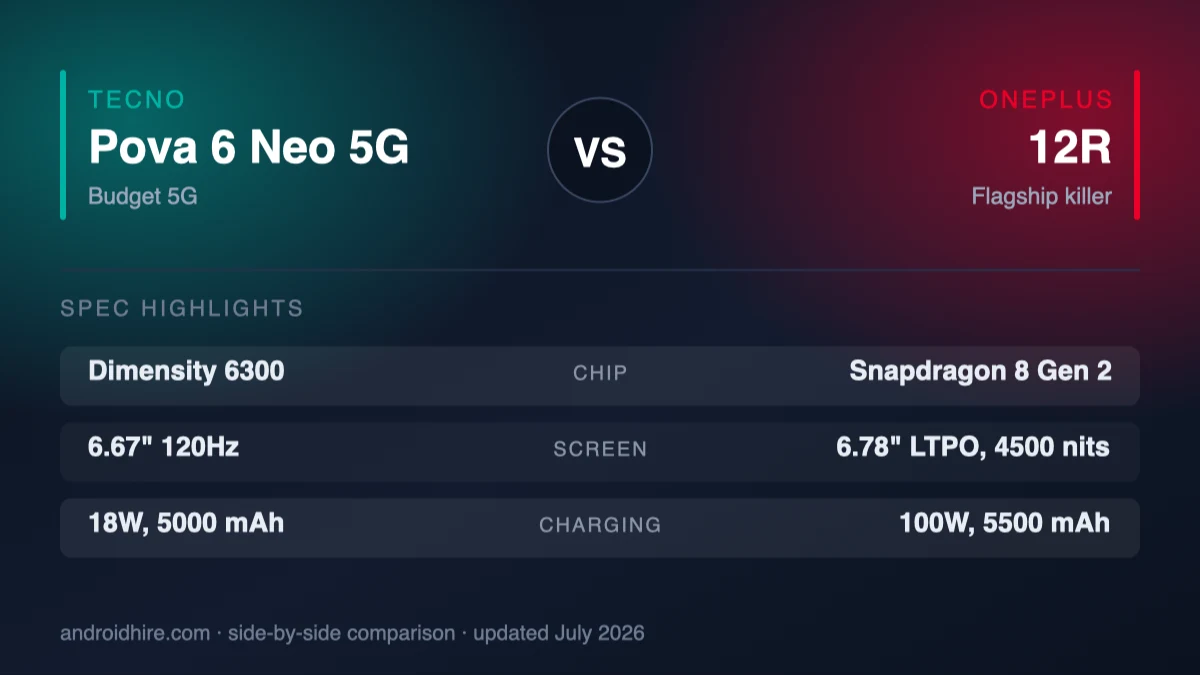
Buy the OnePlus 12R if you can afford it: a 6.78-inch LTPO AMOLED at about 4,500 nits, Snapdragon 8 Gen 2 performance, a 5,500mAh battery and 100W charging that refills it in roughly half an hour. Buy the Tecno Pova 6 Neo 5G if your budget is fixed near $150 and you need working 5G with a full day of battery. Both are 5G phones with 120Hz screens, which is where the similarity ends — the 12R is roughly three times the phone for roughly three times the price.
In a hurry? Jump to → Quick verdict · Full spec comparison · Display · Performance · Cameras · Battery & charging · Updates · Buying gotchas · How we compared · FAQ
This comparison shows up because of one word on both spec sheets: 5G. Budget shoppers reasonably ask whether a ₹12,500 5G phone does the same job as a ₹40,000 one, since both connect to the same network. The answer is that 5G is the cheapest part of a modern phone, and everything around it — the screen, the chip, the charging, the camera stabilisation — is where the money goes. Here is exactly what that money buys.
Quick verdict: Pova 6 Neo 5G vs OnePlus 12R
Choose the OnePlus 12R if you game, watch video, use your phone outdoors, or simply hate waiting for a charge. Its display and 100W charging are the two upgrades you will notice hourly, and its chip will stay capable for years.
Choose the Tecno Pova 6 Neo 5G if the budget is the constraint. It delivers 5G, a 120Hz screen, 5,000mAh, up to 256GB of storage and a 108MP daylight camera for about a third of the price.
Straight answer: the 12R is the better phone by a large margin, and the Tecno is the better value only if $500 is not available.
Who wins what, category by category
| Category | Winner | Why it wins |
|---|---|---|
| Price | Tecno Pova 6 Neo 5G | Roughly a third of the OnePlus |
| Performance | OnePlus 12R | Snapdragon 8 Gen 2 is ~3x faster multi-core |
| Display | OnePlus 12R | LTPO AMOLED at ~4,500 nits vs a 120Hz LCD |
| Charging | OnePlus 12R | 100W (~30 min) vs 18W (hours) |
| Battery capacity | OnePlus 12R | 5,500mAh vs 5,000mAh |
| Cameras | OnePlus 12R | Stabilised 50MP plus an ultrawide |
| Daylight resolution | Tecno Pova 6 Neo 5G | 108MP resolves more detail in good light |
| Storage speed | OnePlus 12R | UFS 4.0 vs UFS 2.2 |
| Extras | OnePlus 12R | IR blaster, stereo speakers, alert slider |
| Software support | OnePlus 12R | 3 OS upgrades and 4 years of patches |
Score: OnePlus 12R 8 – Tecno 2. One of the most lopsided results in this category — the Tecno's case is price, not features.
Tecno Pova 6 Neo 5G vs OnePlus 12R: full spec comparison
| Specification | Tecno Pova 6 Neo 5G | OnePlus 12R |
|---|---|---|
| Announced | September 2024 | February 2024 |
| Typical 2026 price | ~$150 / ₹12,500 | ~$500 / ₹39,999 |
| Display | 6.67" LCD | 6.78" LTPO4 AMOLED |
| Resolution | FHD+ class | 1264 x 2780 |
| Refresh rate | 120Hz | 1–120Hz adaptive |
| Peak brightness | Modest | ~4,500 nits (HDR peak) |
| Cover glass | Not specified | Gorilla Glass Victus 2 |
| Processor | Dimensity 6300 (6nm) | Snapdragon 8 Gen 2 (4nm) |
| GPU | Mali-G57 MC2 | Adreno 740 |
| RAM | 6 / 8GB | 8 / 16GB LPDDR5X |
| Storage | 128 / 256GB UFS 2.2 | 128 / 256GB UFS 4.0 |
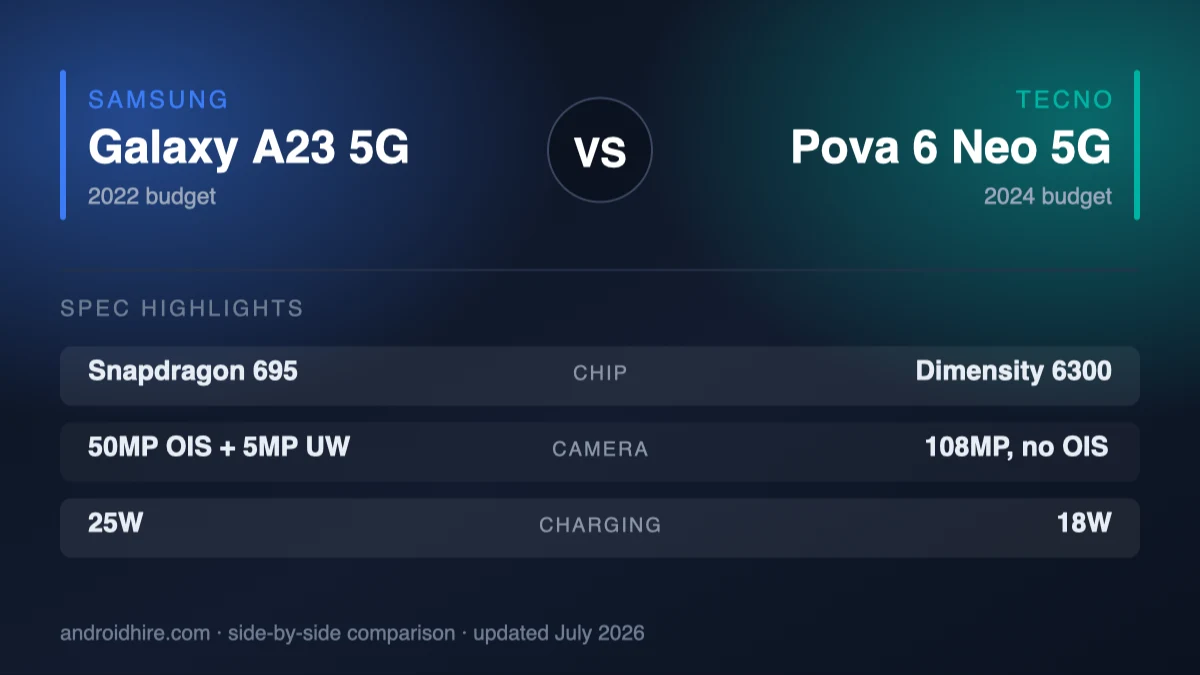
| Main camera | 108MP, no OIS | 50MP Sony IMX890 with OIS |
| Ultrawide | ✖ None | 8MP |
| Front camera | 8MP | 16MP |
| Battery | 5,000 mAh | 5,500 mAh |
| Wired charging | 18W | 100W (80W in NA/EU) |
| Water resistance | IP54 | IP64 |
| Extras | 3.5mm jack, IR blaster | IR blaster, alert slider, stereo speakers |
| Launched on | HiOS / Android 14 | OxygenOS 14 / Android 14 |
| Update policy | ~2 OS / 2 yrs security | 3 OS / 4 yrs security |
OnePlus ships 100W SUPERVOOC in India and 80W in North America and Europe. Confirm the figure for your market.
Display: both say 120Hz, only one is good
This is the trap in budget spec sheets. Both phones advertise a 120Hz refresh rate, so shoppers assume comparable screens. They are not remotely comparable.
- Panel type: the Tecno uses an LCD — grey blacks, flat contrast. The 12R uses an LTPO AMOLED with per-pixel dimming.
- Brightness: the 12R peaks around 4,500 nits in HDR highlights, one of the brightest panels on any phone. The Tecno is readable indoors and struggles in sun.
- Refresh behaviour: the 12R's LTPO ramps from 1Hz to 120Hz, saving power on static screens; the Tecno switches between fixed steps.
- Protection: Gorilla Glass Victus 2 on the OnePlus.
If you watch video or use your phone outside, this is the single biggest reason to spend more.
Performance: entry-level vs former flagship
The Dimensity 6300 is built for cost and efficiency — fine for messaging, video and light games. The Snapdragon 8 Gen 2 was the top Android chip of 2022 and still handles anything.
| Benchmark (approximate) | Tecno Pova 6 Neo 5G | OnePlus 12R |
|---|---|---|
| Geekbench 6 single-core | ~740 | ~1,500 |
| Geekbench 6 multi-core | ~2,000 | ~5,400 |
| AnTuTu v10 total | ~420,000 | ~1,500,000 |
| Heavy gaming | Low settings, ~30fps | High settings, stable 60fps+ |
Benchmark figures are typical published ranges from public test databases rather than our own runs — read them as a class gap, not an exact score for your unit.
Add UFS 4.0 storage against UFS 2.2 and up to 16GB of RAM against 8GB, and the 12R is quicker at everything from app installs to switching between a dozen open apps. For BGMI, Genshin Impact or Call of Duty Mobile, the Tecno simply cannot compete.
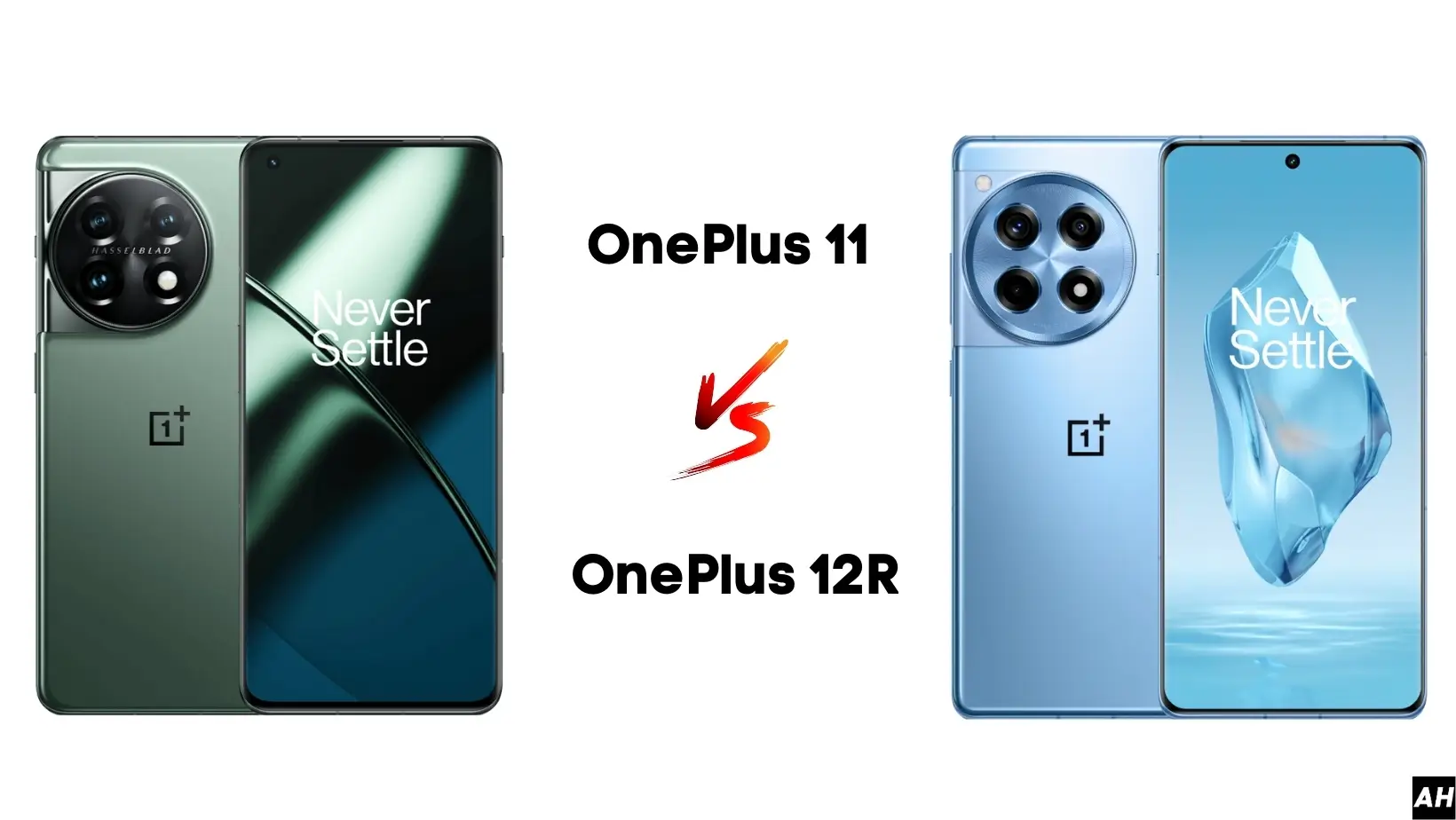
Also Read: OnePlus 11 vs OnePlus 12R
Cameras: megapixels vs stabilisation
Tecno Pova 6 Neo 5G camera
- 108MP main sensor without OIS, with a 3x in-sensor crop
- AI helper lens — not a focal length you would choose
- No ultrawide
- 8MP selfie camera
OnePlus 12R camera
- 50MP Sony IMX890 main with optical image stabilisation
- 8MP ultrawide
- 2MP macro (filler)
- 16MP selfie camera, 4K video
The Tecno's headline number is larger and its daylight detail is genuinely respectable. But it has no stabilisation, which is what determines whether indoor and evening photos come out sharp, and no ultrawide, so you cannot fit a group or a building in frame. The 12R's IMX890 is a far better sensor with OIS on top. In anything other than bright sun, it is not close.
Battery and charging: the five-fold difference
The 12R carries the bigger battery (5,500mAh against 5,000mAh) and, thanks to its LTPO screen, uses it more efficiently — many owners see a day and a half.
Charging is the headline: 100W SUPERVOOC takes the 12R from empty to full in roughly 30–35 minutes (80W in North America and Europe, still around 40 minutes). The Pova 6 Neo's 18W charging takes multiple hours. In practice that means the OnePlus can be topped up meaningfully in a ten-minute break, and the Tecno cannot.
Software and updates
OxygenOS 14 on the 12R is clean, fast and comes with three OS upgrades and four years of security patches from its early-2024 launch — support into roughly 2028. It also includes practical extras like the alert slider and a genuinely good gaming mode.
HiOS on the Pova 6 Neo 5G is capable but preloads recommendation apps and promotional notifications, and Tecno's support window is short — expect around two years of patches from a September 2024 launch. If you keep phones longer than three years, that gap matters as much as the hardware.
Which one should you buy?
Buy the OnePlus 12R if: you game, stream, shoot photos indoors, use your phone outdoors, want fast charging, or plan to keep this phone for three or more years.
Buy the Tecno Pova 6 Neo 5G if: $150 is the budget, you need 5G and a day of battery, you want a headphone jack and up to 256GB of storage, and your camera use is daylight snapshots.
Middle ground: around $250–300 buys an AMOLED screen and a much stronger chip — see the Poco X6 Pro or Redmi Note 14 5G.
What the spec-comparison sites won't tell you
- "120Hz" tells you nothing on its own. A 120Hz LCD and a 120Hz LTPO AMOLED are different products. Refresh rate without panel type and brightness is a meaningless comparison.
- The 12R's charging speed depends on your region. 100W in India, 80W in North America and Europe — and only with the bundled SUPERVOOC charger. A generic USB-C brick will be dramatically slower.
- Neither is properly waterproof. IP54 and IP64 both mean splash resistance, not immersion. Don't take either swimming.
- Check the 12R's RAM tier. The 8GB and 16GB versions age very differently, and the price difference is usually small compared with the longevity gain.
How we compared these phones
We used Tecno's and OnePlus's official specification sheets, cross-checked against independent lab measurements including GSMArena's Pova 6 Neo 5G listing and published OnePlus 12R testing for display brightness and charging times. Two points needed care. First, the shared "120Hz" specification: we separated panel technology, peak brightness and adaptive refresh behaviour rather than treating the refresh rate as equivalence, because that single line misleads more budget buyers than any other. Second, regional charging: OnePlus ships different wattages by market, so we state both rather than quoting the highest. Benchmark ranges come from public databases and describe chip class rather than exact per-unit scores.
Related reading
Bottom line
Tecno Pova 6 Neo 5G vs OnePlus 12R is a lesson in what 5G doesn't tell you. The OnePlus 12R wins the display (LTPO AMOLED at roughly 4,500 nits against an LCD), performance (about three times the multi-core score), charging (100W against 18W), battery capacity, camera stabilisation and software support. The Tecno Pova 6 Neo 5G wins one category that matters to a lot of people: it costs a third as much and still does 5G, 120Hz and a full day of battery. If $500 is available, the 12R is worth every rupee of the difference. If it isn't, the Tecno is an honest phone.
Specifications, software versions and street prices in this comparison were checked in July 2026. We revisit head-to-head guides whenever either phone gets a major OS update or a lasting price change.
Next step: browse every matchup on our phone comparisons hub, or open full spec sheets in the phone specifications directory.
Frequently Asked Questions
How much faster is the OnePlus 12R than the Pova 6 Neo?
Around three times in multi-core benchmarks and far more in GPU work. The 12R uses the Snapdragon 8 Gen 2, a former flagship chip, while the Pova 6 Neo 5G runs an entry-level Dimensity 6300.
What is the biggest everyday difference between them?
Charging. The OnePlus 12R fills a larger 5,500mAh battery in roughly 30 minutes at 100W, while the Pova 6 Neo takes hours at 18W. That changes how you use a phone more than any benchmark.
Is the OnePlus 12R still a good buy in 2026?
Yes, if discounted. Its Snapdragon 8 Gen 2 still handles every current game, its LTPO display hits about 4,500 nits, and it charges faster than most 2026 flagships. Its limits are camera versatility and a three-OS-upgrade window from 2024.
Does the Tecno have a better camera on paper?
It has more megapixels — 108MP against the OnePlus's 50MP — but no optical stabilisation and no ultrawide. The 12R's stabilised 50MP main plus an 8MP ultrawide produces better results in almost every condition, especially indoors.
Which screen is better?
The OnePlus 12R's, by a wide margin. It is a 6.78-inch LTPO AMOLED at 1264 x 2780 with adaptive 1–120Hz refresh and roughly 4,500 nits peak. The Tecno uses a 120Hz LCD, so blacks are grey and outdoor visibility is much worse.
Is the Pova 6 Neo ever the better choice?
Yes — when the budget is fixed near $150, or as a second phone, a work handset, or a device for someone who mainly calls, messages and watches video. It delivers 5G and a day of battery for a third of the money.
Does the OnePlus 12R have wireless charging?
No. Neither phone supports wireless charging. The 12R compensates with 100W wired charging (80W in North America and Europe), which is far faster than any wireless standard.