Redmi Note 14 Pro 5G vs Redmi Note 14 5G (2026): Is the Pro Worth ₹5,000 More?

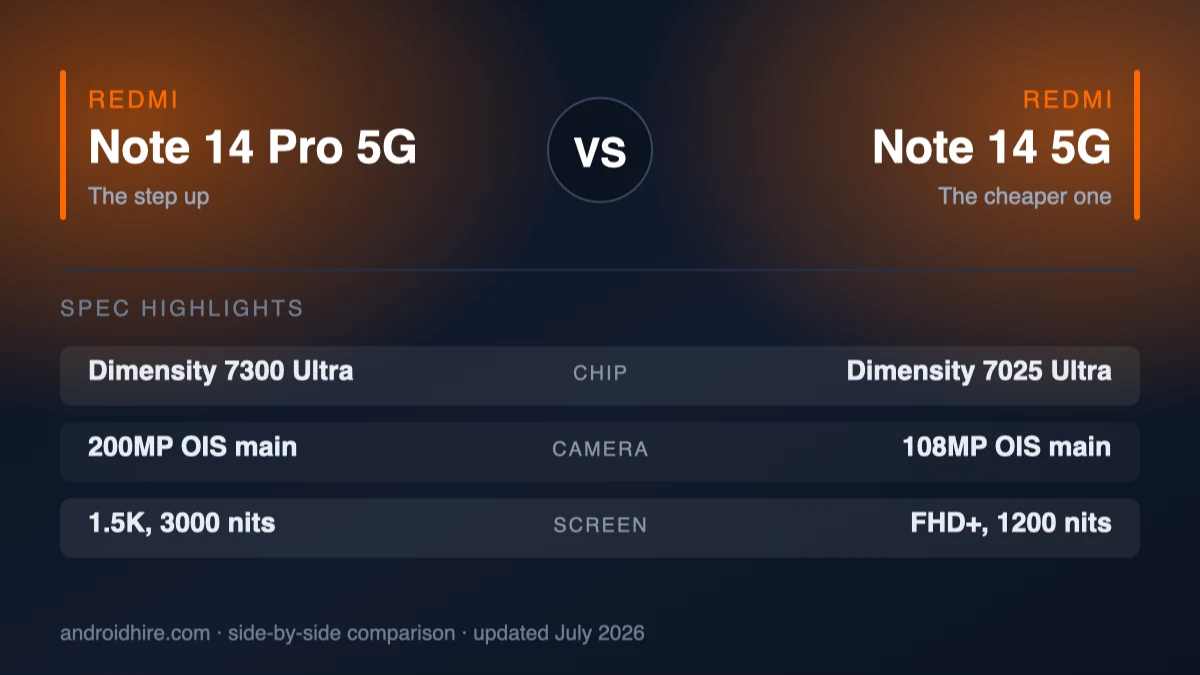
Buy the Redmi Note 14 5G if you want the Note experience for the least money — 120Hz AMOLED, 108MP OIS camera, 5,000mAh and 45W charging cover almost everything. Buy the Redmi Note 14 Pro 5G if you photograph a lot or use your phone outdoors: it adds a 200MP OIS main camera, a sharper 1.5K panel that hits about 3,000 nits, and a faster chip. Same battery, same charging speed, same design language — the gap is narrower than the price.
In a hurry? Jump to → Quick verdict · Full spec comparison · Display · Performance · Cameras · Battery & charging · Updates · Buying gotchas · How we compared · FAQ
This is the most useful comparison in Xiaomi's whole lineup, because the naming hides the answer. "Pro" implies a tier jump, but the Note 14 Pro 5G and Note 14 5G share their battery capacity, charging speed, screen size and refresh rate. Xiaomi spent the difference in exactly three places, and if none of those three matter to you, you are paying ₹5,000 for a bigger number on the camera spec sheet. Here is where the money actually goes.
Quick verdict: Note 14 Pro 5G vs Note 14 5G
Choose the Redmi Note 14 Pro 5G if you shoot photos regularly, especially indoors or at night, or you use your phone outside a lot. The 200MP sensor is physically larger, and a 3,000-nit panel is readable in direct sun where a 1,200-nit one struggles.
Choose the Redmi Note 14 5G if your phone is mostly messaging, video, browsing and casual games. You keep the 120Hz AMOLED, the 45W charging, the 5,000mAh battery and a 108MP OIS camera that is genuinely good in daylight.
Straight answer: most people should take the standard model and spend the difference on more storage.
Who wins what, category by category
| Category | Winner | Why it wins |
|---|---|---|
| Price | Note 14 5G | Roughly ₹5,000 / $60 cheaper |
| Main camera | Note 14 Pro 5G | 200MP with a larger sensor, better in low light |
| Display | Note 14 Pro 5G | 1.5K at ~3,000 nits vs FHD+ at ~1,200 |
| Performance | Note 14 Pro 5G | Dimensity 7300 Ultra leads by ~30–40% |
| Battery | Draw | 5,110mAh vs 5,000mAh — no real difference |
| Charging | Draw | 45W on both |
| Ultrawide | Draw | Both use the same 8MP module |
| Selfie camera | Draw | 20MP on both |
| Value for money | Note 14 5G | Same core experience for less |
Score: Pro 3 – standard 2, with 4 draws. Four draws is the story here — these are closer siblings than the naming suggests.
Redmi Note 14 Pro 5G vs Note 14 5G: full spec comparison
| Specification | Redmi Note 14 Pro 5G | Redmi Note 14 5G |
|---|---|---|
| Announced | Global, January 2025 | Global, January 2025 |
| Typical price | ~$290 / ₹25,000 | ~$230 / ₹20,000 |
| Display | 6.67" AMOLED | 6.67" AMOLED |
| Resolution | 1220 x 2712 (1.5K), 446 ppi | 1080 x 2400 (FHD+), 395 ppi |
| Refresh rate | 120Hz | 120Hz |
| Peak brightness | ~3,000 nits | ~1,200 nits |
| HDR | HDR10+ and Dolby Vision | HDR10+ |
| Processor | Dimensity 7300 Ultra (4nm) | Dimensity 7025 Ultra (6nm) |
| GPU | Mali-G615 MC2 | IMG BXM-8-256 |
| RAM | 8 / 12GB | 6 / 8GB |
| Storage | 128 / 256 / 512GB | 128 / 256GB |
| Main camera | 200MP with OIS | 108MP with OIS |
| Ultrawide | 8MP | 8MP |
| Third lens | 2MP macro | 2MP macro |
| Front camera | 20MP | 20MP |
| Battery | 5,110 mAh | 5,000 mAh |
| Wired charging | 45W | 45W |
| Water resistance | IP68 | IP64 |
| Launched on | HyperOS 2 / Android 14 | HyperOS 2 / Android 14 |
Xiaomi ships global, Indian and Chinese versions of this series with different silicon. The figures above are the global models — verify the exact variant before buying.
Display: the upgrade people underrate
Both are 6.67-inch 120Hz AMOLEDs, so shoppers assume the screens are the same. They are not, and this is arguably a bigger daily difference than the camera.
- Sharpness: 1.5K (446 ppi) on the Pro against FHD+ (395 ppi). Noticeable on small text, not dramatic.
- Brightness: about 3,000 nits versus 1,200. This is the big one — direct sunlight is where cheap AMOLEDs fall apart.
- HDR: the Pro adds Dolby Vision, so Netflix and Disney+ content has more range.
If you spend time outdoors — commuting, driving, working outside — the Pro's panel alone can justify the gap.
Performance: a real but narrow gap
The Pro's Dimensity 7300 Ultra is built on a 4nm process with Cortex-A78 cores; the standard model's Dimensity 7025 Ultra is a 6nm chip. The Pro is faster and more efficient, but both are mid-range parts.
| Benchmark (approximate) | Note 14 Pro 5G | Note 14 5G |
|---|---|---|
| Geekbench 6 single-core | ~1,000 | ~750 |
| Geekbench 6 multi-core | ~3,000 | ~2,100 |
| AnTuTu v10 total | ~750,000 | ~450,000 |
| Heavy gaming | Medium-high settings | Low-medium settings |
Benchmark figures are typical published ranges from public test databases rather than our own runs — read them as a class gap, not an exact score for your unit.
Practical translation: identical for WhatsApp, YouTube, Instagram and banking apps. The Pro pulls ahead in BGMI, Genshin Impact and long gaming sessions, and it will feel current for longer.
Also Read: realme 14 Pro vs OnePlus 13
Cameras: 200MP vs 108MP, honestly
Redmi Note 14 Pro 5G camera
- 200MP main with OIS — a physically larger sensor, binned to around 12MP by default
- 8MP ultrawide (same module as the standard model)
- 2MP macro, effectively filler
- 20MP selfie camera
Redmi Note 14 5G camera
- 108MP main with OIS — also binned, also good in daylight
- 8MP ultrawide, identical
- 2MP macro, identical
- 20MP selfie camera, identical
The honest version: in good light, most people could not pick these apart. The Pro's advantage is sensor size, not resolution — it collects more light, so indoor and night shots hold more detail with less noise, and its 2x in-sensor crop stays usable where the 108MP version softens. Everything else about the camera system is the same hardware.
Rule of thumb: if your photos are mostly daylight and social media, the standard model is enough. If you shoot indoors, at events, or at night, pay for the Pro.
Battery and charging: a genuine tie
5,110mAh against 5,000mAh is a 2% difference — noise. Both charge at 45W, taking roughly an hour, and neither offers wireless charging. The Pro's brighter, sharper screen consumes a little more power, so in practice the two land in the same place: a comfortable full day, with light users reaching a day and a half.
This is worth stating plainly because "Pro" leads people to expect a battery upgrade. There isn't one.
Software and updates
Both launched on HyperOS 2 over Android 14 and share Xiaomi's update policy for the Note series. Both preload the same set of recommendation apps and promotional notifications, which you can disable in the first ten minutes — start with Settings and turn off "Receive recommendations" wherever it appears.
One practical note: the Pro's larger RAM ceiling (12GB against 8GB) will age better than the chip difference. If you keep phones four years, that matters more than benchmarks.
Which one should you buy?
Buy the Note 14 Pro 5G if: you photograph indoors or at night, you use your phone outdoors in bright sun, you play demanding games, or you want IP68 rather than IP64 water resistance.
Buy the Note 14 5G if: your use is messaging, video, browsing and light games; you would rather put the savings toward the 256GB tier; or you simply do not care about a 200MP number you will never shoot at full resolution.
What the spec-comparison sites won't tell you
- There are three different "Redmi Note 14 Pro 5G" phones. Global, India and China variants ship different chipsets and camera hardware. A review of the Indian model does not describe the global one — check the model number on the listing.
- The IP rating differs and nobody mentions it. IP68 on the Pro versus IP64 on the standard model. That is immersion protection versus splash protection.
- 200MP mode is not the default and rarely worth using. Full-resolution files are enormous, need bright light and a steady hand, and most people will shoot binned 12MP forever.
- Don't buy 6GB RAM on the standard model. HyperOS is heavy; 8GB is the minimum that stays smooth as you install apps.
How we compared these phones
We used Xiaomi's global specification sheets for both phones and cross-checked display brightness, charging times and battery endurance against GSMArena's lab measurements for the Note 14 Pro 5G and its review of the standard model. Two things needed care that automated comparison pages get wrong. First, variant confusion: Xiaomi sells regionally different versions of both phones under the same names, so we state which market's specs we are quoting. Second, the camera framing — we treated sensor size and light-gathering as the real difference rather than the megapixel headline, because both sensors bin to a similar output resolution in everyday shooting. Benchmark ranges come from public databases and indicate class, not exact scores.
Related reading
Bottom line
Redmi Note 14 Pro 5G vs Note 14 5G is a three-difference comparison dressed up as a tier gap. Battery, charging, ultrawide, selfie camera, screen size and refresh rate are all the same. The Pro earns its price with a larger 200MP OIS sensor for low light, a 1.5K display at roughly 3,000 nits for outdoor use, IP68 sealing and a faster Dimensity 7300 Ultra. The standard Note 14 5G keeps everything else and costs meaningfully less. Photograph in dim light or work outdoors? Take the Pro. Otherwise take the savings.
Specifications, software versions and street prices in this comparison were checked in July 2026. We revisit head-to-head guides whenever either phone gets a major OS update or a lasting price change.
Next step: browse every matchup on our phone comparisons hub, or open full spec sheets in the phone specifications directory.
Frequently Asked Questions
What is the main difference between the Redmi Note 14 Pro 5G and Note 14 5G?
Three things: the camera (200MP with OIS on the Pro versus 108MP with OIS), the display (1.5K resolution at up to 3,000 nits versus FHD+ at 1,200 nits) and the chip (Dimensity 7300 Ultra versus Dimensity 7025 Ultra). Battery, charging speed and design are close.
Is the 200MP camera actually better than the 108MP one?
Yes, but not because of the megapixels. Both bin down to around 12MP in normal use. The Pro's sensor is larger and gathers more light, which shows in low light and in its cropped 2x zoom mode. In bright daylight the two are close.
How much faster is the Dimensity 7300 Ultra?
Roughly 30–40% higher in multi-core benchmarks than the Dimensity 7025 Ultra, with a bigger gap in GPU work. Both handle everyday apps identically; the difference appears in demanding games and sustained loads.
Do both have the same battery and charging?
Nearly. The Pro has 5,110mAh and the standard model 5,000mAh, and both charge at 45W. Real-world endurance is very similar, though the Pro's sharper display draws slightly more power.
Which display is better?
The Pro's, clearly. It runs 1220 x 2712 at up to 3,000 nits peak with Dolby Vision, while the standard Note 14 5G is 1080 x 2400 at around 1,200 nits. Outdoors in sunlight the difference is obvious.
Is there an India-specific version of these phones?
Yes, and it matters. Xiaomi sells global, Indian and Chinese variants of the Note 14 series with different chipsets and camera hardware. Check the exact model on the listing rather than trusting a generic review.
Which one should most people buy?
The standard Redmi Note 14 5G, unless photography or outdoor screen brightness matters to you. It has the same 120Hz AMOLED experience, the same 45W charging and a very similar battery for meaningfully less money.