realme 14 Pro 256GB vs OnePlus 13 (2026): Save Money or Buy the Flagship?

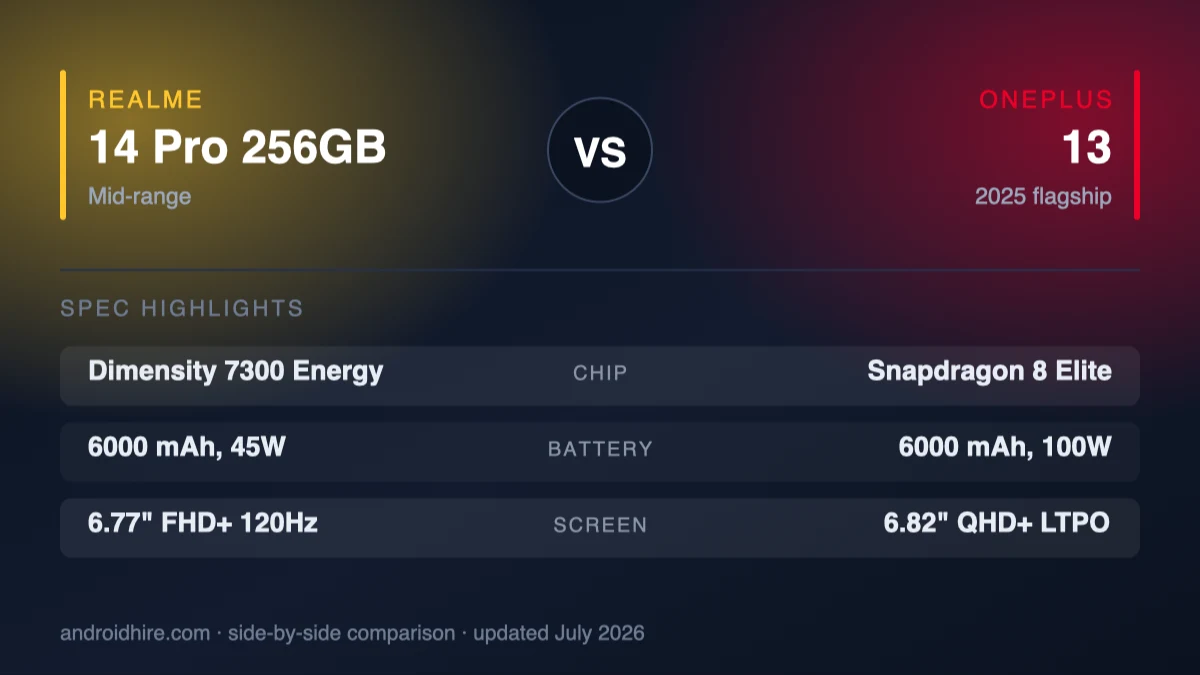
Buy the realme 14 Pro if you want a 6,000mAh battery, a 120Hz OLED screen and MIL-STD-rated toughness for around ₹25,000 (~$290). Buy the OnePlus 13 if you want an actual flagship: Snapdragon 8 Elite speed, a Hasselblad triple-50MP camera with 3x periscope zoom, a QHD+ LTPO display and 100W wired plus 50W wireless charging. They share the same battery size — almost nothing else.
In a hurry? Jump to → Quick verdict · Full spec comparison · Display · Performance · Cameras · Battery & charging · Updates · Buying gotchas · How we compared · FAQ
The interesting wrinkle in this matchup is that realme and OnePlus are corporate siblings, both under BBK Electronics, and the realme 14 Pro deliberately borrows the flagship's most marketable spec: a 6,000mAh silicon-carbon battery. That is why the two turn up in the same searches. But battery capacity is where the overlap ends, and the rest of the comparison is a textbook case of what a flagship premium actually buys in 2026 — mostly the camera and the chip.
Quick verdict: realme 14 Pro vs OnePlus 13
Choose the realme 14 Pro if your budget is fixed near $300 and battery life leads your list. You get a 6.77-inch 120Hz OLED, a 6,000mAh cell, IP66/IP68/IP69 sealing with MIL-STD-810H certification, and a genuinely distinctive colour-changing back.
Choose the OnePlus 13 if you want no compromises: roughly three times the multi-core performance, a QHD+ LTPO panel at 4,500 nits peak, three usable 50MP cameras, 100W wired and 50W wireless charging, and an ultrasonic fingerprint reader.
Simple rule: if you photograph and game, the OnePlus 13 is worth the money. If you scroll, stream and message, the realme is the better spend.
Who wins what, category by category
| Category | Winner | Why it wins |
|---|---|---|
| Price | realme 14 Pro | About a third of the OnePlus 13's launch price |
| Performance | OnePlus 13 | Snapdragon 8 Elite is roughly 3x faster multi-core |
| Cameras | OnePlus 13 | Three 50MP Hasselblad lenses incl. 3x periscope |
| Display | OnePlus 13 | QHD+ LTPO, 4,500 nits peak vs 1080p |
| Battery capacity | Draw | Both 6,000mAh silicon-carbon |
| Battery life | realme 14 Pro | Lower-resolution screen, more frugal chip |
| Charging | OnePlus 13 | 100W wired + 50W wireless vs 45W wired |
| Durability | realme 14 Pro | MIL-STD-810H on top of IP69 sealing |
| Software support | OnePlus 13 | 4 OS upgrades and 6 years of patches |
| Design novelty | realme 14 Pro | Thermochromic colour-changing back |
Score: OnePlus 13 5 – realme 14 Pro 4, with 1 draw. The realme wins on cost and endurance; the OnePlus wins on everything performance-related.
realme 14 Pro vs OnePlus 13: full spec comparison
| Specification | realme 14 Pro (256GB) | OnePlus 13 |
|---|---|---|
| Released | January 2025 | January 2025 (global) |
| Launch price | ~₹25,000 (~$290) | $899 / ₹69,999 |
| Display | 6.77" quad-curved OLED | 6.82" LTPO AMOLED |
| Resolution | 1080 x 2392 (FHD+) | 1440 x 3168 (QHD+) |
| Refresh rate | 120Hz | 1–120Hz adaptive LTPO |
| Peak brightness | ~1,500 nits (local peak) | ~4,500 nits (HDR peak) |
| Processor | Dimensity 7300 Energy (4nm) | Snapdragon 8 Elite (3nm) |
| RAM | 8 / 12GB | 12 / 16GB LPDDR5X |
| Storage | 128 / 256 / 512GB | 256 / 512GB / 1TB UFS 4.0 |
| Main camera | 50MP Sony IMX896 with OIS | 50MP with OIS (Hasselblad) |
| Ultrawide | ✖ None (2MP depth) | 50MP |
| Telephoto | ✖ None | 50MP 3x periscope with OIS |
| Front camera | 16MP | 32MP |
| Max video | 4K at 30fps | 8K at 30fps / 4K at 120fps |
| Battery | 6,000 mAh Si/C | 6,000 mAh Si/C |
| Wired charging | 45W | 100W SUPERVOOC |
| Wireless charging | ✖ No | ✔ 50W |
| Water resistance | IP66 / IP68 / IP69 | IP68 / IP69 |
| Extra durability | MIL-STD-810H certified | — |
| Fingerprint reader | Optical in-display | Ultrasonic in-display |
| Launched on | realme UI 6.0 / Android 15 | OxygenOS 15 / Android 15 |
| Update commitment | 2–3 OS / 3–4 yrs security | 4 OS / 6 yrs security |
| Weight | ~180 g | ~210 g |
Display: both 120Hz, only one is a flagship panel
The realme 14 Pro's 6.77-inch quad-curved OLED is a good screen for the money: 1080p, 120Hz, 10-bit colour and roughly 1,500 nits at local peak. Nothing about it feels cheap.
The OnePlus 13 is on another level. QHD+ resolution at about 510 ppi, true LTPO that drops to 1Hz on static content, an HDR peak around 4,500 nits, Dolby Vision, and an ultrasonic fingerprint sensor that reads wet fingers where the realme's optical reader struggles.
- Sharpness: OnePlus 13, by a wide margin.
- Outdoor visibility: OnePlus 13.
- Battery efficiency at the screen level: OnePlus 13's LTPO, despite the higher resolution.
- Lighter in the hand: realme 14 Pro at 180g versus 210g.
Performance: the widest gap in this comparison
The realme 14 Pro's Dimensity 7300 Energy is named for what it optimises: battery life. It handles everyday apps and casual games well and stays cool. It is not built for sustained heavy gaming.
The OnePlus 13's Snapdragon 8 Elite is among the fastest mobile chips ever shipped, with custom Oryon cores and hardware ray tracing.
| Benchmark (approximate) | realme 14 Pro | OnePlus 13 |
|---|---|---|
| Geekbench 6 single-core | ~1,000 | ~3,000 |
| Geekbench 6 multi-core | ~3,000 | ~9,300 |
| AnTuTu v10 total | ~750,000 | ~2,900,000 |
| Heavy gaming | Medium settings | Max settings with headroom |
Benchmark figures are typical published ranges from public test databases rather than our own runs — read them as a class gap, not an exact score for your unit.
Be honest with yourself about what you need. Three times the benchmark score does not mean three times faster WhatsApp. It means the difference between playing Genshin Impact at medium settings with dips, and playing it maxed out for two hours without them.
Also Read: full OnePlus 13 specifications and review
Cameras: one lens vs three
realme 14 Pro camera
- 50MP Sony IMX896 main with OIS — a genuinely capable sensor
- 2MP depth helper, so no ultrawide and no optical zoom
- 16MP fixed-focus front camera
- 4K/30 video from the main camera
OnePlus 13 camera
- 50MP main with OIS, Hasselblad colour tuning
- 50MP ultrawide with autofocus
- 50MP 3x periscope telephoto with OIS — the lens the realme cannot answer
- 32MP front camera, 8K/30 and 4K/120 video
In good light, pointed at a single subject, the realme's IMX896 holds up better than its price suggests. Everything else favours OnePlus: you can shoot a wide group photo, a compressed 3x portrait, or a stabilised 4K/120 clip, and the Hasselblad tuning keeps colour consistent between lenses. For travel, events or anything where you cannot walk closer, the periscope alone decides it.
Battery and charging: same size, very different speed
Both carry 6,000mAh silicon-carbon batteries — a technology that packs more capacity into the same space than traditional lithium-ion. The realme squeezes marginally more screen-on time out of it because its 1080p panel and efficient chip draw less power.
Charging is not close. The OnePlus 13 does 100W wired (roughly 35 minutes to full) plus 50W wireless. The realme manages 45W wired and no wireless at all, taking around 70 minutes. If you charge in short bursts during the day, the OnePlus effectively removes battery anxiety.
Software and updates: OnePlus buys you years
Both launched on Android 15 with closely related skins — realme UI 6.0 and OxygenOS 15 share a common ColorOS foundation, so navigation and settings feel familiar between them.
The difference is commitment. OnePlus promises four OS upgrades and six years of security patches for the 13, taking it to roughly 2031. realme's number-series phones typically get two to three OS upgrades and three to four years of patches, so the 14 Pro's support ends around 2028–29. Over a five-year ownership window that gap is worth real money.
Which one should you buy?
Buy the realme 14 Pro if: your budget is around $300, you want maximum battery life, you value a light 180g body and extra drop and dust certification, and your camera use is mostly daylight snapshots.
Buy the OnePlus 13 if: you game heavily, you want a real 3x optical zoom, you want the sharpest screen and the fastest charging available, or you plan to keep this phone until the end of the decade.
Watch the price. The OnePlus 13 launched at $899 and is frequently discounted well below that. At a big enough discount, the value argument for the realme weakens considerably.
What the spec-comparison sites won't tell you
- "6,000mAh on both" is the most misleading line on the spec sheet. Identical capacity, but 100W plus wireless versus 45W wired is a completely different daily experience.
- realme's 14 Pro and 14 Pro+ are different phones. Only the Pro+ has the periscope telephoto and Snapdragon 7s Gen 3. Many comparison pages mix the two — check which model a listing is selling.
- The colour-changing back needs cold to work. The thermochromic effect triggger below roughly 16°C, so in a warm climate you will rarely see it.
- Ultrasonic vs optical fingerprint matters more than it sounds. The OnePlus reads wet or greasy fingers; the realme's optical sensor often will not, which is a daily irritation in humid weather.
How we compared these phones
We used realme's and OnePlus's official specification sheets and cross-checked display, charging and battery measurements against independent testing, including GSMArena's realme 14 Pro data and our own OnePlus 13 spec sheet. Particular care went into three areas that automated comparison pages get wrong: separating the realme 14 Pro from the 14 Pro+ (which has different silicon and an extra camera), stating charging speeds alongside battery capacity rather than treating "6,000mAh on both" as parity, and treating software-support length as a specification. Benchmark ranges are drawn from public databases and should be read as class indicators. Prices reflect July 2026, when the OnePlus 13 routinely sells below its launch price.
Related reading
Bottom line
realme 14 Pro vs OnePlus 13 looks like a fair fight on the battery line and nowhere else. The realme 14 Pro is a smart $290 phone: same 6,000mAh capacity, a good 120Hz OLED, MIL-STD toughness, a light 180g body and slightly longer screen-on time. The OnePlus 13 costs far more and earns it with roughly triple the performance, a Hasselblad triple-camera system including 3x periscope zoom, a QHD+ LTPO display, 100W wired and 50W wireless charging, and updates into 2031. Buy the realme to save money without feeling cheated. Buy the OnePlus if you want the last phone you will need for years.
Specifications, software versions and street prices in this comparison were checked in July 2026. We revisit head-to-head guides whenever either phone gets a major OS update or a lasting price change.
Next step: browse every matchup on our phone comparisons hub, or open full spec sheets in the phone specifications directory.
Frequently Asked Questions
How much faster is the OnePlus 13 than the realme 14 Pro?
Roughly three times faster in multi-core benchmarks. The OnePlus 13's Snapdragon 8 Elite is a top-end flagship chip, while the realme 14 Pro uses a Dimensity 7300 Energy built for efficiency. In heavy games the difference is dramatic; for messaging and video it is barely noticeable.
Do both phones have a 6,000mAh battery?
Yes, and that is the most surprising thing about this comparison. Both use 6,000mAh silicon-carbon cells. The OnePlus charges much faster at 100W wired plus 50W wireless, versus 45W wired and no wireless charging on the realme.
Which has the better camera?
The OnePlus 13, clearly. It has three 50MP cameras — main with OIS, ultrawide, and a 3x periscope telephoto — all Hasselblad-tuned. The realme 14 Pro pairs a 50MP main with a 2MP depth helper, so it has no ultrawide and no optical zoom.
Is the realme 14 Pro's colour-changing back a gimmick?
Mostly, yes — but it works. The pearl-white finish shifts to blue in cold temperatures using thermochromic pigment. It is a genuinely novel design touch and has no effect on durability or performance.
Which phone lasts longer between charges?
The realme 14 Pro, slightly. Same battery capacity, but its lower-resolution 1080p screen and efficient chip draw less power. The OnePlus 13 still comfortably clears a full day and recharges in about half the time.
Is the OnePlus 13 worth double the price?
If you game seriously, photograph often, or plan to keep the phone four-plus years, yes — you get flagship silicon, a real periscope zoom, IP68/IP69 sealing and a longer update window. If you mainly message, stream and browse, the realme delivers most of the daily experience for far less.
Does the realme 14 Pro have wireless charging?
No. It supports 45W wired charging only. The OnePlus 13 adds 50W wireless charging, one of the fastest wireless implementations available.