Infinix Hot 50 5G vs OnePlus 10 Pro (2026): New Budget Phone or Used Flagship?

Buy the Infinix Hot 50 5G if you want a brand-new phone, a fresh battery, a warranty and 5G for around ₹11,000 (about $130). Buy a used OnePlus 10 Pro if raw speed, a sharp QHD+ AMOLED screen and real cameras matter more than warranty and updates. These two phones cost roughly the same money in 2026 — one is new and basic, the other is a 2022 flagship past its software support. That single trade-off decides the whole comparison.
In a hurry? Jump to → Quick verdict · Full spec comparison · Display · Performance · Cameras · Battery & charging · Updates · Buying gotchas · How we compared · FAQ
This is not a matchup any brand planned. People search it because their budget lands in one narrow band — roughly $120 to $320 — and at that price the market offers two completely different products: a new entry-level 5G phone, or somebody else's old flagship. The Infinix Hot 50 5G launched in September 2024 at ₹9,999 for 4GB/64GB and ₹10,999 for 8GB/128GB. The OnePlus 10 Pro launched in January 2022 at $899 and now trades used for roughly $300. Comparing them spec-for-spec is lopsided, so the useful question is different: which set of compromises can you live with?
Quick verdict: Infinix Hot 50 5G vs OnePlus 10 Pro
Choose the Infinix Hot 50 5G if this is your only phone and it has to keep working. You get a sealed battery with full capacity, a shop warranty, an IP54 splash rating, dual-SIM 5G, a 120Hz screen and Android 14 with a couple of years of patches ahead of it. It is slow by flagship standards, but it will not surprise you.
Choose a used OnePlus 10 Pro if you are a heavy user who cares about gaming, photos and screen quality, and you already have a backup phone. It is three to four times faster in GPU-heavy games, charges in about half an hour, and shoots photos the Infinix cannot match at any setting.
Neither is a clean win. The honest summary: the Infinix is the safer purchase, the OnePlus is the better phone.
Who wins what, category by category
| Category | Winner | Why it wins |
|---|---|---|
| Price | Infinix Hot 50 5G | New, warrantied, around $130 |
| Display | OnePlus 10 Pro | QHD+ AMOLED vs 720p LCD |
| Performance | OnePlus 10 Pro | Snapdragon 8 Gen 1 is ~2.5x faster in multi-core |
| Cameras | OnePlus 10 Pro | OIS, 150° ultrawide and 3.3x optical zoom |
| Battery life | Infinix Hot 50 5G | Fresh 5,000mAh cell vs a 4-year-old one |
| Charging | OnePlus 10 Pro | 80W wired + 50W wireless vs 18W |
| Software support | Infinix Hot 50 5G | Still patched; OnePlus updates have ended |
| Peace of mind | Infinix Hot 50 5G | Warranty, no battery gamble |
Score: OnePlus 10 Pro 4 – Infinix Hot 50 5G 4. A genuine split, which is why the decision is about your priorities rather than the specs.
Infinix Hot 50 5G vs OnePlus 10 Pro: full spec comparison
| Specification | Infinix Hot 50 5G | OnePlus 10 Pro |
|---|---|---|
| Released | September 2024 | January 2022 |
| Typical 2026 price | ~₹10,999 / $130 new | ~$300 used |
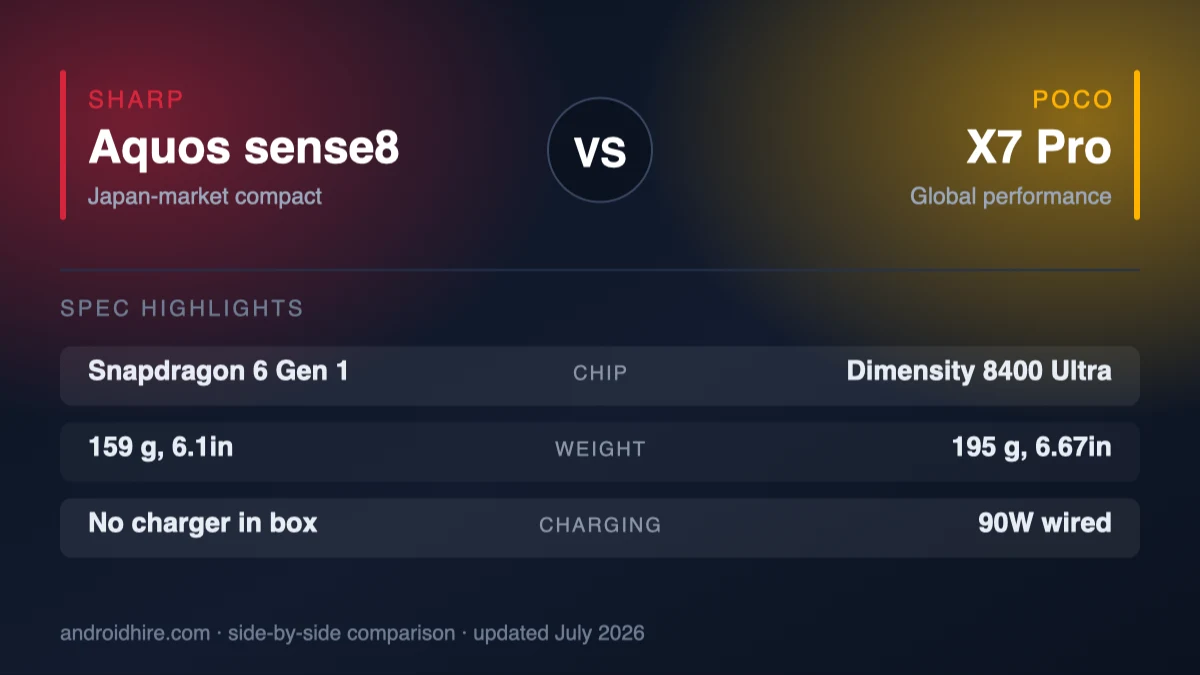
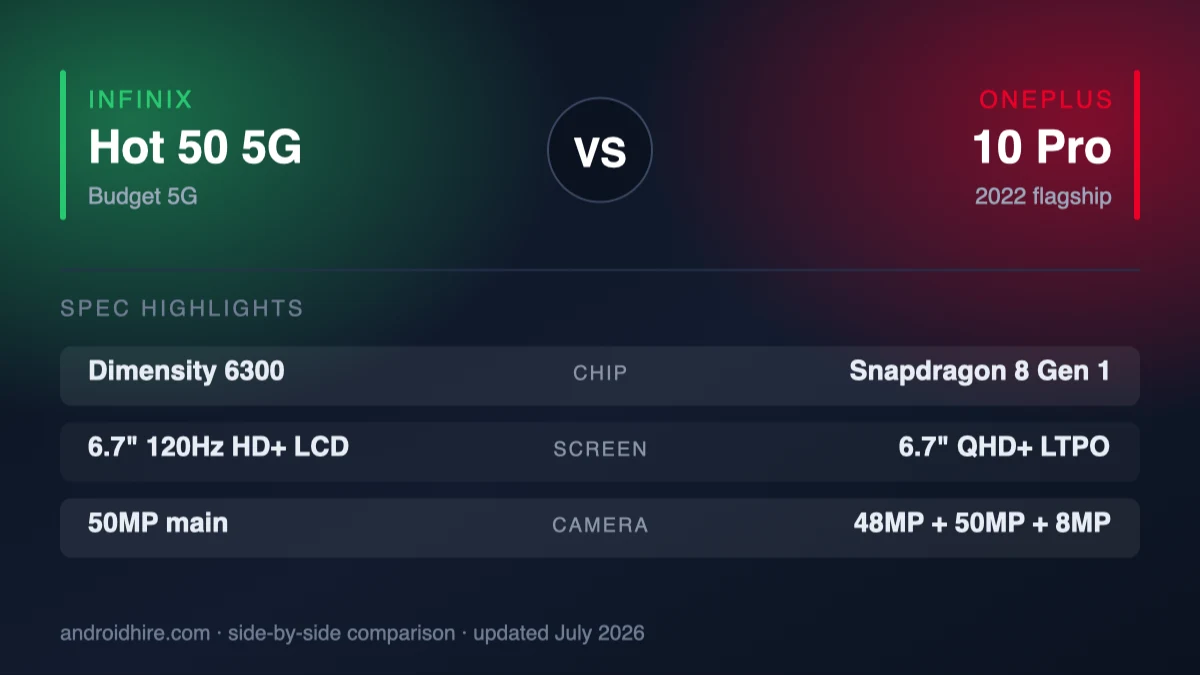
| Display | 6.7" IPS LCD | 6.7" LTPO2 AMOLED |
| Resolution | 720 x 1600 (HD+) | 1440 x 3216 (QHD+) |
| Refresh rate | 120Hz | 1–120Hz adaptive |
| Peak brightness | ~500 nits | ~1,300 nits |
| Processor | MediaTek Dimensity 6300 (6nm) | Snapdragon 8 Gen 1 (4nm) |
| GPU | Mali-G57 MC2 | Adreno 730 |
| RAM | 4 / 8GB | 8 / 12GB LPDDR5 |
| Storage | 64 / 128GB + microSD | 128 / 256 / 512GB UFS 3.1 |
| Main camera | 50MP, no OIS | 48MP with OIS |
| Ultrawide | ✖ None | 50MP, 150° field of view |
| Telephoto | ✖ None | 8MP, 3.3x optical, OIS |
| Front camera | 8MP | 32MP |
| Battery | 5,000 mAh | 5,000 mAh (4+ years old) |
| Wired charging | 18W | 80W (65W in North America) |
| Wireless charging | ✖ No | ✔ 50W |
| Water resistance | IP54 | IP68 (T-Mobile units only) |
| Headphone jack | ✔ Yes | ✖ No |
| Launched on | XOS 14.5 / Android 14 | OxygenOS 12 / Android 12 |
| Highest official OS | Android 15 (one upgrade) | Android 14 (support ended) |
| Weight | ~197 g | ~201 g |
Prices are indicative. Used flagship pricing swings with condition and region — check two or three listings before you judge value.
Display: 120Hz smoothness vs actual sharpness
Infinix does the clever budget thing here: it spends on refresh rate, not resolution. Scrolling on the Hot 50 5G looks fluid because the panel runs at 120Hz, but it is a 720p LCD, so text edges look soft and photos lose fine detail. It is also an LCD, which means blacks are grey and contrast is flat next to any OLED.
The OnePlus 10 Pro's 6.7-inch LTPO2 AMOLED is in a different class: QHD+ resolution at roughly 525 ppi, adaptive 1–120Hz to save power, around 1,300 nits peak in HDR, plus Dolby Vision and HDR10+ support. Four years on, it still looks better than most new phones under $400.
- Reading, video, gaming visuals: OnePlus 10 Pro, decisively.
- Outdoor visibility: OnePlus 10 Pro — roughly double the brightness.
- Risk of a worn panel: only the OnePlus, since old AMOLEDs can show faint burn-in from long-lived status bars.
Performance: a flagship chip beats a budget one, even four years later
The Hot 50 5G runs MediaTek's Dimensity 6300, an entry-level 6nm 5G chip built for messaging, video and light games. It is fine for WhatsApp, YouTube, banking apps and Instagram. It is not fine for sustained high-graphics gaming.
The OnePlus 10 Pro runs the Snapdragon 8 Gen 1 with an Adreno 730 GPU — 2022's top-end Android silicon. Even against 2026 budget chips it holds a large lead in GPU work, so games like BGMI, Genshin Impact or Call of Duty Mobile run at settings the Infinix cannot attempt. The 8 Gen 1's known weakness is heat: it throttles under long sessions, and a used unit with aged thermal paste can get warm fast. If that is a worry, our guide on why an Android phone overheats covers the practical fixes.
One nuance that matters more than benchmarks: RAM. A 4GB Hot 50 5G will reload background apps constantly. If you buy the Infinix, buy the 8GB version — it is only about ₹1,000 more and it changes how the phone feels.
| Benchmark (approximate) | Infinix Hot 50 5G | OnePlus 10 Pro |
|---|---|---|
| Geekbench 6 single-core | ~740 | ~1,300 |
| Geekbench 6 multi-core | ~2,000 | ~4,000 |
| AnTuTu v10 total | ~420,000 | ~1,050,000 |
| Sustained gaming | Low settings, 30fps | High settings, 60fps+ |
Benchmark figures are typical published ranges from public test databases, not our own runs — treat them as a class indicator rather than exact scores for your unit.
Also Read: Best Snapdragon 8 Gen 3 phones
Cameras: one usable lens vs three
Infinix Hot 50 5G camera
- 50MP main sensor, fixed focus assistance, no optical stabilisation
- Secondary depth/AI lenses that add little real value
- 8MP selfie camera with a screen-flash assist
- Video capped at 1080p — no 4K
OnePlus 10 Pro camera
- 48MP main (Sony IMX789) with OIS
- 50MP ultrawide with an unusually wide 150° mode
- 8MP telephoto with 3.3x optical zoom and OIS
- 32MP selfie camera, 4K video on the rear cameras, Hasselblad colour tuning
In daylight the gap is visible but not brutal — a good 50MP sensor takes decent photos in strong light. Indoors and at night it becomes obvious: the OnePlus has stabilisation, a bigger sensor and better processing, so it keeps detail where the Infinix produces blur and smeared noise. If you photograph kids, pets, food indoors or anything after sunset, this section alone should decide it.
Battery and charging: the used-phone catch
Both list a 5,000mAh cell, but only one of them still has it. A four-year-old flagship battery typically retains 80–85% of its original capacity, and often less if the previous owner charged it hard with 80W every day. So expect the Infinix — new cell, low-power 720p LCD, efficient chip — to last comfortably longer per charge in real use.
Charging flips it. The OnePlus 10 Pro does 80W wired (65W in North America) plus 50W wireless, filling in about 30–35 minutes. The Hot 50 5G's 18W takes well over 90 minutes. If you buy used, budget roughly $30–$50 for a battery replacement and treat that as part of the purchase price — it restores most of the endurance gap.
Software and updates: the deciding factor for most buyers
The Hot 50 5G shipped with XOS 14.5 on Android 14, with one major OS upgrade and about two years of security patches promised. XOS is heavy and ships with bloatware you will want to uninstall on day one, but it is supported.
The OnePlus 10 Pro shipped on OxygenOS 12 (Android 12) and its official update path ended at Android 14 with security patches now finished. That means no new Android features and no vendor security fixes. It is not immediately dangerous — Google Play system updates continue to patch parts of the system — but it is a real, growing risk for a phone you use for banking. Custom ROM users can extend its life; most buyers will not.
Which one should you buy?
Buy the Infinix Hot 50 5G if: you need a dependable daily phone with a warranty, you mostly use social apps, calls, video and light games, you want a headphone jack and microSD expansion, and you would rather have current security patches than raw speed.
Buy the used OnePlus 10 Pro if: you game seriously, you care about photos, you want a genuinely premium screen and fast charging, you can inspect the phone's battery health before buying, and you accept that its official updates are over.
Buy neither if: you can stretch to about $220–$250 for something like a current Poco or Redmi mid-ranger. That is the price where you stop choosing between "new but slow" and "fast but unsupported" — see our Poco X7 Pro comparison for what that money buys.
What the spec-comparison sites won't tell you
Automated spec tables put these phones side by side and stop there. Four things they miss decide whether you are happy in six months:
- Check the OnePlus 10 Pro's model number. The NE2210 (China) and NE2213 (India/Europe) do not carry the same 5G band support as the North American NE2215. A cheap import can lose the bands your carrier actually uses.
- Ask the seller for a battery health screenshot. On the OnePlus, Settings → Battery → Battery health shows remaining capacity. Below 85%, budget for a replacement.
- The Infinix ships with bloatware. XOS preloads recommendation apps and, in some regions, lock-screen ads. Most can be uninstalled or disabled in about ten minutes — do that before you judge the phone.
- Chargers differ. Infinix includes an 18W brick in the box. A used OnePlus 10 Pro often arrives without its SUPERVOOC charger, and a generic USB-C adapter will charge it far more slowly. Add roughly $30 for the proper one.
How we compared these phones
We built this comparison from the manufacturers' own specification sheets, cross-checked against GSMArena's published measurements and independent reviews, then reconciled the differences. Because one device here is bought second-hand, we deliberately factored in the things spec sheets ignore: battery degradation after four years, the end of OxygenOS security support, regional charging differences (80W internationally versus 65W in North America), and the fact that the OnePlus 10 Pro's IP68 rating applied only to T-Mobile units in the US. Where a number varies by market or by unit condition, we have said so instead of printing one figure as universal. Prices quoted are July 2026 street prices, which move quickly on used flagships.
Related reading
Bottom line
The Infinix Hot 50 5G vs OnePlus 10 Pro question is really "new and safe" versus "old and fast." The Infinix Hot 50 5G wins on warranty, battery health, current security patches, expandable storage and a headphone jack — it is the sensible buy if the phone has to just work. The OnePlus 10 Pro wins on everything you notice while using it: a QHD+ AMOLED screen, flagship gaming performance, a three-camera system with real optical zoom, and 80W charging. If you can inspect the battery and you have a spare phone in the drawer, the OnePlus is the better experience for the money. If you cannot, buy new.
Prices, software versions and street availability in this comparison were checked in July 2026. We revisit head-to-head guides when either phone gets a major update or a lasting price change.
Still unsure? Compare full spec sheets in our phone specifications directory, then browse every head-to-head comparison to find your exact matchup.
Frequently Asked Questions
Is the OnePlus 10 Pro still worth buying in 2026?
As a cheap second-hand phone, yes — for performance, screen quality and cameras it still beats any new phone at the same used price. But it launched on Android 12, its official OxygenOS updates have run out at Android 14, and its battery is at least four years old. Buy it only if you accept those two risks.
Which phone is faster, the Infinix Hot 50 5G or the OnePlus 10 Pro?
The OnePlus 10 Pro, by a wide margin. Its Snapdragon 8 Gen 1 is a flagship chip with an Adreno 730 GPU, while the Hot 50 5G's Dimensity 6300 is an entry-level 5G chip. Expect roughly three to four times the GPU performance on the OnePlus in demanding games.
Does the Infinix Hot 50 5G have a Full HD screen?
No. The Hot 50 5G uses a 6.7-inch HD+ (720 x 1600) IPS LCD with a 120Hz refresh rate. It is smooth, but noticeably less sharp than the OnePlus 10 Pro's 6.7-inch QHD+ (1440p) LTPO AMOLED panel.
Which one has the better camera?
The OnePlus 10 Pro. It pairs a 48MP main sensor with OIS, a 50MP 150-degree ultrawide and an 8MP telephoto, all with Hasselblad colour tuning. The Hot 50 5G has one usable 50MP main camera plus depth/AI helper lenses, and no optical stabilisation.
Is a new budget phone safer than a used flagship?
Generally yes. The Infinix comes with a fresh battery, a manufacturer warranty and ongoing security patches for a couple of years. A used OnePlus 10 Pro has no warranty, a degraded battery and no further OS updates — so factor a battery replacement into its price.
How much does an Infinix Hot 50 5G cost in 2026?
Street prices sit around ₹10,999 (roughly $130) for the 8GB/128GB version, with the 4GB/64GB model closer to ₹9,999. A used OnePlus 10 Pro in good condition typically lands between $280 and $330 depending on storage and battery health.
Which phone is better for PUBG or BGMI?
The OnePlus 10 Pro, comfortably. Its Adreno 730 GPU sustains 60fps at high graphics settings, while the Hot 50 5G is limited to low settings around 30fps. If mobile gaming is your main use, the used flagship is the only sensible pick here.