Google Pixel 7a vs Tecno Pova 6 Pro (2026): Best Camera or Best Battery?

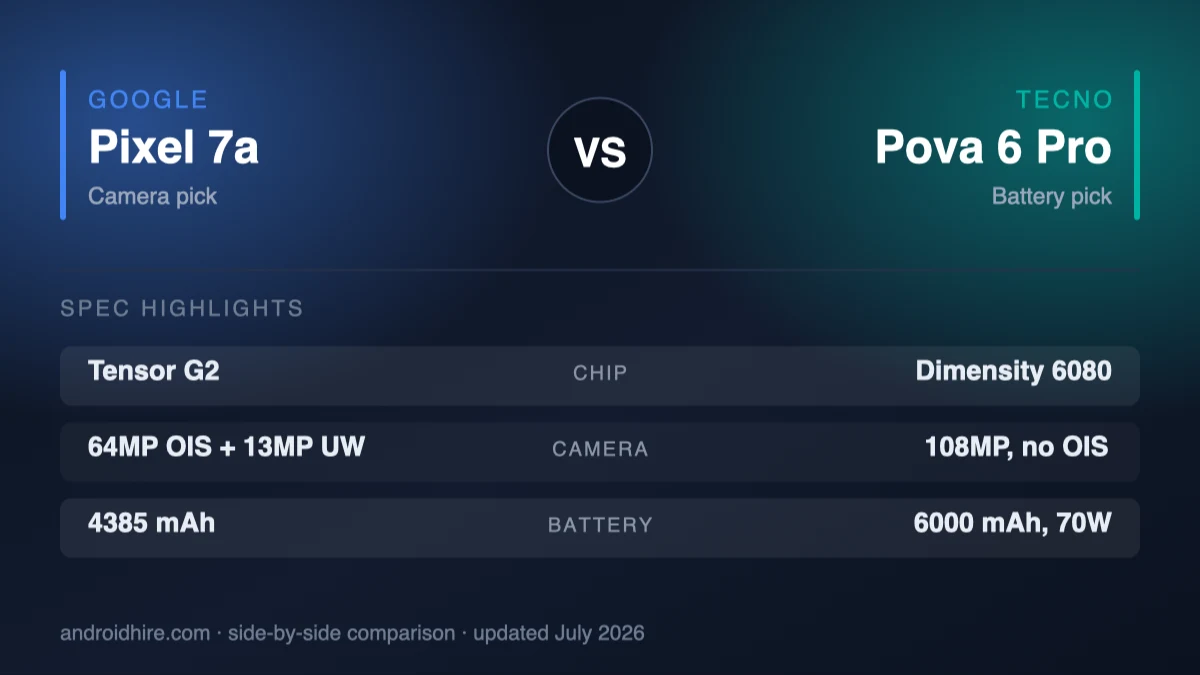
Buy the Google Pixel 7a if photos matter most — its 64MP stabilised camera and Google's processing beat anything Tecno sells, and it gets security patches into 2028. Buy the Tecno Pova 6 Pro if battery life and screen size matter most: 6,000mAh, 70W charging and a 6.78-inch 120Hz AMOLED for roughly half the price. This is not a matchup of equals. It is a straight choice between the best cheap camera and the best cheap battery.
In a hurry? Jump to → Quick verdict · Full spec comparison · Display · Performance · Cameras · Battery & charging · Updates · Buying gotchas · How we compared · FAQ
These two phones almost never appear on the same shopping list, which is exactly why the comparison is useful. The Pixel 7a launched in May 2023 at $499 and now sells used and refurbished for far less. The Tecno Pova 6 Pro launched in March 2024 at around ₹19,999 (~$230) and targets people who want a huge screen and battery for the least money. If you are weighing them against each other, you are really asking one question: is a much better camera worth giving up half a day of battery?
Quick verdict: Pixel 7a vs Tecno Pova 6 Pro
Choose the Pixel 7a if you photograph people, pets, food or anything after sunset. You also get clean Android with no bloatware, Google's call screening and Magic Eraser tools, wireless charging, IP67 water resistance and security patches until roughly May 2028.
Choose the Tecno Pova 6 Pro if you watch a lot of video, game casually, travel without a charger or simply hate charging. Its 6,000mAh battery, 70W charging, 6.78-inch AMOLED and 3.5mm headphone jack cover the practical basics far better.
The honest framing: the Pixel is the better phone, the Pova is the better deal.
Who wins what, category by category
| Category | Winner | Why it wins |
|---|---|---|
| Cameras | Pixel 7a | OIS, real ultrawide, Google image processing |
| Battery life | Tecno Pova 6 Pro | 6,000mAh vs 4,385mAh |
| Charging speed | Tecno Pova 6 Pro | 70W (~45 min) vs ~18W (~100 min) |
| Screen size | Tecno Pova 6 Pro | 6.78in 120Hz AMOLED vs 6.1in 90Hz |
| Performance | Pixel 7a | Tensor G2 leads the Dimensity 6080 clearly |
| Software | Pixel 7a | Clean Android, 5 years of patches, no bloat |
| Durability | Pixel 7a | IP67 vs IP53 |
| Wireless charging | Pixel 7a | 7.5W Qi; the Pova has none |
| Price | Tecno Pova 6 Pro | Roughly half the money |
Score: Pixel 7a 5 – Tecno Pova 6 Pro 4. Close on points, but the categories are not equal — decide which four matter to you.
Pixel 7a vs Tecno Pova 6 Pro: full spec comparison
| Specification | Google Pixel 7a | Tecno Pova 6 Pro |
|---|---|---|
| Released | May 2023 | March 2024 |
| Launch price | $499 | ~₹19,999 (~$230) |
| Display | 6.1" OLED | 6.78" AMOLED |
| Resolution | 1080 x 2400 | 1080 x 2436 |
| Refresh rate | 90Hz | 120Hz |
| Peak brightness | ~1,000 nits | ~1,300 nits |
| Processor | Google Tensor G2 (5nm) | MediaTek Dimensity 6080 (6nm) |
| RAM | 8GB | 8 / 12GB |
| Storage | 128GB, no microSD | 256GB + microSD |
| Main camera | 64MP with OIS | 108MP, no OIS |
| Ultrawide | 13MP (120°) | ✖ None (2MP depth instead) |
| Front camera | 13MP | 32MP with dual LED flash |
| Max video | 4K at 60fps | 1440p at 30fps |
| Battery | 4,385 mAh | 6,000 mAh |
| Wired charging | ~18W | 70W |
| Wireless charging | ✔ 7.5W | ✖ No (10W reverse wired) |
| Water resistance | IP67 | IP53 |
| Headphone jack | ✖ No | ✔ Yes |
| Extras | Face Unlock, Google AI features | IR blaster, FM radio, stereo speakers |
| Launched on | Android 13 | HiOS 14 / Android 14 |
| Security support until | ~May 2028 | ~2026 |
| Weight | ~193 g | ~198 g |
Display: bigger and faster vs smaller and calibrated
The Pova 6 Pro wins on paper — 6.78 inches, 120Hz, AMOLED, brighter. It is the better screen for video, games and reading, and the 120Hz refresh makes scrolling look smoother than the Pixel's 90Hz.
The Pixel 7a's 6.1-inch panel wins on two things a spec table cannot show: colour accuracy out of the box, and one-handed usability. If you have ever fumbled a large phone on public transport, that 6.1-inch body is a feature, not a compromise.
- Watching video and gaming: Pova 6 Pro.
- Photo editing and colour accuracy: Pixel 7a.
- Using it one-handed: Pixel 7a, easily.
Performance: Tensor G2 vs Dimensity 6080
Google's Tensor G2 is a mid-tier chip by 2026 standards, but it is well ahead of the Dimensity 6080, and its dedicated image and machine-learning blocks are what make the Pixel's camera and voice features work. The Pova 6 Pro's Dimensity 6080 is an efficiency-focused 6nm chip designed to keep costs down.
| Benchmark (approximate) | Pixel 7a | Tecno Pova 6 Pro |
|---|---|---|
| Geekbench 6 single-core | ~1,050 | ~570 |
| Geekbench 6 multi-core | ~2,900 | ~1,750 |
| AnTuTu v10 total | ~750,000 | ~400,000 |
| Heavy gaming | Medium settings, stable | Low settings |
Benchmark figures are typical published ranges from public test databases rather than our own runs — read them as a class gap, not an exact score for your unit.
One caveat that goes the other way: the Tensor G2 runs warm. Long camera sessions or 4K recording can make the Pixel 7a noticeably hot, and it will throttle. The Pova's cooler chip is less capable but more consistent.
Also Read: Pixel tips and tricks worth knowing
Cameras: this is why the Pixel costs more
Google Pixel 7a camera
- 64MP main sensor with optical stabilisation, output binned to 16MP
- 13MP ultrawide with a 120° field of view
- 13MP selfie camera, 4K/60 video on the rear
- Night Sight, Real Tone, Magic Eraser and Photo Unblur in Google Photos
Tecno Pova 6 Pro camera
- 108MP main sensor without optical stabilisation, with a cropped 3x mode
- 2MP depth helper plus an auxiliary lens — no true ultrawide
- 32MP selfie camera with dual-tone flash
- Video capped at 1440p/30, so no 4K
Megapixels mislead here. The Pova's 108MP sensor captures more pixels, but without stabilisation and with weaker processing the results are softer, and low-light shots show visible noise and motion blur. The Pixel 7a's advantage is not the sensor at all — it is Google's processing pipeline, which is still the best in this price class. It also has a real ultrawide, which the Pova simply lacks.
If you take photos of moving children or pets indoors, this section decides the comparison on its own.
Battery and charging: this is why the Pova exists
The Pixel 7a's 4,385mAh battery is its weakest spec. It gets through a normal day, but heavy camera use, navigation or gaming will have you charging by evening — and at about 18W, a full charge takes well over an hour and a half. Wireless charging at 7.5W is a convenience, not a solution.
The Pova 6 Pro's 6,000mAh cell routinely runs a day and a half, and its 70W charger refills it in around 45 minutes. It also does 10W reverse wired charging, so it can top up earbuds. For anyone who travels, commutes long distances or forgets chargers, this gap is felt every single day.
Software and updates: clean Android vs HiOS
The Pixel 7a runs stock Android with no duplicate apps and no advertising, and it received Google's three-year OS upgrade commitment plus five years of security patches — support to roughly May 2028. Feature Drops also add functions after launch, which almost no budget phone gets.
The Pova 6 Pro runs HiOS 14 on Android 14. HiOS is fast and has genuinely useful extras (an IR blaster app, a proper game mode), but it preloads recommendation apps and pushes notifications you will want to switch off. Tecno's update policy is short — expect its security patches to be finished around 2026, which is the strongest argument against buying one today.
Which one should you buy?
Buy the Pixel 7a if: photos and videos of people matter to you, you want clean software and years of patches, you prefer a compact phone, or you want wireless charging and IP67 protection.
Buy the Tecno Pova 6 Pro if: you want maximum battery and screen for minimum money, you charge in a hurry, you use a headphone jack or microSD card, and your photography is mostly daylight snapshots.
Consider a third option if: you want the Pixel camera and the Pova battery. A current-generation Pixel A-series or a Dimensity 8000-class mid-ranger gets you closer to both — see Poco X7 Pro compared for that tier.
What the spec-comparison sites won't tell you
- The Pixel 7a's security window is the real clock. Patches end around May 2028. A phone you buy in 2026 has two years of safety left, not five — price it accordingly.
- Tecno's 108MP mode is not the default. Out of the box the camera shoots binned 12MP files. The full-resolution mode needs good light and a steady hand, and most people will never use it.
- Neither is great for 4K video. The Pova cannot shoot 4K at all; the Pixel can, but heats up doing it. If video is your priority, budget higher.
- Check regional model support. The Pova 6 Pro's 5G band selection varies by market, and Tecno's carrier certification in the US and Europe is limited — a factor if you are importing.
How we compared these phones
We worked from Google's and Tecno's official specification sheets, then cross-checked display brightness, charging times and battery endurance against published independent lab tests, including GSMArena's Pova 6 Pro review measurements and Google's own published update-support schedule. We deliberately resisted the megapixel comparison that dominates automated spec pages: a 108MP sensor without stabilisation is not better than a 64MP sensor with it, and the difference shows up in exactly the conditions people photograph most — indoors and at night. Charging figures are manufacturer ratings verified against reviewer timings, and support windows come from each company's stated policy, not estimates.
Related reading
Bottom line
Pixel 7a vs Tecno Pova 6 Pro is camera versus battery, and both sides win convincingly. The Pixel 7a takes clearly better photos, runs cleaner software, lasts longer in support terms and fits one hand. The Tecno Pova 6 Pro costs about half as much, lasts a day and a half, charges in 45 minutes and gives you a bigger, smoother screen. Photographers should buy the Pixel. Everyone who resents charging their phone should buy the Pova.
Specifications, software versions and street prices in this comparison were checked in July 2026. We revisit head-to-head guides whenever either phone gets a major OS update or a lasting price change.
Next step: browse every matchup on our phone comparisons hub, or open full spec sheets in the phone specifications directory.
Frequently Asked Questions
Which takes better photos, the Pixel 7a or the Tecno Pova 6 Pro?
The Pixel 7a, by a wide margin. Its 64MP main camera has optical stabilisation and Google's computational processing, and it also has a real 13MP ultrawide. The Pova 6 Pro's 108MP sensor produces higher-resolution files but softer, noisier images, especially indoors and at night.
Does the Tecno Pova 6 Pro have better battery life?
Yes, clearly. Its 6,000mAh battery is roughly 37% larger than the Pixel 7a's 4,385mAh cell, and it charges at 70W versus about 18W. Expect a day and a half from the Pova against a single day from the Pixel.
Is the Pixel 7a still getting updates in 2026?
Yes. Google shipped it with three years of OS upgrades and five years of security patches from its May 2023 launch, so security support runs to around May 2028. Tecno commits to far less — typically two OS upgrades and two years of patches.
Which phone is faster?
The Pixel 7a. Its Tensor G2 posts roughly 40–50% higher multi-core scores than the Pova 6 Pro's Dimensity 6080, and it holds up better in demanding games. The Pova is fine for casual titles and video.
Does the Pixel 7a have wireless charging?
Yes, at 7.5W — slow, but useful for overnight charging on a pad. The Tecno Pova 6 Pro has no wireless charging, though its 70W wired charging more than compensates in speed.
Which has the bigger screen?
The Tecno Pova 6 Pro, with a 6.78-inch FHD+ AMOLED at 120Hz. The Pixel 7a uses a 6.1-inch OLED at 90Hz, which many people prefer for one-handed use.
Which one is better value in 2026?
It depends on your priority. The Pova 6 Pro costs roughly half as much and wins on battery, charging and screen size. The Pixel 7a costs more but delivers a genuinely better camera, cleaner software and three extra years of security patches.