Oppo Reno13 256GB vs realme P3 Pro (2026): Which Mid-Ranger Is Worth It?

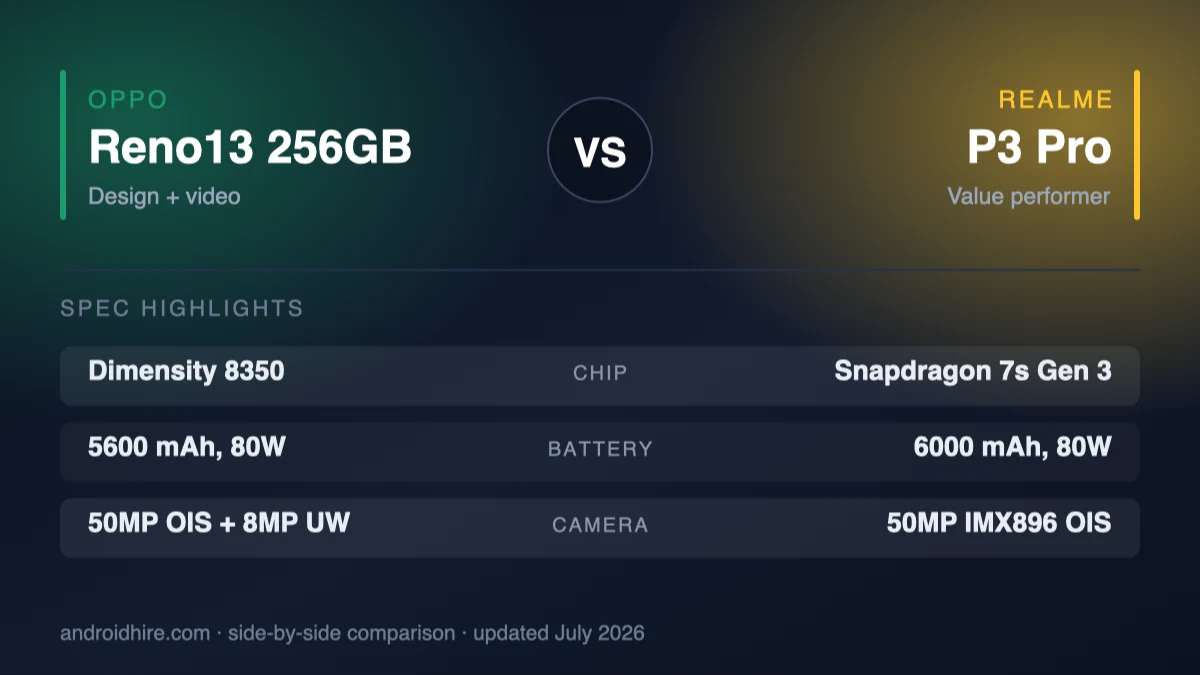
Buy the realme P3 Pro if value is the point: 6,000mAh, 80W charging, a 6.83-inch quad-curved OLED and IP69 durability for around ₹23,000 (~$270). Buy the Oppo Reno13 256GB if you want the better cameras, the faster chip and the more refined build, and you can absorb roughly double the price. Both are 2024–25 mid-rangers still on sale in 2026, and they overlap far more than their prices suggest.
In a hurry? Jump to → Quick verdict · Full spec comparison · Display · Performance · Cameras · Battery & charging · Updates · Buying gotchas · How we compared · FAQ
Here is what makes this pairing interesting: these phones come from the same corporate family (both Oppo and realme sit under BBK Electronics), so they share a lot of engineering — the same 80W charging architecture, similar IP69 sealing, similar ColorOS-derived software. The differences are deliberate product positioning, not capability gaps. Knowing that changes how you read the spec sheet: you are not comparing two philosophies, you are comparing two price points inside one design language.
Quick verdict: Oppo Reno13 vs realme P3 Pro
Choose the Oppo Reno13 if you shoot a lot of photos and video. It has an ultrawide lens, a 50MP autofocus front camera, 4K/60 recording on both sides and the faster Dimensity 8350. It is also the slimmer, lighter, better-finished phone at 181g.
Choose the realme P3 Pro if you want the most phone per rupee. A 6,000mAh battery, an enormous 6.83-inch curved OLED with roughly 1,500 nits of local peak brightness, the same 80W charging and the same IP69 rating — at a price the Reno13 cannot approach.
Straight answer: most people should buy the P3 Pro. Buy the Reno13 if cameras are the reason you are upgrading.
Who wins what, category by category
| Category | Winner | Why it wins |
|---|---|---|
| Price | realme P3 Pro | Roughly half the Reno13's street price |
| Performance | Oppo Reno13 | Dimensity 8350 leads the Snapdragon 7s Gen 3 |
| Battery capacity | realme P3 Pro | 6,000mAh vs 5,600mAh, plus bypass charging |
| Charging | Draw | Both 80W wired, both around 45 minutes |
| Cameras | Oppo Reno13 | Ultrawide lens plus a 50MP autofocus selfie |
| Video | Oppo Reno13 | 4K/60 front and rear |
| Screen size | realme P3 Pro | 6.83in curved OLED, ~1,500 nits local peak |
| Screen sharpness | Oppo Reno13 | 1256 x 2760 vs 1080p |
| Durability | Draw | Both IP68/IP69 rated |
| Build quality | Oppo Reno13 | 181g, slimmer, more premium finish |
Score: Reno13 5 – P3 Pro 3, with 2 draws. The Oppo wins more categories; the realme wins the one most people budget around.
Oppo Reno13 vs realme P3 Pro: full spec comparison
| Specification | Oppo Reno13 (256GB) | realme P3 Pro |
|---|---|---|
| Announced | November 2024 | February 2025 |
| Typical price | ~£505 / ~$610 | ~₹23,000 / ~$270 |
| Display | 6.59" AMOLED | 6.83" quad-curved OLED |
| Resolution | 1256 x 2760 | 1080 x 2400 (FHD+) |
| Refresh rate | 120Hz | 120Hz |
| Peak brightness | ~1,200 nits | ~1,500 nits (local peak) |
| Cover glass | Gorilla Glass 7i | Gorilla Glass 7i |
| Processor | Dimensity 8350 (4nm) | Snapdragon 7s Gen 3 (4nm) |
| RAM | 8 / 12 / 16GB | 8 / 12GB |
| Storage | 256GB / 512GB / 1TB | 128 / 256GB |
| Main camera | 50MP f/1.8 with OIS | 50MP IMX896 with OIS |
| Ultrawide | 8MP | ✖ None (2MP depth) |
| Front camera | 50MP with autofocus | 16MP |
| Max video | 4K at 60fps (front and rear) | 4K at 30fps |
| Battery | 5,600 mAh | 6,000 mAh |
| Wired charging | 80W SuperVOOC | 80W, plus bypass charging |
| Water resistance | IP68 / IP69 | IP68 / IP69 |
| Cooling | Vapour chamber | 6,050mm² vapour chamber |
| Launched on | ColorOS 15 / Android 15 | realme UI 6.0 / Android 15 |
| Weight | ~181 g | ~194 g |
Display: sharper vs bigger and brighter
The Reno13's 6.59-inch panel has the higher resolution — 1256 x 2760 works out sharper than the P3 Pro's 1080p — so text and fine detail look crisper. It is also the easier phone to hold.
The P3 Pro answers with size and brightness: 6.83 inches of quad-curved OLED with a local peak around 1,500 nits, which makes HDR video punchier and outdoor reading easier. Curved edges are divisive — they look premium and can cause accidental touches.
- Reading and one-handed use: Reno13.
- Video, gaming, outdoor brightness: P3 Pro.
- Both: 120Hz, 10-bit colour, in-display fingerprint sensor, Gorilla Glass 7i.
Performance: Dimensity 8350 vs Snapdragon 7s Gen 3
The Reno13's Dimensity 8350 sits a clear tier above the P3 Pro's Snapdragon 7s Gen 3. In practice that means higher frame rates in demanding games and better sustained performance under load, not a difference you will notice launching WhatsApp.
| Benchmark (approximate) | Oppo Reno13 | realme P3 Pro |
|---|---|---|
| Geekbench 6 single-core | ~1,250 | ~1,150 |
| Geekbench 6 multi-core | ~4,000 | ~3,200 |
| AnTuTu v10 total | ~1,400,000 | ~830,000 |
| Heavy gaming | High settings | Medium-high settings |
Benchmark figures are typical published ranges from public test databases rather than our own runs — read them as a class gap, not an exact score for your unit.
Both phones use large vapour chambers, and the P3 Pro's is the bigger of the two at 6,050mm² — one reason it holds frame rates better than its raw scores suggest. The P3 Pro's bypass charging also helps: while gaming plugged in, power goes to the phone rather than through the battery, so it runs cooler.
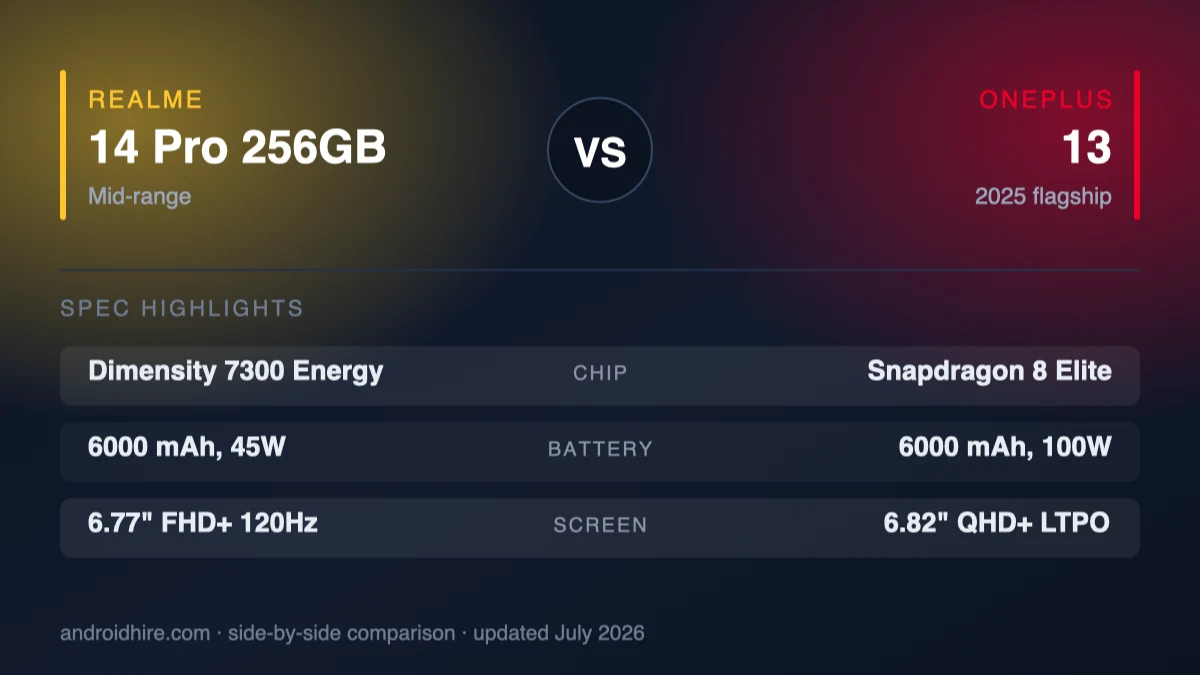
Also Read: realme 14 Pro vs OnePlus 13
Cameras: the clearest reason to pay more
Oppo Reno13 camera
- 50MP main with OIS (f/1.8)
- 8MP ultrawide — a genuine second focal length
- 50MP autofocus front camera, which is rare at any price
- 4K/60 video on both front and rear cameras
realme P3 Pro camera
- 50MP Sony IMX896 main with OIS — a genuinely good sensor
- 2MP depth helper, so no ultrawide
- 16MP fixed-focus front camera
- 4K/30 video from the main camera
For single-lens daylight shots the two are closer than the price gap implies — the P3 Pro's IMX896 is a strong sensor. The Reno13 pulls ahead in three specific situations: wide landscape or group shots (it has the ultrawide), selfies and vlogging (50MP with autofocus versus 16MP fixed), and smooth 4K/60 video. If you record yourself for social media, that difference alone justifies the Oppo.
Battery and charging: realme by a nose
6,000mAh versus 5,600mAh is a modest 7% capacity advantage, and both charge at 80W to roughly full in about 45 minutes. The P3 Pro's extra edge is bypass charging for gaming, plus a lower-resolution screen that draws slightly less power.
In practice both are comfortable day-and-a-half phones. Neither supports wireless charging — a reminder that these are mid-rangers regardless of their flagship-grade IP69 ratings.
Software and updates
Both launched on Android 15 — ColorOS 15 on the Reno13, realme UI 6.0 on the P3 Pro — and the two skins are close relatives, so the experience feels similar right down to gesture behaviour. Both preload more apps than you want; both let you remove most of them.
Oppo generally commits to a longer window on Reno-series phones than realme does on P-series value models, which matters if you keep phones four years or more. Check the exact commitment for your market before buying, because both companies vary their policy by region — a detail no comparison table will show you.
Which one should you buy?
Buy the Oppo Reno13 if: you shoot photos and video regularly, you want an ultrawide lens and a high-quality selfie camera, you prefer a lighter and slimmer body, or you play the most demanding games.
Buy the realme P3 Pro if: you want the best value in this class, you prioritise battery and screen size, you game plugged in and want bypass charging, or you simply cannot justify paying double for cameras you rarely use.
What the spec-comparison sites won't tell you
- Reno13 pricing varies wildly by region. It sells in Europe at a premium and much closer to the P3 Pro in Asian markets. Check your local price before assuming the gap is double.
- "Triple camera" on the Reno13 is really two. The third module is an auxiliary lens, not a lens you will choose. Same story with the P3 Pro's 2MP depth sensor.
- Curved screens cost more to repair. The P3 Pro's quad-curved panel is more expensive to replace than the Reno13's flatter display, and harder to fit with cheap screen protectors.
- IP69 does not mean swim-proof. It certifies resistance to high-pressure jets, not prolonged submersion in salt water or pools, and liquid damage is usually excluded from warranty on both.
How we compared these phones
We used Oppo's and realme's official specification sheets, cross-checked against independent lab measurements — GSMArena's Reno13 review for display and charging data in particular — and reconciled the differences rather than averaging them. Two points needed care. First, camera counts: both phones advertise more rear lenses than they have usable focal lengths, so we counted only lenses you would deliberately switch to. Second, price: the Reno13's street price swings substantially between Europe and Asia, so we have quoted a range rather than pretending a single figure applies everywhere. Benchmark figures come from published databases, and battery claims from manufacturer ratings verified against reviewer timings.
Related reading
Bottom line
Oppo Reno13 vs realme P3 Pro is a family argument, not a rivalry — same charging tech, same IP69 sealing, same Android 15 roots. The Reno13 earns its premium with a sharper screen, the faster Dimensity 8350, an ultrawide lens, a 50MP autofocus selfie camera and 4K/60 video. The realme P3 Pro gives you a bigger, brighter screen, a larger 6,000mAh battery with bypass charging and the same durability for roughly half the price. Buy the Oppo for cameras. Buy the realme for everything else.
Specifications, software versions and street prices in this comparison were checked in July 2026. We revisit head-to-head guides whenever either phone gets a major OS update or a lasting price change.
Next step: browse every matchup on our phone comparisons hub, or open full spec sheets in the phone specifications directory.
Frequently Asked Questions
Which is faster, the Oppo Reno13 or the realme P3 Pro?
The Oppo Reno13. Its Dimensity 8350 is a step above the P3 Pro's Snapdragon 7s Gen 3 — expect roughly 25–35% higher multi-core performance and clearly better sustained gaming. For everyday apps both feel equally quick.
Does the realme P3 Pro have a bigger battery?
Yes. The P3 Pro carries 6,000mAh against the Reno13's 5,600mAh, and both charge at 80W. The realme also supports bypass charging, which routes power straight to the phone while gaming to keep temperatures down.
Which one has the better camera?
The Reno13. Both use a 50MP main sensor with OIS, but Oppo adds an 8MP ultrawide, a 50MP autofocus selfie camera and 4K/60 video on both sides. The P3 Pro pairs its 50MP main with only a 2MP depth helper.
Are both phones water resistant?
Yes, and unusually well for the price — both carry IP68/IP69 ratings, meaning they resist dust, immersion and high-pressure water jets. That is flagship-grade protection on a mid-range phone.
Which screen is better?
It depends what you want. The Reno13's 6.59-inch panel is sharper at 1256 x 2760, while the P3 Pro's 6.83-inch quad-curved OLED is bigger and hits a higher local peak brightness of around 1,500 nits. Both run at 120Hz.
Is the realme P3 Pro good for gaming?
Yes, for most titles. The Snapdragon 7s Gen 3 plus a large vapour chamber handles popular games well at medium-to-high settings, and bypass charging helps on long sessions. The Reno13 is the better choice for the most demanding games.
Which offers better value in 2026?
The realme P3 Pro, on pure price-to-spec. It delivers about 85% of the Reno13 experience — same charging speed, bigger battery, same durability rating — for well under half the money. Pay the Oppo premium only for its cameras, build and video.