Sharp Aquos sense8 vs Poco X7 Pro (2026): Compact Japan Phone or Global Speed?

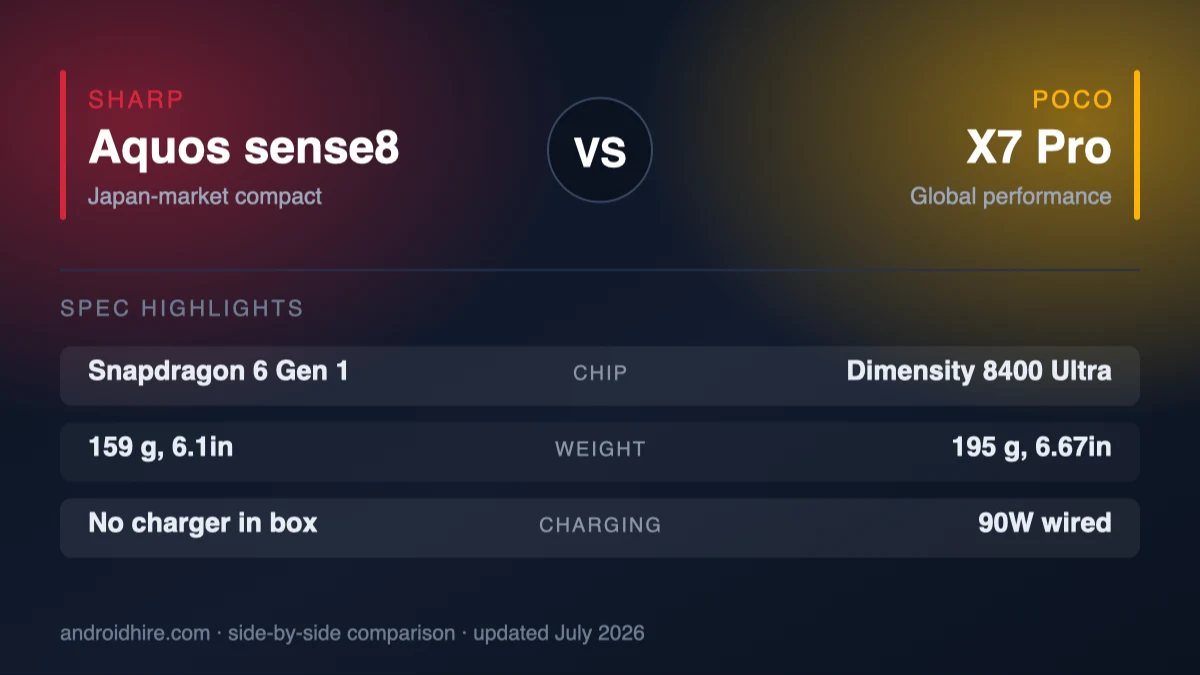
Buy the Poco X7 Pro if you want the most capable phone: Dimensity 8400 Ultra performance, a 6,000mAh battery with 90W charging, a 3,200-nit 120Hz AMOLED and IP68 sealing for around $330. Buy the Sharp Aquos sense8 only if you specifically want a light, compact phone — 159g, 6.1 inches, with a headphone jack, a microSD slot and military-grade durability. One is the better phone. The other is the only phone of its kind.
In a hurry? Jump to → Quick verdict · Full spec comparison · Display · Performance · Cameras · Battery & charging · Updates · Buying gotchas · How we compared · FAQ
This is a rare comparison, and it exists because of a gap in the market rather than a rivalry. The Sharp Aquos sense8 (January 2024) is a Japan-only phone built around priorities most brands abandoned: low weight, one-handed size, expandable storage, a headphone jack, and a display tuned for efficiency rather than headline brightness. The Poco X7 Pro (January 2025) is the global mainstream answer — bigger, heavier, far faster, much better value. If you are comparing them, you already suspect the Poco wins on paper and are wondering whether the Sharp's compactness is worth it.
Quick verdict: Aquos sense8 vs Poco X7 Pro
Choose the Sharp Aquos sense8 if you genuinely dislike large phones. At 159g and 6.1 inches it is one of the few modern Androids you can use comfortably with one hand, and it keeps a 3.5mm jack, microSD expansion, MIL-STD-810H shock certification and Sharp's power-sipping IGZO OLED.
Choose the Poco X7 Pro if you want value and capability. More than double the performance, a bigger and much brighter screen, a 6,000mAh battery, 90W charging, IP68 sealing and global warranty support — for less money than an imported Sharp.
For most readers this is straightforward: buy the Poco. The Sharp exists for the minority who want a small phone and are willing to pay for one.
Who wins what, category by category
| Category | Winner | Why it wins |
|---|---|---|
| Performance | Poco X7 Pro | Dimensity 8400 Ultra more than doubles the Sharp |
| Battery capacity | Poco X7 Pro | 6,000mAh (6,550 in India) vs 5,000mAh |
| Charging | Poco X7 Pro | 90W refills in ~40 min; Sharp has no fast charging |
| Screen brightness | Poco X7 Pro | ~3,200 nits peak vs a dimmer IGZO panel |
| Size and weight | Sharp Aquos sense8 | 159g and 6.1in vs 195g and 6.67in |
| Headphone jack | Sharp Aquos sense8 | 3.5mm jack plus USB-C DisplayPort |
| Expandable storage | Sharp Aquos sense8 | microSD slot; the Poco has none |
| Durability | Draw | MIL-STD-810H on Sharp, IP68 on Poco |
| Availability | Poco X7 Pro | Sold globally with local warranty |
| Value | Poco X7 Pro | Cheaper and far better specified |
Score: Poco X7 Pro 6 – Sharp Aquos sense8 3, with 1 draw. The Sharp's three wins are all about physical form, which no benchmark measures.
Sharp Aquos sense8 vs Poco X7 Pro: full spec comparison
| Specification | Sharp Aquos sense8 | Poco X7 Pro |
|---|---|---|
| Announced | January 2024 (Japan) | January 2025 (global) |
| Typical price | ~¥55,000 (~$380 imported) | ~$330 / ₹27,999 |
| Display | 6.1" IGZO OLED | 6.67" AMOLED |
| Resolution | 1080 x 2432 | 1220 x 2712 (1.5K) |
| Refresh rate | 1–90Hz variable | 120Hz |
| Peak brightness | ~1,300 nits | ~3,200 nits |
| Cover glass | Gorilla Glass Victus | Gorilla Glass 7i |
| Processor | Snapdragon 6 Gen 1 (4nm) | Dimensity 8400 Ultra (4nm) |
| RAM | 8GB | 8 / 12GB LPDDR5X |
| Storage | 256GB + microSD | 256 / 512GB UFS 4.0, no microSD |
| Main camera | 50MP with OIS | 50MP with OIS |
| Ultrawide | 8MP | 8MP |
| Front camera | 8MP | 20MP |
| Battery | 5,000 mAh | 6,000 mAh (6,550 in India) |
| Wired charging | Modest — no charger included | 90W (~40 min) |
| Water resistance | IP68 + MIL-STD-810H | IP68 |
| Headphone jack | ✔ Yes | ✖ No |
| Launched on | Android 13 | HyperOS 2 / Android 15 |
| Weight | ~159 g | ~195 g |
The Aquos sense8 is a Japanese-market phone. Prices outside Japan reflect import costs, and 5G band support may not match your carrier.
Display: efficiency vs brightness
Sharp makes its own IGZO panels, and their advantage is power draw rather than peak numbers: the sense8 varies from 1Hz to 90Hz and uses very little energy on static screens, which is how a 5,000mAh battery stretches so far in a small body. Colour accuracy is good, and 6.1 inches at 1080p is sharp.
The Poco X7 Pro simply overwhelms it on specification — a 6.67-inch 1.5K panel at 120Hz with about 3,200 nits of peak brightness. Outdoors in strong sun there is no contest, and 120Hz is visibly smoother than 90Hz.
- Outdoors and gaming: Poco X7 Pro.
- One-handed use and pocketability: Aquos sense8.
- Battery efficiency per inch: Aquos sense8's IGZO.
Performance: not remotely close
The Aquos sense8's Snapdragon 6 Gen 1 is an upper-entry chip. It is smooth for messaging, maps, video and light games, and it stays cool — Sharp tuned this phone for reliability, not speed.
The Poco X7 Pro's Dimensity 8400 Ultra is an eight-core Cortex-A725 design that outperforms some previous-generation flagship chips.
| Benchmark (approximate) | Sharp Aquos sense8 | Poco X7 Pro |
|---|---|---|
| Geekbench 6 single-core | ~950 | ~1,450 |
| Geekbench 6 multi-core | ~2,700 | ~6,200 |
| AnTuTu v10 total | ~580,000 | ~1,600,000 |
| Heavy gaming | Low settings | High settings, stable |
Benchmark figures are typical published ranges from public test databases rather than our own runs — read them as a class gap, not an exact score for your unit.
For context, the Dimensity 8400 Ultra's multi-core score sits above the Snapdragon 8 Gen 2 that powered 2023 flagships. That is a lot of performance for $330, and it is the single strongest argument for the Poco.
Also Read: Poco F6 Pro vs Xiaomi 15 Ultra
Cameras: closer than everything else
Sharp Aquos sense8 camera
- 50MP main sensor (1/1.55-inch) with OIS and a native 2x crop mode
- 8MP ultrawide
- 8MP selfie camera
- Sharp's processing favours natural, restrained colour
Poco X7 Pro camera
- 50MP main with OIS
- 8MP ultrawide
- 20MP selfie camera
- 4K video with better stabilisation, plus Xiaomi's AI processing tools
On hardware these are near-identical two-lens setups, and the Sharp's relatively large 1/1.55-inch main sensor with OIS holds its own in daylight. The Poco wins on video (better stabilisation and processing) and on selfies (20MP against 8MP). Neither has optical zoom, so for photography this is the one category where the two phones are genuinely comparable.
Battery and charging: Poco, decisively
The Aquos sense8 gets impressive endurance from 5,000mAh thanks to its efficient IGZO screen and modest chip — Sharp designed it to reach a second day for light users. But charging is slow, and no charger is included in the box.
The Poco X7 Pro carries 6,000mAh globally and 6,550mAh in India, plus 90W charging that fills it in about 40 minutes, with Xiaomi rating the cell for 90% capacity after 1,000 cycles. It lasts longer and recovers faster — a rare combination at this price.
Software and updates
The Aquos sense8 launched on Android 13 with a light Sharp skin and a short update commitment typical of Japanese-market phones — a couple of OS upgrades at most. Its interface is clean and free of the promotional clutter common at this price.
The Poco X7 Pro launched on HyperOS 2 over Android 15, so it starts two full Android versions ahead and has a longer runway. HyperOS is feature-rich but ships with preinstalled apps and recommendation notifications you will want to turn off in the first ten minutes.
Which one should you buy?
Buy the Sharp Aquos sense8 if: a small, light phone is a real requirement rather than a preference; you want a headphone jack and microSD card; you value drop-tested MIL-STD durability; or you live in Japan where it is sold with warranty and carrier support.
Buy the Poco X7 Pro if: you want the fastest phone for the money, a brighter and smoother screen, much better battery and charging, and the simple reassurance of a global warranty.
Worth knowing: if compactness is the draw but importing puts you off, look at current small flagships instead — they cost more but are sold everywhere.
What the spec-comparison sites won't tell you
- Importing a Japanese phone has real costs. Beyond shipping and duty, some Japan-market units carry carrier software, and 5G band coverage may not match your network. Verify bands before ordering.
- Neither includes a charger in most markets. The Poco's 90W speed only happens with a 90W brick — budget for one or you are buying a slow-charging phone.
- The Poco has two battery versions. India gets 6,550mAh, most other regions 6,000mAh. Reviews quoting battery life may not describe the unit you buy.
- MIL-STD-810H is not the same as IP68. Sharp's certification covers shock, vibration and temperature — drops and rough handling — while IP68 covers dust and water. The Sharp has both; the Poco has only the latter.
How we compared these phones
We used Sharp's Japanese specification sheet and Xiaomi's global sheet, cross-checked against independent measurements from GSMArena's database and published reviews. Two things needed unusual care here. First, availability: the Aquos sense8 is not officially sold outside Japan, so its price is an import estimate and its band support varies — we say so rather than listing a clean global figure. Second, the Poco X7 Pro exists in two battery configurations, so we quote the global 6,000mAh figure and flag India's larger 6,550mAh cell separately instead of averaging them. Charging times are manufacturer ratings confirmed against reviewer timings, and benchmark numbers come from public databases as class indicators.
Related reading
Bottom line
Sharp Aquos sense8 vs Poco X7 Pro is specs versus shape. The Poco X7 Pro wins nearly every measurable category — more than double the multi-core performance, a brighter 120Hz 1.5K screen, a 6,000mAh battery with 90W charging, and a global warranty for less money. The Sharp Aquos sense8 wins the things a spec table cannot score: 159 grams, a genuinely one-handed 6.1-inch body, a headphone jack, microSD expansion and military-grade shock certification. Buy the Poco unless you want a small phone badly enough to import one.
Specifications, software versions and street prices in this comparison were checked in July 2026. We revisit head-to-head guides whenever either phone gets a major OS update or a lasting price change.
Next step: browse every matchup on our phone comparisons hub, or open full spec sheets in the phone specifications directory.
Frequently Asked Questions
Which phone is faster, the Aquos sense8 or the Poco X7 Pro?
The Poco X7 Pro, by a large margin. Its Dimensity 8400 Ultra scores around 6,200 in Geekbench 6 multi-core against roughly 2,700 for the Aquos sense8's Snapdragon 6 Gen 1 — more than double, and the gap in gaming is bigger still.
Why would anyone choose the Sharp Aquos sense8?
Size and practicality. At 159g with a 6.1-inch screen it is far easier to use one-handed than the 195g Poco, and it keeps a microSD slot, a 3.5mm headphone jack and MIL-STD-810H durability. Sharp's IGZO OLED is also excellent for battery efficiency.
Is the Sharp Aquos sense8 sold outside Japan?
Not officially. It is a Japan-market phone, so buying one elsewhere means importing, and you should check 5G band compatibility with your carrier before ordering. The Poco X7 Pro is sold globally with local warranty support.
How big is the battery difference?
Significant. The Poco X7 Pro's global model has 6,000mAh (6,550mAh in India) versus 5,000mAh on the Aquos sense8, and it charges at 90W against the Sharp's much slower rate. The Poco fills up in roughly 40 minutes.
Which has the better screen?
The Poco X7 Pro for brightness and smoothness — a 6.67-inch 1.5K AMOLED at 120Hz with about 3,200 nits peak. The Sharp's 6.1-inch IGZO OLED runs 1-90Hz and is superb for power efficiency and colour, just smaller and dimmer.
Do either of them have a headphone jack?
Only the Sharp Aquos sense8, which also keeps a microSD slot and USB-C DisplayPort output. The Poco X7 Pro has neither a headphone jack nor expandable storage.
Which is the better buy in 2026?
The Poco X7 Pro for almost everyone — it is faster, brighter, better sealed, charges much quicker and is sold globally with warranty. Choose the Aquos sense8 only if a genuinely light, compact phone with a headphone jack and microSD is what you actually want.