Lava Yuva Smart vs Poco X6 Pro (2026): ₹6,000 Phone vs ₹25,000 Phone

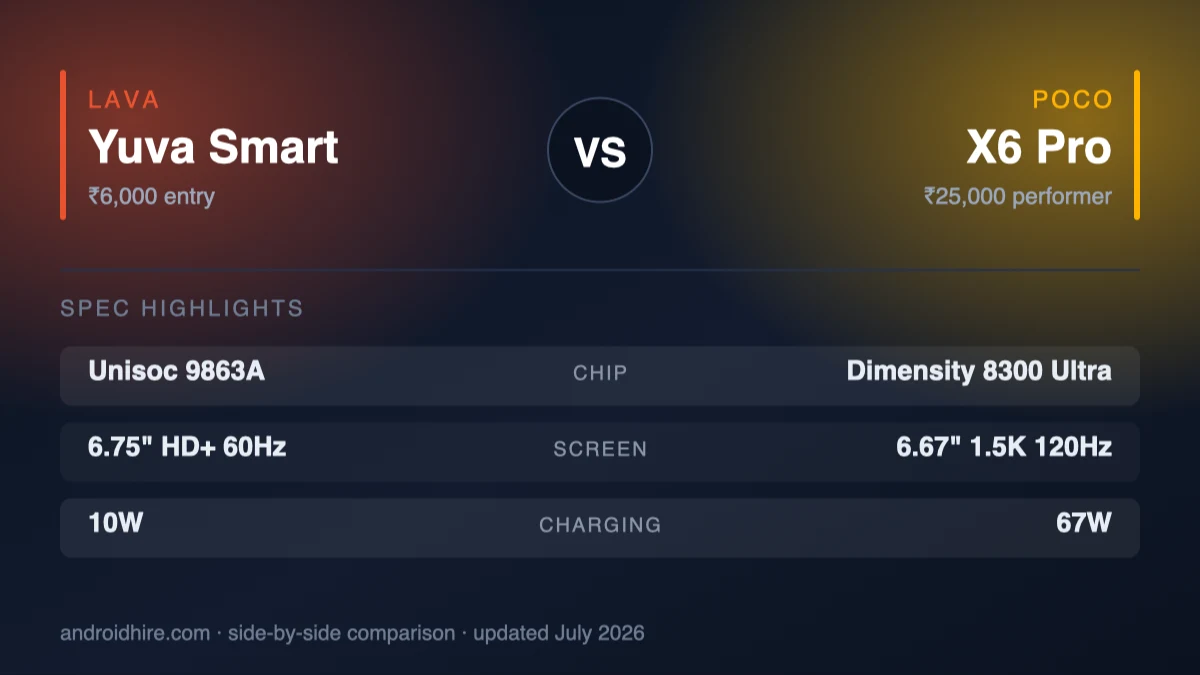
Buy the Poco X6 Pro if this is your main phone and you use it for anything beyond calls: a 6.67-inch 1.5K 120Hz AMOLED, Dimensity 8300 Ultra performance and 67W charging for around ₹25,000. Buy the Lava Yuva Smart if you need a working smartphone for ₹6,000 — calls, WhatsApp, UPI, YouTube and a 5,000mAh battery. Comparing them on specs is pointless. The real question is what "enough" means for you, and for a surprising number of buyers the ₹6,000 phone clears it.
In a hurry? Jump to → Quick verdict · Full spec comparison · Display · Performance · Cameras · Battery & charging · Updates · Buying gotchas · How we compared · FAQ
This pairing looks absurd on a spec table, which is exactly why it deserves a plain answer instead of a chart. These phones sit at opposite ends of the Indian market: the Yuva Smart is a ₹6,000 4G entry device on Android 14 Go, and the X6 Pro is a ₹25,000 performance phone with flagship-class silicon. Nobody is genuinely torn between them for the same use. What people actually want to know is whether spending four times more is necessary — so that is the question we have answered.
Quick verdict: Lava Yuva Smart vs Poco X6 Pro
Choose the Poco X6 Pro if you use your phone for social media, photography, gaming, video or long sessions of anything. Every part of the experience — screen, speed, camera, charging — is in a different class, and it will stay usable for years longer.
Choose the Lava Yuva Smart if the phone needs to make calls, run WhatsApp and UPI, and survive a day. It is a first phone, a spare, a phone for a parent or grandparent, or a work handset you would not mind losing.
Blunt version: the Poco is a smartphone, the Lava is a phone that runs apps. Both are the right answer to different questions.
Who wins what, category by category
| Category | Winner | Why it wins |
|---|---|---|
| Price | Lava Yuva Smart | ₹6,000 vs ₹25,000 — a quarter of the cost |
| Display | Poco X6 Pro | 1.5K 120Hz AMOLED vs HD+ 60Hz LCD |
| Performance | Poco X6 Pro | Dimensity 8300 Ultra is roughly 8x faster |
| Camera | Poco X6 Pro | 64MP OIS + ultrawide vs a single 13MP |
| Charging | Poco X6 Pro | 67W (~45 min) vs 10W (several hours) |
| Network | Poco X6 Pro | 5G vs 4G only |
| Battery life | Draw | Both 5,000mAh; the Lava's low-power screen evens it |
| Expandable storage | Lava Yuva Smart | microSD; the Poco has none |
| Repair cost | Lava Yuva Smart | Cheap to fix or replace outright |
Score: Poco X6 Pro 5 – Lava Yuva Smart 3, with 1 draw. Note what the Lava wins: cost of ownership, not capability.
Lava Yuva Smart vs Poco X6 Pro: full spec comparison
| Specification | Lava Yuva Smart | Poco X6 Pro |
|---|---|---|
| Launch price | ₹6,000 (~$70) | ~₹25,000 (~$300) |
| Display | 6.75" LCD | 6.67" AMOLED |
| Resolution | HD+ (720p class) | 1220 x 2712 (1.5K) |
| Refresh rate | 60Hz | 120Hz |
| Peak brightness | Modest — struggles outdoors | ~1,800 nits |
| Processor | Unisoc 9863A | Dimensity 8300 Ultra (4nm) |
| GPU | IMG8322 | Mali-G615 MC6 |
| RAM | 3GB | 8 / 12GB LPDDR5X |
| Storage | 64GB + microSD | 256 / 512GB UFS 4.0, no microSD |
| Main camera | 13MP | 64MP with OIS |
| Ultrawide | ✖ None | 8MP |
| Front camera | 5MP | 16MP |
| Battery | 5,000 mAh | 5,000 mAh |
| Wired charging | 10W | 67W |
| Network | 4G only | 5G |
| Launched on | Android 14 Go | HyperOS / Android 14 |
Android 14 Go is a lighter build of Android for phones with limited RAM. It runs slimmed-down versions of Google apps and caps some background activity.
Display: the difference you see immediately
The Yuva Smart's 6.75-inch HD+ LCD at 60Hz is the compromise that pays for everything else. Text looks soft, colours are flat, and in bright sunlight it is hard to read. For calls and WhatsApp it is perfectly serviceable.
The X6 Pro's 6.67-inch AMOLED runs 1.5K resolution at 120Hz with roughly 1,800 nits of peak brightness, plus Dolby Vision. It is a genuinely good screen by any standard, not just for the price.
- Video, gaming, reading: Poco X6 Pro, no contest.
- Outdoor use: Poco X6 Pro.
- Battery efficiency: the Lava's dimmer, lower-resolution panel uses less power — part of why 5,000mAh lasts well on it.
Performance: eight-fold, and it matters
The Unisoc 9863A is an entry-level chip designed for cost, not speed. With 3GB of RAM and Android 14 Go it handles messaging, calls, UPI and video — and it will stutter if you push past that.
The Dimensity 8300 Ultra is upper-mid-range silicon that outperforms some previous-generation flagship chips.
| Benchmark (approximate) | Lava Yuva Smart | Poco X6 Pro |
|---|---|---|
| Geekbench 6 single-core | ~180 | ~1,430 |
| Geekbench 6 multi-core | ~600 | ~4,500 |
| AnTuTu v10 total | ~110,000 | ~1,450,000 |
| Gaming | Light 2D titles only | High settings, stable 60fps |
Benchmark figures are typical published ranges from public test databases rather than our own runs — read them as a class gap, not an exact score for your unit.
These are not scores you split hairs over — they describe two different eras of hardware. What matters practically: the Yuva Smart will slow down as apps grow heavier over the next two years, while the X6 Pro has years of headroom.
Also Read: Redmi Note 14 Pro 5G vs Note 14 5G
Cameras: one lens vs a real system
Lava Yuva Smart camera
- 13MP main camera, no optical stabilisation
- 5MP front camera in a waterdrop notch
- Fine for documents, QR codes and daylight snapshots; poor indoors
Poco X6 Pro camera
- 64MP main with OIS and a 2x lossless in-sensor crop
- 8MP ultrawide, plus a 2MP macro
- 16MP selfie camera, 4K video
Nothing surprising here, but one point is worth making: the X6 Pro's OIS is the difference that matters most, not its megapixels. Optical stabilisation is what keeps indoor and evening photos sharp, and no ₹6,000 phone includes it.
Battery and charging: same capacity, different lives
Both carry 5,000mAh, and both last well — the Lava because its screen and chip sip power, the Poco because it is efficiently built. Light users get a day and a half from either.
Charging is where they part company completely. The X6 Pro's 67W refills it in about 45 minutes. The Yuva Smart's 10W charging takes several hours from empty, which in daily life means charging overnight and never topping up quickly before leaving the house.
Software and updates
The Yuva Smart runs Android 14 Go, a lighter Android build for low-RAM devices. Lava deserves genuine credit here: its software is close to stock with no bloatware and no ads, which is more than some ₹15,000 phones manage. Update support, however, is minimal — assume one OS upgrade at most.
The X6 Pro runs HyperOS over Android 14, with a longer support window and far more features — but also preinstalled apps and recommendation notifications you will want to switch off on day one.
Which one should you buy?
Buy the Poco X6 Pro if: it is your primary phone, you use social media and a camera, you game, you want 5G, or you want a phone that still feels fast in three years.
Buy the Lava Yuva Smart if: you need a working smartphone at the lowest price — a first phone, a spare, a device for an older relative, a second SIM handset, or a phone for a site or shop where damage is likely.
The middle path most people should consider: around ₹12,000–15,000 buys an entry 5G phone with an AMOLED screen and much better longevity. That tier is a large jump over the Yuva Smart for far less than the Poco — see Galaxy A23 5G vs Pova 6 Neo.
What the spec-comparison sites won't tell you
- 3GB of RAM is the real ceiling, not the chip. Android 14 Go manages it, but WhatsApp, a browser and a camera app together will reload constantly. It is why the Yuva Smart feels slow before it *is* slow.
- 4G-only in 2026 is a shrinking bet. Networks are shifting spectrum toward 5G, and coverage priorities follow. A 4G phone will work for years, but do not expect the best data experience.
- The Poco has no microSD slot. Buy the storage you need up front; the 256GB base model is the sensible minimum.
- 67W charging needs the right brick. If the bundled charger is missing from your region's box, a generic adapter will charge the X6 Pro far slower than advertised.
How we compared these phones
We used Lava's and Xiaomi's published specifications, cross-checked against GSMArena's Poco X6 Pro lab tests for display brightness and charging times, and GSMArena's launch coverage for the Yuva Smart's pricing and configuration. Because the price gap is so wide, we deliberately avoided the usual "the expensive phone wins everything" framing: the useful analysis is what each phone is *sufficient* for, so we weighted RAM ceiling, charging time and update runway — the three things that decide whether an entry phone stays usable — rather than listing spec deltas. Benchmark ranges are drawn from public databases and describe class rather than exact scores. Prices are July 2026 Indian street prices.
Related reading
Bottom line
Lava Yuva Smart vs Poco X6 Pro is not really a contest — it is a budget question. The Poco X6 Pro wins the screen (1.5K 120Hz AMOLED against HD+ 60Hz LCD), performance by roughly eightfold, the camera, 5G support and charging speed by a factor of six. The Lava Yuva Smart wins on the only axis it competes: ₹6,000, expandable storage, clean bloat-free software and a battery that lasts. If the phone is your main device, buy the Poco. If it only has to work, the Lava does the job for a quarter of the money — and there is nothing wrong with that.
Specifications, software versions and street prices in this comparison were checked in July 2026. We revisit head-to-head guides whenever either phone gets a major OS update or a lasting price change.
Next step: browse every matchup on our phone comparisons hub, or open full spec sheets in the phone specifications directory.
Frequently Asked Questions
How much cheaper is the Lava Yuva Smart?
About four times cheaper. It launched at ₹6,000 (roughly $70) for 3GB/64GB, while the Poco X6 Pro sits around ₹25,000 (roughly $300). They are not competitors so much as different categories of device.
Does the Lava Yuva Smart support 5G?
No. It is a 4G phone built on the Unisoc 9863A platform. If you want 5G at the lowest possible price, look at entry-level Dimensity 6300 phones instead — they cost more but are futureproof for network changes.
Is the Poco X6 Pro good for gaming?
Very. Its Dimensity 8300 Ultra outperforms some older flagship chips, and paired with UFS 4.0 storage it runs demanding titles at high settings. The Lava Yuva Smart cannot run those games at all.
What can the Lava Yuva Smart actually do well?
Calls, WhatsApp, UPI payments, YouTube at modest quality, maps and photos in good light. With 5,000mAh and a low-power screen it also lasts a long time. Android 14 Go is tuned for 3GB of RAM, so it stays usable within those limits.
Which has the better screen?
The Poco X6 Pro, by an enormous margin — a 6.67-inch 1.5K AMOLED at 120Hz and around 1,800 nits peak, against a 6.75-inch HD+ LCD at 60Hz. This is the single biggest difference between them.
Does the Lava Yuva Smart have expandable storage?
Yes, via microSD, which matters on a 64GB phone. The Poco X6 Pro has no microSD slot, but it starts at 256GB of much faster UFS 4.0 storage.
Who should buy the cheaper phone?
Someone buying a first phone, a backup, a device for an elderly relative, or a work phone for calls and messaging. If the phone only needs to do the basics reliably, the Yuva Smart does them for a quarter of the price.