Huawei Mate X5 vs iPhone 12 mini (2026): Biggest Foldable or Smallest Flagship?

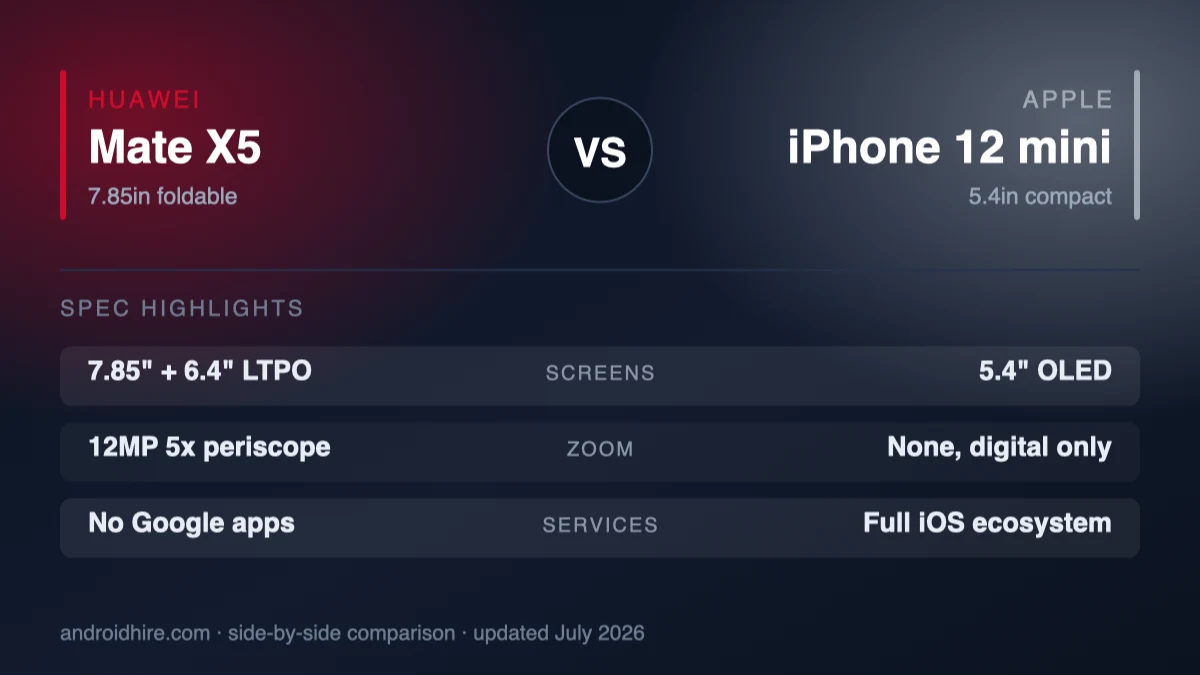
These are opposite phones, so the answer depends entirely on what you want from a screen. The Huawei Mate X5 opens into a 7.85-inch LTPO tablet with a 5x periscope camera — extraordinary hardware, sold mainly in China, and it ships with no Google services. The iPhone 12 mini is the last genuinely pocketable flagship at 5.4 inches, still running current iOS, with a 2,227mAh battery that is its obvious weak point. One maximises screen. The other maximises portability.
In a hurry? Jump to → Quick verdict · Full spec comparison · Display · Performance · Cameras · Battery & charging · Updates · Buying gotchas · How we compared · FAQ
Nobody arrives at this comparison by accident — it turns up because both phones are rejections of the same thing. Almost every phone sold today is a 6.5-to-6.8-inch slab, and these two are the escape routes: fold out to a tablet, or shrink to something that disappears in a pocket. The useful analysis is therefore not "which is better" but which extreme suits you, and what each one costs you in practice. For the Mate X5, that cost is app availability. For the 12 mini, it is battery life.
Quick verdict: Mate X5 vs iPhone 12 mini
Choose the Huawei Mate X5 if you want the biggest screen you can carry — reading, documents, split-screen multitasking and video are transformed by a 7.85-inch panel — and you live somewhere Huawei is sold and serviced properly.
Choose the iPhone 12 mini if you want a phone you barely notice carrying, with full app support, current iOS updates and a camera that still holds up. Accept that you will charge it more than once on busy days.
For most readers outside China, the practical answer is the iPhone 12 mini — not because it is the better device, but because the Mate X5's software situation is a daily obstacle.
Who wins what, category by category
| Category | Winner | Why it wins |
|---|---|---|
| Screen size and multitasking | Huawei Mate X5 | 7.85in main plus a 6.4in cover display |
| Portability | iPhone 12 mini | 5.4in and 133g — genuinely pocketable |
| Zoom | Huawei Mate X5 | 12MP 5x periscope; the mini has none |
| Camera hardware | Huawei Mate X5 | 50MP main plus a 13MP ultrawide |
| Video | iPhone 12 mini | Dolby Vision HDR and better consistency |
| Battery | Huawei Mate X5 | 5,060mAh vs 2,227mAh |
| App availability | iPhone 12 mini | No Google services on the Huawei |
| Software updates | iPhone 12 mini | Still on Apple's supported list |
| Price | iPhone 12 mini | Roughly a sixth of the Mate X5's cost |
| Durability | iPhone 12 mini | IP68 vs a folding screen and hinge |
Score: iPhone 12 mini 6 – Mate X5 4. The Huawei wins on hardware ambition; the iPhone wins on everything practical.
Huawei Mate X5 vs iPhone 12 mini: full spec comparison
| Specification | Huawei Mate X5 | Apple iPhone 12 mini |
|---|---|---|
| Released | September 2023 | November 2020 |
| Typical 2026 price | ~$1,500+ imported | ~$230–280 used |
| Main display | 7.85" LTPO OLED, 2224 x 2496 | 5.4" Super Retina XDR OLED |
| Cover display | 6.4" LTPO OLED, 1080 x 2504 | — |
| Resolution (outer) | 1080 x 2504 | 1080 x 2340 |
| Refresh rate | Up to 120Hz LTPO | 60Hz |
| Cover glass | Kunlun Glass | Ceramic Shield |
| Processor | Kirin 9000s (7nm) | A14 Bionic (5nm) |
| RAM | 12 / 16GB | 4GB |
| Storage | 256GB – 1TB | 64 / 128 / 256GB |
| Main camera | 50MP with OIS | 12MP with OIS |
| Ultrawide | 13MP | 12MP |
| Telephoto | 12MP, 5x optical periscope | ✖ None |
| Video | 4K | 4K/60 with Dolby Vision HDR |
| Battery | 5,060 mAh | 2,227 mAh (5+ years old) |
| Wired charging | 66W | ~20W |
| Wireless charging | ✔ 50W | ✔ 12W MagSafe |
| Water resistance | IPX8 (splash and immersion, no dust rating) | IP68 |
| Google services | ✖ Not included | N/A (iOS) |
| Software | HarmonyOS | Runs current iOS |
| Weight | ~243 g | ~133 g |
Huawei has not officially detailed the Mate X5's chipset; the Kirin 9000s attribution comes from teardowns and reporting. Apple does not publish battery capacity or charging wattage.
Displays: the entire point of both phones
The Mate X5 gives you two screens: a 7.85-inch LTPO OLED inside (2224 x 2496, nearly square) and a 6.4-inch LTPO cover display for one-handed use. Folded, it works like a normal phone. Open, it is a small tablet — genuinely better for reading, PDFs, spreadsheets and side-by-side apps.
The iPhone 12 mini goes the other way: a 5.4-inch Super Retina XDR OLED at 1080 x 2340. It is sharp and well calibrated, but small enough that typing is cramped and video feels tiny. It is locked to 60Hz, which by 2026 is its most dated trait.
- Reading, documents, multitasking: Mate X5, no contest.
- Using one-handed, pocketability: iPhone 12 mini at 133g against 243g.
- Smoothness: Mate X5 — 120Hz LTPO against 60Hz.
- Crease: the Mate X5 has one down the middle of the inner screen. You stop noticing it; you can always feel it.
Performance: both fine, neither current
The Kirin 9000s is Huawei's domestically produced 7nm chip — a significant engineering achievement, and roughly in the class of a 2021–22 flagship rather than a 2024 one. The A14 Bionic was Apple's 2020 flagship silicon and remains quick.
| Benchmark (approximate) | Huawei Mate X5 | iPhone 12 mini |
|---|---|---|
| Geekbench 6 single-core | ~1,150 | ~1,580 |
| Geekbench 6 multi-core | ~3,500 | ~4,000 |
| AnTuTu v10 total | ~900,000 | ~950,000 |
| Multitasking | 12–16GB RAM handles split-screen well | 4GB RAM limits background apps |
Benchmark figures are typical published ranges from public test databases rather than our own runs — read them as a class gap, not an exact score for your unit.
Apple edges the raw scores, which is remarkable for a 2020 chip. The Huawei's advantage is RAM: 12–16GB against 4GB, which matters enormously on a foldable where you run two or three apps at once. Cross-platform benchmarks are indicative only.
Also Read: Pixel 9 Pro vs Pixel 9 Pro Fold
Cameras: the Huawei has a real zoom
Huawei Mate X5 camera
- 50MP main with OIS (f/1.8)
- 13MP ultrawide
- 12MP periscope with 5x optical zoom — the standout lens
- Folding design lets you use the main cameras for selfies on the cover screen
iPhone 12 mini camera
- 12MP main with OIS
- 12MP ultrawide
- No telephoto — zoom is digital only
- 4K/60 Dolby Vision HDR video, still excellent
The Mate X5 has the more capable hardware, and its 5x periscope does something the iPhone simply cannot: hold real detail at distance. Its folding form also means you can shoot selfies with the far better rear cameras while framing on the cover display.
Apple's counter is video and consistency — Dolby Vision HDR recording, better audio, and colour that matches between lenses. For photos, the Huawei. For video, the iPhone.
Battery and charging: not close
5,060mAh against 2,227mAh is more than double, and the iPhone's cell is five years old, so realistically you are comparing with roughly 1,800mAh of usable capacity. The iPhone 12 mini's battery life was criticised when new; in 2026 a used one will need charging during the day, every day.
The Mate X5 also charges much faster — 66W wired and 50W wireless against about 20W wired and 12W MagSafe. If you buy the 12 mini, a battery replacement is close to mandatory and transforms it.
Software: the Mate X5's dealbreaker
This is where the comparison is decided for most people. Because of US trade restrictions, the Mate X5 ships with no Google Mobile Services — no Play Store, no Gmail, no Google Maps preinstalled. Huawei's AppGallery covers a lot in China and less elsewhere, and while workarounds exist, banking apps and services that depend on Google's frameworks are frequently a problem. HarmonyOS itself is fast and polished; the gap is the app ecosystem around it.
The iPhone 12 mini runs current iOS, gets updates on day one, and every app you want is available. Its A14 chip is newer than the A12 generation Apple dropped from iOS 26, so it remains supported — though as an older model, check Apple's current list before buying.
Which one should you buy?
Buy the Huawei Mate X5 if: you want a large foldable, you read or work on your phone, you value a 5x optical zoom and huge battery, and you are in a market where Huawei is officially sold, serviced and app-supported.
Buy the iPhone 12 mini if: a genuinely small phone is what you want, you need full app support and current updates, you shoot video, or you want to spend a few hundred dollars rather than well over a thousand.
If you want a foldable with Google apps: that is what the Pixel Fold and Galaxy Z lines are for — see Pixel 9 Pro vs Pixel 9 Pro Fold.
What the spec-comparison sites won't tell you
- No Google services is the headline, not a footnote. Spec tables list "HarmonyOS" and move on. In daily use outside China this affects maps, mail, payments and app updates.
- The iPhone 12 mini's battery is its defining flaw. 2,227mAh was small in 2020. Five years later, assume you are buying a phone that needs a mid-day charge until you replace the cell.
- Foldable repairs are expensive and scarce. A cracked inner screen or a failed hinge on an imported Mate X5 can cost a substantial fraction of the phone, if you can find anyone to do it.
- IPX8 is not IP68. The Mate X5's rating covers water but carries no dust rating — a real consideration for a device with a hinge mechanism.
How we compared these phones
We used Huawei's published specifications and Apple's technical specifications, cross-checked against GSMArena's Mate X5 listing. Two caveats are stated rather than smoothed over: Huawei has not officially confirmed the Mate X5's chipset, so the Kirin 9000s attribution comes from teardowns and reporting and we treat its performance figures as approximate; and Apple does not publish battery capacity or charging wattage, so those come from teardown and third-party testing. Because these phones are at opposite extremes, we did not attempt a like-for-like value verdict — the price gap is roughly sixfold. Instead we weighted the two factors that actually determine satisfaction here: app ecosystem availability for the Huawei, and battery degradation for a five-year-old compact iPhone. Neither appears on an automated spec table.
Related reading
Bottom line
Huawei Mate X5 vs iPhone 12 mini is a choice between extremes, not a contest. The Mate X5 wins screen area by a mile with a 7.85-inch LTPO fold plus a 6.4-inch cover display, adds a 12MP 5x periscope camera, more than double the battery and 66W wired plus 50W wireless charging. The iPhone 12 mini wins portability at 133g, app availability, current iOS updates, video quality, IP68 durability and price — roughly a sixth of the Huawei's cost. Want the largest screen you can carry, and live where Huawei works properly? Take the Mate X5. Want a small phone that just works? Take the mini and replace its battery.
Specifications, software versions and street prices in this comparison were checked in July 2026. We revisit head-to-head guides whenever either phone gets a major OS update or a lasting price change.
Next step: browse every matchup on our phone comparisons hub, or open full spec sheets in the phone specifications directory.
Frequently Asked Questions
Why would anyone compare a foldable with the iPhone 12 mini?
Because they represent the two extremes of phone design. The Mate X5 opens to a 7.85-inch tablet screen; the iPhone 12 mini is 5.4 inches and fits any pocket. Buyers looking at one are usually rejecting the middle-ground phones everyone else makes.
Does the Huawei Mate X5 have Google apps?
No. Because of US trade restrictions, Huawei phones ship without Google Mobile Services, so no Play Store, Gmail or Google Maps out of the box. Huawei's AppGallery and petal-based alternatives exist, but many Western apps are missing or awkward to install.
Does the iPhone 12 mini still get iOS updates?
Yes. It uses the A14 Bionic, which is newer than the A12 generation Apple dropped from iOS 26, so the 12 mini remains on the supported list. Check Apple's current compatibility page before buying, since it is an older model.
How bad is the iPhone 12 mini's battery life?
It is the phone's known weakness. A 2,227mAh cell was small when new, and after five years of use most units will struggle through a full day of moderate use. Budget for a battery replacement, which makes a big difference.
Which has the better camera?
The Mate X5, on hardware. It has a 50MP main, a 13MP ultrawide and a 12MP periscope with 5x optical zoom, which the iPhone 12 mini cannot match — the mini has two 12MP lenses and no zoom at all. Apple still holds an edge in video consistency.
How much do they cost in 2026?
They are far apart. A Mate X5 is a flagship foldable that typically costs well over $1,500 imported, while a used iPhone 12 mini sits in the $230–280 range. This is not a like-for-like budget comparison.
Which should I buy?
The iPhone 12 mini if you want a genuinely small phone with current software and normal app support. The Mate X5 only if you specifically want a large foldable, live where Huawei is properly supported, and can work around the absence of Google services.