Pixel 9 Pro vs Pixel 9 Pro Fold (2026): Which Is Worth Buying?
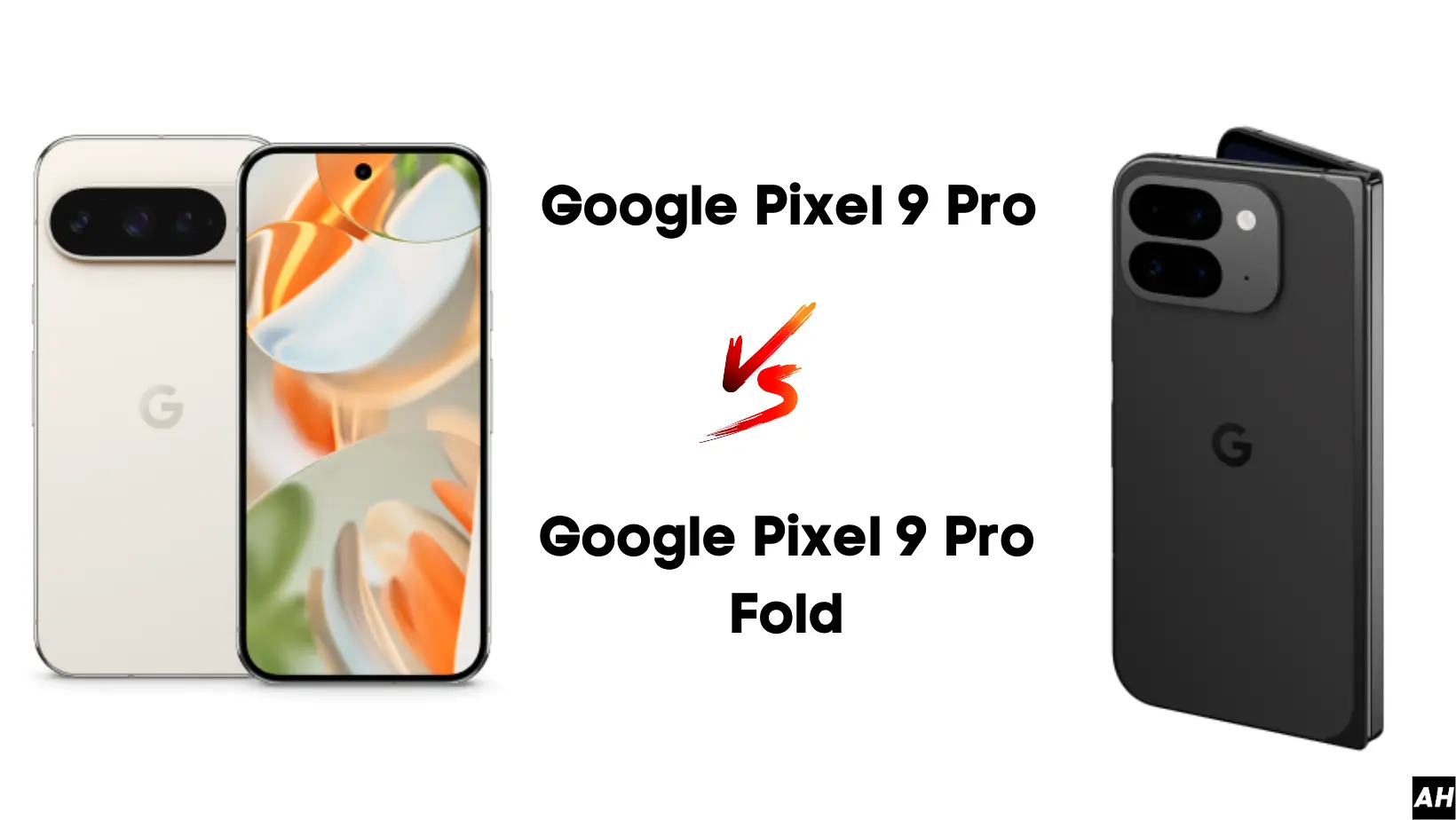
For most people, the Pixel 9 Pro is the smarter buy: it has the better cameras, a brighter display, faster charging, longer battery life and costs hundreds of dollars less. The Pixel 9 Pro Fold only wins if you genuinely want a tablet-sized 8-inch screen that folds into your pocket for multitasking, reading and big-screen video. Both run the same Google Tensor G4 chip, 16GB of RAM and Google's 7-year update promise, so the real decision comes down to one question: do you need a foldable, or just a great phone?
In a hurry? Jump to the verdict, the full spec comparison, displays, cameras, battery, price in 2026, or the FAQ.
Google announced both phones together at Made by Google on August 13, 2024. The Pixel 9 Pro started at $999 and the Pixel 9 Pro Fold at $1,799. Nearly two years on, prices have fallen sharply and the newer Pixel 10 Pro Fold now sits above the lineup, which actually makes the 9-series a stronger value pick in 2026. Below we break down where each phone earns its keep.
The short verdict
Buy the Pixel 9 Pro if you want the best Pixel camera system in a compact, one-handed body, all-day battery, the brightest screen Google makes, and you would rather spend the savings elsewhere. It is the better choice for photography, durability (full IP68 dust and water resistance) and value.
Buy the Pixel 9 Pro Fold if you treat your phone like a mini tablet — long reading sessions, split-screen apps, spreadsheets, drawing, or watching video on an 8-inch panel — and you are willing to accept weaker cameras, slower charging and a higher price for that flexibility.
They share the same Tensor G4 processor, 16GB of RAM, 120Hz refresh rate, Android 16 (upgradable), 7 years of OS and security updates, USB-C, 5G, Wi-Fi 7 and Bluetooth 5.4 — so day-to-day performance and software feel nearly identical. The differences that matter are form factor, screen, camera and battery.
Pixel 9 Pro vs Pixel 9 Pro Fold: full spec comparison
| Feature | Pixel 9 Pro | Pixel 9 Pro Fold |
|---|---|---|
| Form factor | Standard bar phone | Book-style foldable |
| Main display | 6.3" LTPO OLED | 8.0" OLED (inner) |
| Cover display | — | 6.3" OLED |
| Resolution | 1280 x 2856 | 2076 x 2152 (inner) / 1080 x 2424 (cover) |
| Refresh rate | 1–120Hz | 120Hz (both screens) |
| Peak brightness | 3,000 nits | 2,700 nits |
| Glass protection | Gorilla Glass Victus 2 | Victus 2 (cover); plastic inner |
| Chipset | Google Tensor G4 (4nm) | Google Tensor G4 (4nm) |
| RAM | 16GB | 16GB |
| Storage | 128GB / 256GB / 512GB / 1TB | 256GB / 512GB |
| Main camera | 50MP wide | 48MP wide |
| Ultrawide | 48MP | 10.5MP |
| Telephoto | 48MP, 5x optical | 10.8MP, 5x optical |
| Front camera | 42MP | 10MP (inner) + 10MP (cover) |
| Battery | 4,700 mAh | 4,650 mAh |
| Wired charging | 27W | 21W |
| Wireless charging | 21W | 7.5W |
| Reverse wireless | ✔ | ✖ |
| Water/dust rating | IP68 (dust + water) | IPX8 (water only) |
| Weight | 199 g | 257 g |
| Dimensions (folded) | 152.8 x 72 x 8.5 mm | 155.2 x 77.1 x 10.5 mm |
| Software | Android 14 → 16 | Android 14 → 16 |
| Update support | 7 years OS + security | 7 years OS + security |
| 5G / Wi-Fi 7 / NFC | ✔ / ✔ / ✔ | ✔ / ✔ / ✔ |
| Launch price (USD) | $999 (128GB) | $1,799 (256GB) |
Design and build
The Pixel 9 Pro is the easier phone to live with. At 6.3 inches and 199 grams it fits one hand, slips into any pocket, and carries a full IP68 rating, meaning it resists both dust and submersion in up to 1.5 m of water for 30 minutes. The flat aluminum frame, matte rails and the signature camera bar make it feel like a finished, premium object.
The Pixel 9 Pro Fold is an engineering showpiece. Closed, it is a usable 6.3-inch phone; opened, it becomes an 8-inch near-square tablet just 5.1 mm thick. The trade-offs are real: it weighs 257 grams, costs more, and carries only an IPX8 rating — it survives water but, crucially, has no official dust resistance, which matters for a hinge with moving parts. The inner screen also uses a flexible plastic layer with a visible center crease, as every book-style foldable does today.
Displays
If you only ever look at one screen, the Pixel 9 Pro's 6.3-inch LTPO OLED is the better panel in isolation: 1280 x 2856 resolution, a 1–120Hz adaptive refresh rate, and a class-leading 3,000 nits of peak brightness that stays readable in direct sunlight. It is protected by Corning Gorilla Glass Victus 2.
The Fold answers with quantity. Its 8-inch inner OLED (2076 x 2152) is built for multitasking — two or three apps side by side, comfortable e-reading, and immersive video — while a 6.3-inch cover screen handles quick tasks when folded. Both Fold screens run at up to 120Hz, but peak brightness tops out at 2,700 nits, slightly dimmer than the Pro, and the inner panel cannot use scratch-resistant glass because it has to bend.
Also Read: OnePlus Open vs Xiaomi Mix Fold 3
Performance and software
This is effectively a tie. Both phones use Google's Tensor G4, a 4nm chip paired with 16GB of RAM and the Titan M2 security coprocessor. In everyday use — messaging, browsing, photography, Gemini AI features, light gaming — they feel the same. Tensor G4 is tuned for Google's on-device AI rather than raw benchmark dominance, so neither phone leads the Android pack for sustained gaming, but both are smooth and responsive.
Where the Fold pulls ahead is what you do with that power: its larger canvas makes split-screen, drag-and-drop and desktop-style multitasking genuinely useful, whereas the same features feel cramped on the 9 Pro. Both ship upgradable to Android 16 and carry Google's industry-leading 7 years of OS and security updates, so longevity is identical. If you want to dig into the latest Pixel software perks, see our roundup of the best Android 15 features.
Cameras
The Pixel 9 Pro has the clearly superior camera system and it is the single biggest reason most buyers should choose it. It carries a 50MP main sensor, a 48MP ultrawide and a 48MP 5x periscope telephoto, plus a 42MP front camera. That is the same flagship-grade hardware found in the Pixel 9 Pro XL, and it delivers Google's best computational photography — excellent low light, detailed 5x zoom and sharp ultrawide shots.
The Fold compromises on optics to fit its slim folding body. Its 48MP main sensor is solid, but the ultrawide drops to 10.5MP and the 5x telephoto to 10.8MP, both noticeably smaller sensors than the Pro's. It still takes very good photos thanks to Google's image processing, and its party trick is real: you can use the high-quality rear cameras for selfies by previewing on the cover screen. But for pure image quality, the 9 Pro wins on every lens.
Battery and charging
The Pixel 9 Pro is the more dependable all-day phone. It packs a 4,700 mAh battery feeding a single, efficient 6.3-inch screen, and charges at 27W wired and 21W wireless, with Battery Share reverse wireless charging to top up earbuds.
The Pixel 9 Pro Fold has a slightly smaller 4,650 mAh battery that also has to drive a power-hungry 8-inch panel, so real-world endurance trends shorter, especially during heavy big-screen use. It also charges slower — 21W wired and just 7.5W wireless — and drops reverse wireless charging entirely. If battery life and fast top-ups are priorities, the 9 Pro is the safer pick. For more on getting the most from a Pixel battery, see our Pixel battery and 120Hz display guide.
Price and value in 2026
At launch the gap was stark: $999 for the Pixel 9 Pro versus $1,799 (256GB) or $1,919 (512GB) for the Pixel 9 Pro Fold. In mid-2026, with the Pixel 10 Pro Fold now the current foldable, the Pixel 9 Pro Fold has dropped significantly at third-party retailers — frequently around $1,099–$1,199 — while the Pixel 9 Pro can be found well below its original price.
That still leaves a meaningful premium for the foldable. Unless the 8-inch screen is the whole reason you are buying, the Pixel 9 Pro delivers more camera, more battery and more durability per dollar. The Fold is for buyers who specifically value the form factor and are happy to pay for it.
Related reading
How we compared these phones
We built this comparison from Google's official Pixel 9 Pro and Pixel 9 Pro Fold spec sheets and cross-checked every figure — display sizes, brightness, camera resolutions, battery capacity and charging speeds — against independent databases including GSMArena and hands-on reviews. We weighted the categories that change real-world ownership the most: camera quality, screen usability, battery endurance, durability and price. We also factored in 2026 market reality, including current street pricing and the arrival of the Pixel 10 Pro Fold, so the recommendation reflects what these phones actually cost and compete against today rather than their launch-day positioning.
Bottom line
Choose the Pixel 9 Pro if you want the best overall Pixel experience — the strongest cameras, the brightest screen, longer battery life, faster charging, full dust-and-water protection and the better price. It is the right phone for the vast majority of buyers. Choose the Pixel 9 Pro Fold only if a pocketable 8-inch tablet for multitasking and media is the feature you care about most and you accept weaker cameras, slower charging and a higher cost to get it. Same brain, same software promise — the decision is purely about the shape of the screen you want in your hand.
Frequently Asked Questions
What is the main difference between the Pixel 9 Pro and Pixel 9 Pro Fold?
The Pixel 9 Pro is a standard 6.3-inch bar phone, while the Pixel 9 Pro Fold is a book-style foldable that opens to an 8-inch inner screen with a 6.3-inch cover display. They share the same Tensor G4 chip and 16GB of RAM, but the 9 Pro has better cameras, brighter screen and faster charging, while the Fold offers a tablet-sized display for multitasking.
Does the Pixel 9 Pro have better cameras than the Pixel 9 Pro Fold?
Yes. The Pixel 9 Pro uses a 50MP main, 48MP ultrawide and 48MP 5x telephoto, the same flagship array as the Pixel 9 Pro XL. The Fold drops to a 48MP main, 10.5MP ultrawide and 10.8MP telephoto with smaller sensors. Both benefit from Google's processing, but the 9 Pro produces clearly better photos on every lens.
Which has better battery life, the Pixel 9 Pro or the Pixel 9 Pro Fold?
The Pixel 9 Pro generally lasts longer. It has a 4,700 mAh battery driving a single 6.3-inch screen and charges at 27W wired and 21W wireless. The Fold's 4,650 mAh battery has to power an 8-inch panel and charges slower at 21W wired and 7.5W wireless, so heavy big-screen use drains it faster.
Is the Pixel 9 Pro Fold water and dust resistant?
The Pixel 9 Pro Fold has an IPX8 rating, meaning it resists water submersion but has no official dust resistance — a consideration given its moving hinge. The Pixel 9 Pro carries a full IP68 rating, protecting against both dust and water up to 1.5 m for 30 minutes.
Do both phones get the same software updates?
Yes. Both the Pixel 9 Pro and Pixel 9 Pro Fold ship with Android upgradable to Android 16 and receive Google's 7 years of OS and security updates. Software features, Gemini AI tools and Pixel-exclusive functions are essentially identical between the two.
Is the Pixel 9 Pro Fold worth the extra money over the Pixel 9 Pro?
Only if you specifically want a foldable. The Fold costs hundreds more yet has weaker cameras, slower charging, shorter battery life and no dust resistance. You are paying the premium purely for the pocketable 8-inch screen and multitasking. If that form factor is not essential, the Pixel 9 Pro is the better value.
Should I buy the Pixel 9 Pro Fold in 2026 or wait for the Pixel 10 Pro Fold?
The Pixel 10 Pro Fold launched in 2025 as the successor and sits at a higher price, while the Pixel 9 Pro Fold has dropped to roughly $1,099–$1,199 at third-party retailers in 2026. If you want a foldable on a budget and value the savings over the latest hinge and processor, the discounted 9 Pro Fold remains a strong buy.
Can the Pixel 9 Pro Fold replace a tablet?
For light tablet tasks, yes. The 8-inch inner display handles split-screen apps, e-reading, note-taking and video well, making it a credible mini-tablet replacement that fits in a pocket. It is not as large or as optimized as a dedicated tablet, but it covers most on-the-go big-screen needs in a single device.