OnePlus Open vs Xiaomi Mix Fold 3 (2026): Which Foldable Wins?
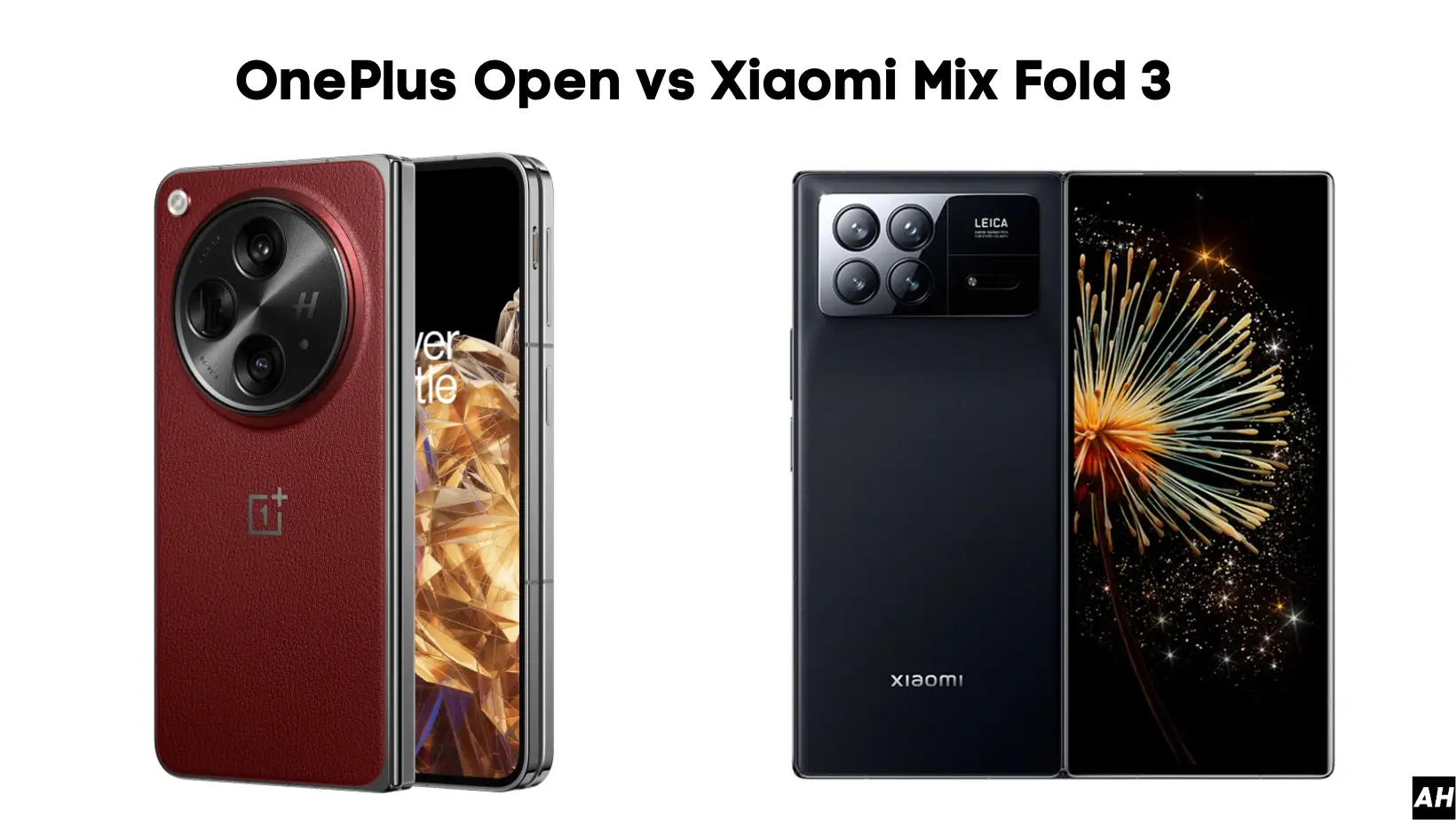
For most buyers in 2026, the OnePlus Open is the smarter book-style foldable to own globally, thanks to its IPX4 splash rating, true global availability, ongoing OxygenOS updates (it has reached Android 16), and a flatter, more usable cover screen. The Xiaomi Mix Fold 3 counters with a thinner hinge, a slightly larger 8.03-inch inner display, a quad Leica camera array with a dedicated 5x periscope, and 50W wireless charging — but it shipped as a China-only handset with no IP rating, so outside China it makes sense mainly as an imported camera enthusiast's foldable.
In a hurry? Jump to: Quick verdict · Full specs table · Design & displays · Cameras · Performance & battery · Software & updates · How we compared · FAQ
Both phones launched in late 2023 on the same Qualcomm Snapdragon 8 Gen 2 platform, so on raw silicon they are near-identical. Where they split is in the things that actually shape daily ownership: build durability, where you can buy them, how the cameras behave, and how long each maker keeps the software fresh. This guide breaks all of that down with verified specs and a clear recommendation, updated for 2026.
Quick verdict: which should you buy?
- Buy the OnePlus Open if you want a foldable you can actually buy and service worldwide, with splash resistance, clean fast software, and a cover screen with a natural, candybar-like aspect ratio that you can comfortably one-hand.
- Buy the Xiaomi Mix Fold 3 if you can import from China (or live there), you prioritise a versatile Leica camera system with both 3.2x and 5x optical telephoto reach, and you want wireless charging plus the thinnest folded profile in this matchup.
- Skip both and wait if you need the latest hardware — newer foldables now ship with Snapdragon 8 Elite-class chips and longer update commitments. See our 2026 flagship comparison for where the market has moved.
OnePlus Open vs Xiaomi Mix Fold 3: full specifications
| Specification | OnePlus Open | Xiaomi Mix Fold 3 |
|---|---|---|
| Release | October 2023 (global) | August 2023 (China) |
| Inner display | 7.82" LTPO AMOLED, 120Hz, 2440 x 2268, up to 2800 nits | 8.03" LTPO OLED, 120Hz, 2160 x 1916, HDR10+ & Dolby Vision |
| Cover display | 6.31" LTPO AMOLED, 120Hz, 2484 x 1116, up to 2800 nits | 6.56" AMOLED, 120Hz, 2520 x 1080 |
| Chipset | Snapdragon 8 Gen 2 (4 nm) | Snapdragon 8 Gen 2 (4 nm) |
| RAM / Storage | 16GB LPDDR5X / 512GB or 1TB UFS 4.0 | 12–16GB LPDDR5X / up to 1TB UFS 4.0 |
| Main camera | 48MP Sony LYT-T808 (f/1.7, OIS) | 50MP Sony IMX800 (f/1.8, OIS) |
| Telephoto | 64MP, 3x optical (f/2.6) | 10MP 3.2x + 10MP 5x periscope (both OIS) |
| Ultrawide | 48MP (f/2.2, 114°) | 12MP (f/2.2) |
| Camera tuning | Hasselblad | Leica |
| Front cameras | 32MP (cover) + 20MP (inner) | 20MP (cover) + 20MP (inner) |
| Battery | 4805 mAh | 4800 mAh |
| Wired charging | 67W SUPERVOOC | 67W |
| Wireless charging | None | 50W |
| IP rating | IPX4 (splash resistant) | None |
| Weight | 239 g (245 g Voyager Black) | 255–259 g |
| Folded thickness | 11.7 mm | 10.86 mm |
| Launch OS | OxygenOS 13 (Android 13) | HyperOS / MIUI Fold 14 (Android 13) |
| Updated to (2026) | OxygenOS 16 (Android 16) | HyperOS (China ROM) |
Design, build and displays
Both are book-style foldables that open into a near-square tablet, but they prioritise different things. The Xiaomi Mix Fold 3 is the thinner of the two when folded (around 10.86 mm versus the OnePlus Open's 11.7 mm) and its hinge is engineered to lie almost flat, which keeps the centre crease subtle. Its inner display is also marginally bigger at 8.03 inches.
The OnePlus Open answers with two practical advantages. First, it carries an IPX4 splash-resistance rating; the Mix Fold 3 has no official IP rating at all, which matters for a device this expensive that you fold and unfold hundreds of times a day. Second, its 6.31-inch cover screen uses a taller, candybar-style aspect ratio that feels like a normal phone when closed — you can type and browse one-handed without unfolding. The Mix Fold 3's 6.56-inch cover panel is slightly wider and shorter, which some users find less natural for one-handed use.
On the inside, the OnePlus Open's panel is sharper on paper (its 2440 x 2268 resolution yields a higher pixel density than the Mix Fold 3's 2160 x 1916), and both peak at a 120Hz LTPO refresh rate that can drop low to save power. The Mix Fold 3 pulls ahead on HDR: it supports HDR10+ and Dolby Vision on the main display, making it the better pick for HDR streaming. The OnePlus Open is rated for an exceptionally bright 2800 nits peak, so it is the easier of the two to read in direct sunlight.
Also Read: Google Pixel 9 Pro vs Pixel 9 Pro Fold: Slab or Foldable?
Cameras: Hasselblad vs Leica
This is where the two phones diverge most. The Xiaomi Mix Fold 3 ships a true four-camera Leica system: a 50MP main sensor with OIS, a 12MP ultrawide, a 10MP 3.2x telephoto, and a 10MP 5x periscope telephoto — both zoom lenses stabilised. That dual-telephoto setup gives it genuine optical reach from portraits to distant subjects, and the Leica colour profiles are a draw for enthusiasts who like the "Leica Authentic" and "Leica Vibrant" looks.
The OnePlus Open takes a different route with a Hasselblad-tuned triple system: a 48MP Sony LYT-T808 "pixel-stacked" main sensor with strong dynamic range, a 64MP 3x telephoto, and a 48MP ultrawide. It has only one dedicated zoom lens versus Xiaomi's two, so it can't match the Mix Fold 3's 5x optical reach, but its higher-resolution sensors mean cleaner ultrawide shots and excellent main-camera consistency. For everyday photography and video, the OnePlus Open is one of the most reliable foldable cameras of its generation; for maximum zoom flexibility, the Mix Fold 3 wins.
Both shoot 4K video, support OIS on the main camera, and offer manual/Pro modes. If photography is your single biggest reason to buy a foldable, the Mix Fold 3's quad array is more versatile — just remember it is harder to buy and update outside China.
Performance and battery
Performance is effectively a tie. Both phones run the Qualcomm Snapdragon 8 Gen 2 with the Adreno 740 GPU, paired with up to 16GB of LPDDR5X RAM and UFS 4.0 storage. In real use they handle multitasking, split-screen apps, and demanding games identically, and both remain comfortably fast in 2026 for everyday flagship workloads.
Battery capacity is also near-identical — 4805 mAh on the OnePlus Open versus 4800 mAh on the Mix Fold 3 — and both top up at 67W wired, refilling fully in well under an hour. The deciding factor here is wireless charging: the Mix Fold 3 supports 50W wireless charging, while the OnePlus Open has no wireless charging at all. If dropping the phone on a pad matters to you, that is a clear point for Xiaomi.
Related reading
- Google Pixel 9 Pro vs Pixel 9 Pro Fold
- Galaxy S26 Ultra vs Pixel 10 Pro XL
- iPhone 15 Pro Max vs Samsung S24 Ultra
Software and update support
Software is the strongest argument for the OnePlus Open in 2026. It launched on OxygenOS 13 (Android 13) and has since been carried forward by OnePlus, reaching Android 16 — a clean, fast, near-stock-feeling skin that many reviewers rate among the best Android experiences. Crucially, those updates roll out globally.
The Xiaomi Mix Fold 3 launched as a China-exclusive on MIUI Fold 14 and has since moved to HyperOS on the Chinese ROM. Because it was never an official global release, international owners rely on imported units and Chinese-ROM updates, which can lag and may include region-specific software quirks. For a buyer outside China who wants long-term, hassle-free updates, the OnePlus Open is the safer choice. Both phones are now a generation or two behind on update runway compared with the latest 2026 foldables.
How we compared these foldables
We built this comparison by cross-referencing each phone's official specification sheets from OnePlus and Xiaomi, then verified the contested figures — display sizes and resolutions, camera sensors, charging speeds, and IP ratings — against independent databases. We weighted the categories that genuinely change daily ownership of a foldable: durability and IP rating, cover-screen ergonomics, camera versatility, charging options, and — most importantly for longevity — software update support and global availability. We also re-checked each device's current software status in 2026 so the recommendation reflects reality today, not the launch-day picture.
Bottom line
If you are shopping internationally and want a foldable you can buy, service, and keep updated without friction, the OnePlus Open is the better all-round choice — it adds splash resistance, a more usable cover screen, exceptional peak brightness, and ongoing OxygenOS updates that have already reached Android 16. The Xiaomi Mix Fold 3 is the enthusiast's pick: a thinner fold, a slightly larger HDR-capable inner display, 50W wireless charging, and a quad Leica camera with both 3.2x and 5x optical zoom — best suited to buyers in China or those comfortable importing. Choose the OnePlus Open for everyday peace of mind, and the Mix Fold 3 for camera reach and charging flexibility.
Frequently Asked Questions
Is the OnePlus Open or Xiaomi Mix Fold 3 better in 2026?
For most buyers worldwide, the OnePlus Open is the better choice because it has an IPX4 splash rating, sells and updates globally, and has been carried forward to Android 16. The Xiaomi Mix Fold 3 is better only if you want its quad Leica camera with 5x periscope zoom and 50W wireless charging, and you can buy or import it from China.
Which foldable has the better camera, OnePlus Open or Mix Fold 3?
It depends on what you shoot. The Mix Fold 3 has a more versatile four-camera Leica system with both a 3.2x and a 5x periscope telephoto, so it offers more optical zoom reach. The OnePlus Open uses a Hasselblad-tuned triple camera with higher-resolution main and ultrawide sensors, giving cleaner everyday shots but only one 3x zoom lens.
Do the OnePlus Open and Xiaomi Mix Fold 3 use the same processor?
Yes. Both phones run the Qualcomm Snapdragon 8 Gen 2 with the Adreno 740 GPU, so raw performance is effectively identical. Both pair the chip with up to 16GB of LPDDR5X RAM and UFS 4.0 storage, and both remain fast for flagship tasks in 2026.
Does the OnePlus Open support wireless charging?
No. The OnePlus Open does not support wireless charging; it charges only over its 67W SUPERVOOC wired connection. The Xiaomi Mix Fold 3 supports both 67W wired and 50W wireless charging, so if wireless top-ups matter to you, the Mix Fold 3 is the better option.
Are these foldables waterproof?
Neither is fully waterproof. The OnePlus Open carries an IPX4 rating, meaning it resists splashes from any direction but not submersion. The Xiaomi Mix Fold 3 has no official IP rating at all, so it offers no certified protection against water and you should keep it away from moisture.
Can you buy the Xiaomi Mix Fold 3 outside China?
Not officially. The Xiaomi Mix Fold 3 launched as a China-exclusive device, so outside China it is available only through importers and grey-market sellers. That also means it runs the Chinese software ROM, with updates that can lag behind and some region-specific quirks. The OnePlus Open, by contrast, was a true global release.
Which phone has the bigger screen?
The Xiaomi Mix Fold 3 has the larger displays on both sides: an 8.03-inch inner screen and a 6.56-inch cover screen, versus the OnePlus Open's 7.82-inch inner and 6.31-inch cover panels. However, the OnePlus Open's inner display is sharper and its taller cover screen is often easier to use one-handed.
Will the OnePlus Open keep getting Android updates?
The OnePlus Open launched on Android 13 and has been updated through OnePlus's OxygenOS to Android 16. It is now near the end of its planned update window, so while it is still receiving security and feature support in 2026, buyers wanting the longest runway should look at newer 2026 foldables.