RayNeo Splits Its AR Glasses in Two: iO for Work, GT Max for a 307-Inch Screen

RayNeo unveiled three new AR glasses on Friday instead of one do-everything pair. The iO Smart Glasses target all-day productivity, while the GT and GT Max are built for AR gaming and movie-watching, with the GT Max projecting a virtual screen as large as 307 inches. All three go on sale September 4, with pricing still unannounced.
Founder and CEO Howie Li framed the split as a deliberate rejection of one-size-fits-all hardware: "Rather than compromising with a single device that tries to do everything, we designed two dedicated experiences," he said, one for productivity and one for entertainment.
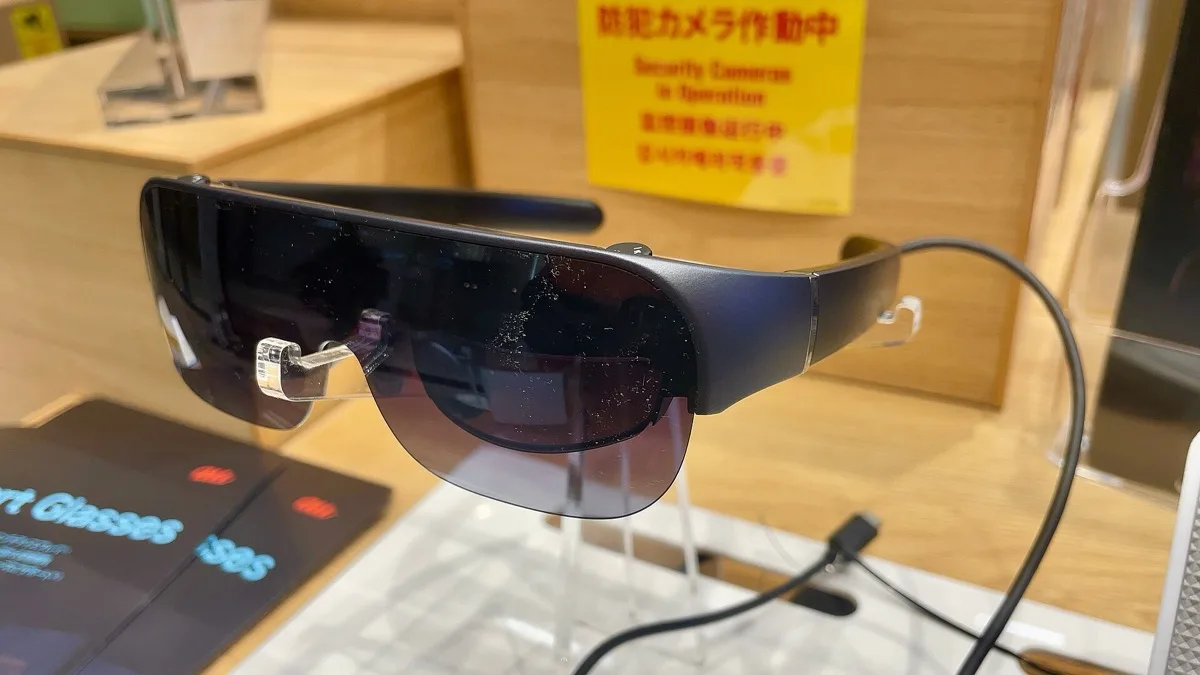
The iO glasses look like ordinary frames
At 33 grams, the iO is built to be worn all day rather than for short bursts. It uses a monochrome green waveguide display — RayNeo calls it the Firefly Nano Engine — rated at 97 percent optical transparency and 1,300 nits of brightness, projected across a 23.5-degree field of view. There are no built-in speakers; audio runs through a bone-conduction sensor paired with a four-microphone array, and a rotating "Smart Crown" dial handles input alongside head gestures.
The headline feature is what RayNeo calls its Ambient AI Life Log: the glasses can listen to conversations and summarize them, transcribe on the fly, and run a live translator covering 55 languages and 109 accents at roughly one second of latency. RayNeo says the iO can call on Gemini, ChatGPT, Claude, or DeepSeek for those tasks rather than locking users into a single assistant. Battery life is rated at up to two days of typical use, or about 18 hours of continuous recording. The frame is IP54-rated against dust and light water, built from an AZ91D magnesium-aluminum alloy with titanium temples, and ships in Polar Night (dark grey) or Dune (gold).
GT and GT Max are for watching, not walking around
The GT series drops the all-day ambition and instead chases a bigger picture. The standard GT weighs 68 grams, uses birdbath optics with a 46-degree field of view, and can scale its virtual screen up to 231 inches. The GT Max weighs 78 grams, uses a newer Peacock Optical Engine 3.0 Max with a fifth-generation tandem micro-OLED panel, widens the field of view to 59 degrees, and stretches the screen up to 307 inches with three-level dynamic scaling.
Both models carry a quad-speaker setup co-tuned with Bang & Olufsen, and the GT Max adds head-tracked spatial audio, a 6-magnetic-circuit driver design RayNeo says boosts low-frequency output by 5dB, and a "Whisper Mode" for quieter private listening. On the video side, the GT Max supports native Dolby Vision and can convert standard-dynamic-range footage to HDR in real time. A built-in 3DoF chip offers three viewing modes: one that filters out travel shake for use on planes or trains, one that pins the screen in a fixed spot in 3D space, and one that follows your head movement.
The GT Max also comes in three interpupillary-distance sizes — small (under 64mm), medium (64–67mm), and large (over 67mm) — and supports official prescription lens inserts, a detail RayNeo has not offered across its full lineup before.
What's confirmed and what isn't
- Availability — all three models go on sale September 4 through RayNeo's own site and Amazon, with a live demo planned at IFA 2026 in Berlin the same week.
- Pricing — not announced for any of the three models as of launch. RayNeo's existing lineup spans roughly $130 to $650, so expect the final numbers to land somewhere in that range, but treat any third-party price guess as speculation until RayNeo confirms it.
- Regions — RayNeo has not published a country-by-country rollout list. The company cites Counterpoint Research data putting it at 23.7 percent of global consumer AR glasses shipments in the first quarter of 2026, so a global launch alongside the US date is likely but not yet confirmed.
How this compares to other display glasses
RayNeo's split mirrors a trend the whole smart-glasses market has been moving toward: separating an always-on assistant pair from a tethered, screen-focused pair rather than merging both into one device. Viture's Pro 2, which launched earlier this month at $299, takes the wired, big-screen approach the GT series is chasing, though at 63 grams and a 50-degree field of view it sits between the standard GT and the GT Max on both weight and field of view.
The iO's pitch is closer to Meta's Ray-Ban glasses in ambition — an always-worn device that leans on AI rather than a wide display — but RayNeo is betting on giving users a choice of AI backend instead of building its own from scratch.
Should you wait for pricing?
With less than two weeks until launch and no price attached to any of the three models, there is little to decide yet beyond which use case fits: the iO for hands-free notes, translation, and quick AI queries throughout the day, or the GT series for a private, oversized screen on a plane, train, or couch. RayNeo says full pricing will follow ahead of the September 4 on-sale date.
Related reading
Frequently Asked Questions
When do the RayNeo iO and GT Series glasses go on sale?
All three models — the iO, GT, and GT Max — go on sale September 4, 2026, through RayNeo's own website and Amazon. RayNeo will also demo the lineup at IFA 2026 in Berlin starting the same day.
How much do the RayNeo iO and GT Max cost?
RayNeo has not announced pricing for any of the three new models. Its existing glasses range from roughly $130 to $650, so the new lineup will likely fall somewhere in that band, but no official price has been confirmed.
What AI assistants work with the RayNeo iO glasses?
RayNeo says the iO supports Gemini, ChatGPT, Claude, and DeepSeek rather than a single built-in assistant. It also runs real-time translation covering 55 languages and 109 accents with about a second of latency.
What is the difference between the RayNeo GT and GT Max?
The GT weighs 68 grams, has a 46-degree field of view, and projects a virtual screen up to 231 inches. The GT Max weighs 78 grams, widens the field of view to 59 degrees, projects up to 307 inches, and adds Dolby Vision support, head-tracked spatial audio, and interpupillary-distance sizing with prescription lens support.
Do the RayNeo GT glasses need to be plugged into another device?
Yes. The GT and GT Max are display glasses that connect to a phone, handheld console, or laptop to show that device's screen, similar to other wired AR glasses like Viture's Pro 2. They are not standalone computers.