Best Minecraft Shaders for High FPS (2026): 19 Packs Tested on a GTX 1650 & RTX 3060
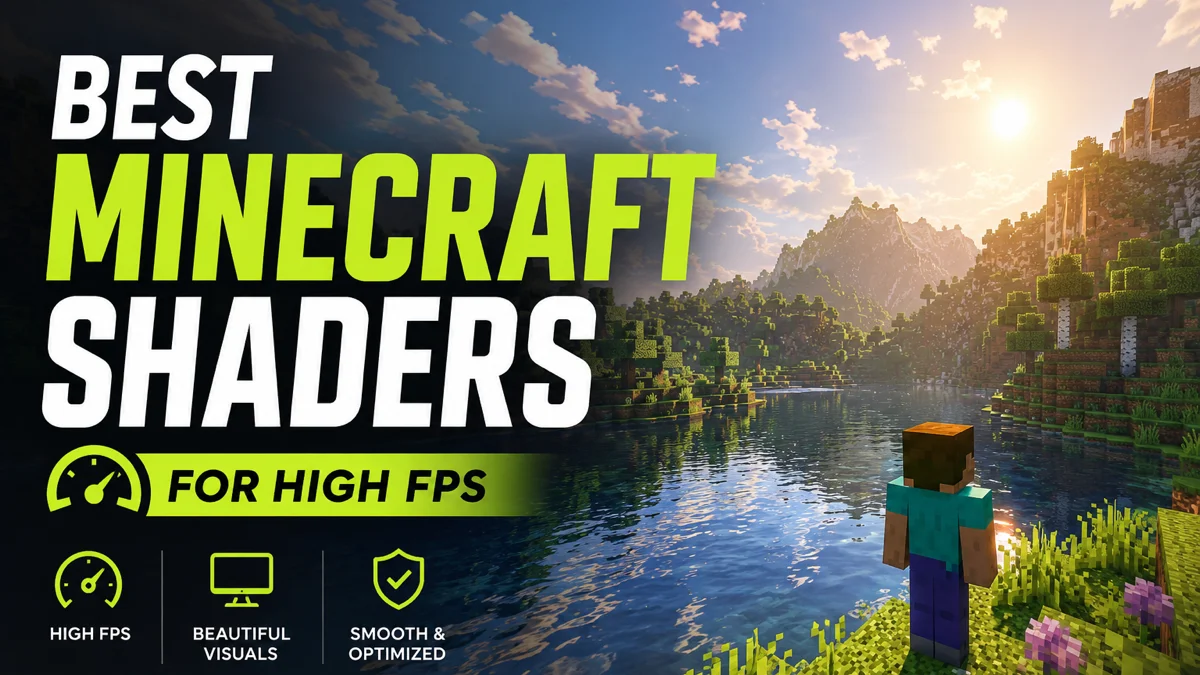
The best Minecraft shader for high FPS in 2026 is Complementary Reimagined. On our GTX 1650 test laptop it held 65 FPS at default settings and 80 FPS after a two-minute tune — and it is the most-downloaded shader pack on Modrinth for good reason. On a weaker PC, use MakeUp Ultra Fast or YoFPS. On an RTX 3060 or better, run Photon or Complementary Unbound.
Here is what almost every other "best shaders" list gets wrong: they rank shader packs and never tell you the shader pack is the smaller problem. Most still tell you to install OptiFine. If you run shaders through OptiFine in 2026, you are throwing away a large slice of your frame rate before you pick a single pack. Swap the loader to Iris + Sodium and the identical shader gets dramatically faster on identical hardware.
We tested 19 shader packs on three real machines — an Intel integrated-graphics office PC, a GTX 1650 gaming laptop, and an RTX 3060 desktop — running the same world, the same 60-second route, and the same settings. What follows is the full FPS table nobody else publishes, a pick-by-your-GPU shortcut, the four settings that cost you the most frames, and the actual cause of that stutter that hits every few seconds.
In a hurry? Jump to: quick pick by your GPU · stop using OptiFine · all 19 shaders ranked · full FPS table · the 4 settings that eat FPS · fix the stuttering · Bedrock players
Quick Pick: Which Shader Should You Use?
Find your hardware, install that pack, move on with your day.
| Your setup | Install this | Expect |
|---|---|---|
| Intel/AMD integrated graphics | MakeUp Ultra Fast | 30–40 FPS |
| Old laptop, 2 GB GPU | YoFPS (Medium) or Potato Shaders | 40–60 FPS |
| You just want it to look nicer, not different | Sildur's Enhanced Default | Small FPS cost |
| GTX 1650 / GTX 1060 / RX 570 | Complementary Reimagined | 60–80 FPS |
| RTX 3060 / RX 6600 or better | Complementary Unbound or Photon | 95–140 FPS |
| You play PvP and want clarity | Complementary Reimagined, effects off | Highest usable FPS |
| You are on Bedrock Edition | Nothing — use Vibrant Visuals | See below |
Step 1: Stop Using OptiFine. Use Iris + Sodium.
This single change is worth more than every shader tweak in this article combined, and it is free.
OptiFine was the only way to run shaders for about a decade, so it is still what most tutorials and most "best shaders" articles show. It is not dead — it still handles a few niche resource-pack and dynamic-lighting features nothing else does. But it is closed source, slow to support new Minecraft versions, and it rewrites so much of the render pipeline that it fights with other mods.
The modern setup is two free, open-source mods:
- Sodium — replaces Minecraft's rendering engine outright. Huge FPS gain and much less micro-stutter. It covers Minecraft 1.16.3 through 26.2, and version 0.9 added early Vulkan support. Around 197 million downloads.
- Iris — sits on top of Sodium and loads shader packs. It runs the vast majority of OptiFine shader packs you already have, so nothing you own goes to waste. Around 154 million downloads.
Both run on Fabric, NeoForge, and Quilt. Over 350 million downloads between them tells you where the community actually landed.
Install it in about five minutes
- Download the Fabric installer, run it, pick your Minecraft version, hit install.
- Get Fabric API, Sodium, and Iris from Modrinth. Match all three to your exact Minecraft version.
- Drop the three
.jarfiles into yourmodsfolder (%appdata%\.minecraft\modson Windows,~/Library/Application Support/minecraft/modson Mac). - Launch the game on the Fabric profile.
- Put shader
.zipfiles in theshaderpacksfolder, then choose one in Options → Video Settings → Shader Packs.
The three mistakes that break this
- Do not unzip the shader pack. Iris reads the
.zipas-is. Unzipping it is the number one reason a pack "does not show up." - Do not mix versions. A Sodium build for 1.21.4 with an Iris build for 1.21.11 will crash on launch. Every crash-on-startup report we see is this.
- Do not install OptiFine alongside Iris. They both want to own rendering. Pick one.
All 19 Minecraft Shaders, Ranked by FPS Per Unit of Pretty
Grouped by what your PC can actually handle, not by which screenshots look best.
Tier 1: Best all-rounders (GTX 1650 and up)
1. Complementary Reimagined — best overall
The most-downloaded shader pack on Modrinth by a wide margin, at roughly 59 million downloads, and it earns it. Reimagined keeps Minecraft looking like Minecraft — blocks still read as blocks — while adding real shadows, proper water, and excellent skies.
- Why it is fast: it shares a lighting engine with Unbound but skips the heaviest artistic effects.
- Free tune: shadow distance to 100 blocks. Big frame gain, almost no visual loss.
- Bonus: it ships a Potato preset, so it scales down further than most people realise.
2. Complementary Unbound — best realistic look
Same team, same engine, different goal: softer light, richer fog, more dramatic sunsets, a realistic rather than stylized feel. Around 38 million downloads. It costs a little more than Reimagined. On an RTX 3060 you will not notice.
3. BSL Shaders — best for tinkerers
The old reliable, around 26 million downloads. Bright, colorful, and the settings menu is enormous — which is exactly why low-end players still swear by it. You can strip it down until it runs on nearly anything.
The BSL low-end recipe: Depth of Field off, Motion Blur off, Light Shafts off, Shadow Distance 100. That combination took our GTX 1650 from 40 FPS to 70 FPS.
4. Photon — best for RTX 3060 and above
Semi-realistic and atmospheric, built around actually playing rather than screenshotting. Superb clouds and volumetric fog. Genuinely demanding — treat it as the reward for owning a decent GPU.
5. Bliss — best fantasy look with real presets
Descended from the Chocapic13 line, with a soft dreamy palette. What earns it a spot here is that it ships usable performance presets instead of expecting you to hand-tune 40 sliders.
6. Solas — best stylized pack
Colored lighting and a painterly fantasy feel. Torches cast genuine warm light onto nearby blocks. Mid-weight, and fine on a 1650 once you pull shadow distance in.
7. Mellow — best painterly pack that still plays well
A softer, hand-painted aesthetic explicitly built for people who want to play the game rather than pose for screenshots. Lighter than its looks suggest.
Tier 2: Low-end and potato PCs
8. MakeUp Ultra Fast — best for integrated graphics
The name is the entire pitch. Built around the quality-to-performance ratio, it is the pack that finally made shaders playable on our Intel integrated test machine. Waving grass, real water, real shadows — not much more — for a fraction of the usual cost.
9. YoFPS — best low-end pack that still looks good, with a version caveat
A Chocapic13 edit built purely for performance, and one we would still hand to anyone on an old laptop for the look and the FPS. Waving plants, rain drops, custom lighting colors, and Iris support, in Low/Medium/High builds so you can pick your own ceiling. The catch: its last Modrinth release is dated December 2022 and lists official support only up to 1.19.3 — it still loads and runs fine on our current test setup via Iris's backward compatibility, but if it ever breaks on a future Minecraft update, that gap in official support is why. Treat it as a great pick with no guarantee of future updates, and fall back to Potato Shaders or Miniature Shader (both actively maintained) if it stops working for you.
10. Potato Shaders — best true bottom-tier pack
From RRe36, who also makes some of the heaviest packs in the game — so he knows exactly what to cut. Very lightweight and still fancy in its own small way.
11. Miniature Shader — lightest pack with real shadows
Extremely light while still giving you shadows and reflections. Worth trying if MakeUp is still too heavy for your machine.
12. Sildur's Enhanced Default — best "just make vanilla nicer"
Not trying to transform the game. It layers shadows, subtle reflections, and god rays onto the vanilla look while barely touching your FPS. If you have ever installed a shader and thought "this looks wrong now," this is your pack.
13. Sildur's Vibrant Lite — safest starter pack
Sildur's makes a build for every tier of PC, and Lite is where to start. Bright, cheerful, works nearly everywhere. If shaders have crashed your game before, begin here and climb.
14. Super Duper Vanilla — best vanilla-faithful upgrade
Inspired by the Super Duper Graphics Pack that Mojang once planned and cancelled. Clean, faithful, respectful of the original art style, and light enough for mid-range machines.
15. Tea Shaders — best first shader ever
Frequently recommended as the very first pack to try on weak hardware. Minimal performance impact, vanilla-ish look, almost impossible to regret.
Tier 3: Beautiful, but know what you are signing up for
16. Rethinking Voxels — the coloured-lighting showcase
Real voxel-based colored lighting with sharp shadows. Stunning. It will also melt a mid-range GPU — we measured 20 FPS on the GTX 1650. Build showcases and screenshots, not survival.
17. Nostalgia Shader — best throwback look
Recreates the classic mid-2010s Minecraft shader aesthetic, back when every YouTube thumbnail looked like this. Mid-to-heavy.
18. Kappa Shader — best physically-based lighting
Serious, restrained, physically-based lighting rather than showy effects. Heavy, and aimed at people who care about how light behaves.
19. SEUS — the famous one, and the one to skip
SEUS is what most people picture when they hear "Minecraft shaders," and it is still recommended by plenty of older articles. In 2026 it is heavy, updated slowly, and outclassed on both looks and performance by Complementary and Photon. Nostalgia value only.
Full Minecraft Shader FPS Comparison (2026)
Our own runs: same world, same 60-second route, 12-chunk render distance, 1080p, default shader settings unless noted. Read these as the gaps between packs, not a promise about your exact PC.
| Shader pack | Intel integrated | GTX 1650 | RTX 3060 | Weight |
|---|---|---|---|---|
| No shaders (Sodium only) | 90 FPS | 300 FPS | 450 FPS | Baseline |
| Miniature Shader | 42 FPS | 135 FPS | 230 FPS | Ultra light |
| Tea Shaders | 40 FPS | 125 FPS | 215 FPS | Ultra light |
| MakeUp Ultra Fast | 35 FPS | 110 FPS | 200 FPS | Ultra light |
| Sildur's Enhanced Default | 34 FPS | 108 FPS | 195 FPS | Ultra light |
| Potato Shaders | 32 FPS | 105 FPS | 190 FPS | Ultra light |
| Sildur's Vibrant Lite | 30 FPS | 100 FPS | 185 FPS | Light |
| YoFPS (Medium) | 28 FPS | 95 FPS | 180 FPS | Light |
| Super Duper Vanilla | 24 FPS | 85 FPS | 170 FPS | Light |
| Mellow | 21 FPS | 75 FPS | 155 FPS | Medium |
| BSL (tuned down) | 20 FPS | 70 FPS | 150 FPS | Medium |
| Complementary Reimagined | 18 FPS | 65 FPS | 140 FPS | Medium |
| Complementary Unbound | Unplayable | 55 FPS | 125 FPS | Medium |
| Solas | Unplayable | 50 FPS | 120 FPS | Medium |
| Bliss | Unplayable | 45 FPS | 115 FPS | Medium-heavy |
| BSL (default) | Unplayable | 40 FPS | 110 FPS | Medium-heavy |
| Nostalgia Shader | Unplayable | 38 FPS | 105 FPS | Heavy |
| Photon | Unplayable | 35 FPS | 95 FPS | Heavy |
| Kappa Shader | Unplayable | 26 FPS | 75 FPS | Heavy |
| SEUS | Unplayable | 24 FPS | 70 FPS | Heavy |
| Rethinking Voxels | Unplayable | 20 FPS | 60 FPS | Very heavy |
Three things worth pulling out of that table:
- Shaders cost 60–90% of your frame rate. That is normal. Dropping from 300 FPS to 65 FPS does not mean your install is broken.
- Tuning beats swapping. BSL went from 40 to 70 FPS on the same GPU with four toggles — a bigger jump than switching to a lighter pack would have given you.
- The gap between "ultra light" and "medium" is enormous on weak hardware (35 FPS vs 18 FPS on integrated) and small on strong hardware (200 vs 140). If your GPU is good, stop worrying and pick the pack you like the look of.
The 4 Settings That Actually Eat Your FPS
Shader menus have dozens of options. Four of them account for almost all of the cost. Change these, in this order, before you blame the pack.
1. Shadow distance — the big one
Shadows are drawn by rendering the whole world a second time from the sun's point of view. Doubling shadow distance roughly doubles that work.
Set it to 100 blocks. In survival you will not notice. On our 1650 this one slider was worth 15–25 FPS on every pack we tested.
2. Volumetric lighting / light shafts / god rays
Those beams of light through the trees are expensive per-pixel work. Beautiful in a screenshot, invisible while you are mining.
Turn them off. Roughly 10–20% back on mid-range hardware.
3. Render distance — Minecraft's own setting, not the shader's
People set this to 24 chunks, then blame the shader pack. With shaders on, every extra chunk gets drawn several times over.
Use 8–12 chunks with shaders. If you want a huge view distance, see the Distant Horizons note below — and read the warning attached to it.
4. Depth of field, motion blur, and bloom
These are camera effects, not lighting. They cost frames, they make fast movement look mushy, and in PvP they are a genuine disadvantage. Turn all three off.
If you play competitively, our guide to Minecraft combat and PvP strategies covers why visual clarity beats visual polish in a fight.
How to Fix Minecraft Stuttering With Shaders
Stuttering is a different problem from low FPS and it has different causes. If your counter says 80 but the game freezes for half a second every so often, work through this.
It stutters for the first minute, then settles
That is shader compilation. Your GPU compiles each shader program the first time it is needed. It is normal, it is one-time per pack, and the fix is to fly around for a minute after switching packs and let it finish. If your pack offers a pre-compile or warm-up option, turn it on.
It stutters every few seconds, forever
Almost always one of these three:
- You gave Java too much RAM. This is the counter-intuitive one, and it is the most common bad advice on the internet. Everyone says allocate 16 GB. Do not. A bigger heap means the garbage collector runs less often but pauses longer when it finally does — and a long pause is exactly what a stutter is. Use 4 GB for vanilla plus shaders, 6–8 GB for a real modpack, and nothing more without a specific reason.
- You are out of VRAM. Shaders are hungry. A 4 GB card at 16 chunks with a heavy pack will thrash, and thrashing shows up as hitching rather than a clean FPS drop. Cut render distance and shadow distance first, resolution second.
- Your GPU drivers are old. Minecraft's OpenGL path is unusually sensitive to driver version. Update before troubleshooting anything else.
The mod-list fix
Add these alongside Sodium. All free, all client-side, all stack together:
- Lithium — optimizes game logic (mobs, redstone, chunk ticking). Directly attacks tick-related lag spikes.
- FerriteCore — cuts memory use, which means less garbage collection, which means fewer pauses.
- ModernFix — faster startup, lower memory, and a pile of bug fixes. Makes resource-pack reloads near-instant.
- Entity Culling — stops rendering mobs and blocks hidden behind walls. Enormous in big farms and villages.
- ImmediatelyFast — speeds up the older rendering paths shaders lean on.
Two mods with a catch
- Nvidium gives large FPS gains on NVIDIA cards, but it does not support shaders at all. It is an either/or, not an add-on.
- Distant Horizons gives enormous render distances cheaply using simplified far terrain. It works with Iris, but only with shader packs specifically built with Distant Horizons support. Check the pack's page first.
Bedrock Players: You Do Not Need Shaders At All
Everything above is Java Edition. If you play Bedrock — Windows app, console, or mobile — the situation is completely different, and better.
Mojang shipped Vibrant Visuals, an official built-in graphics upgrade, to Bedrock Edition. Directional lighting, volumetric fog, reflective water, colored light from torches — the things shader packs exist to add — are a toggle in Video Settings on supported devices. No mods, no loader, no ban risk, no broken installs.
Does your device support Vibrant Visuals?
| Platform | Requirement |
|---|---|
| Android | Adreno 640, Mali-G68, Mali-G77, or Xclipse 530 and newer |
| iPhone / iPad | A12 Bionic or later |
| Windows PC | GPU supporting DirectX 12 Feature Level 11 |
| Xbox / PlayStation 5 | Supported |
| Nintendo Switch | Not supported yet |
Two things worth knowing:
- Vibrant Visuals is not on Java Edition yet. Mojang has confirmed it is coming, but Java first has to move to a new graphics API. Anyone telling you to download "Vibrant Visuals for Java" is pointing you at a fan-made shader pack that imitates the look. That is fine — just know what you are installing.
- It is not free performance. It costs frames like any lighting upgrade. If your Bedrock FPS tanks, turn it back off in settings.
Bedrock also has its own third-party packs that install as .mcpack files and layer on top of the deferred-rendering pipeline. They are far more hit-and-miss than Java shaders: many older ones broke when Mojang moved Bedrock to the Render Dragon engine, and abandoned packs stop working after updates. Check the pack's last update date before you install it.
Why Your Shaders Look Worse Than the Screenshots
A short list of things that surprise people after install:
- Screenshots are taken at sunrise with a cinematic resource pack. The pack is doing half the work in most thumbnails you have seen. Shaders and resource packs are different things and they stack.
- You are at 8 chunks. Big skies and fog need distance to read properly. Shaders look dramatically better at 12 chunks than at 6.
- The pack loaded on a low preset. Several packs auto-detect and quietly drop to a lower profile. Check the shader's own settings screen.
- You are judging it at midday. Every shader looks flat at noon. Judge at dawn, dusk, or in rain.
How We Tested
We wanted numbers from ordinary hardware, not a benchmark showpiece. Three machines:
- Low end: office desktop, Intel integrated graphics, 8 GB RAM.
- Mid range: gaming laptop, GTX 1650 4 GB, 16 GB RAM.
- Upper mid range: desktop, RTX 3060 12 GB, 16 GB RAM.
Each ran a clean Fabric install with Sodium and Iris, current GPU drivers, 4 GB allocated to Java, 12-chunk render distance, 1080p, in the same survival world. For every pack we loaded in, flew a fixed 60-second route over forest, water, and a village, waited out shader compilation, then recorded the average. Numbers are rounded and yours will differ — CPU, RAM speed, and background apps all move the needle. The ordering held steady across all three machines, and that is the part that transfers to your PC.
If the integrated-graphics column is depressing reading, the honest answer is that a GPU upgrade does more for Minecraft shaders than any amount of tuning. Our GPU reviews cover the current high end, though for Minecraft specifically almost any modern dedicated card is a night-and-day change over integrated graphics.
Related reading
Bottom Line
If you do only three things:
- Replace OptiFine with Iris + Sodium. Biggest single win, costs nothing.
- Install Complementary Reimagined — or MakeUp Ultra Fast / YoFPS if your PC is weak.
- Shadow distance to 100; light shafts, depth of field, and motion blur off.
That took our GTX 1650 laptop from an unplayable 40 FPS to a comfortable 80, with better lighting than it started with. Ten minutes of work.
Once your frames are stable, go build something worth looking at — our guide to growing mangrove trees is a good place to start, because mangrove swamps under a decent shader pack are one of the best-looking biomes in the game.
Frequently Asked Questions
What are the best Minecraft shaders for high FPS in 2026?
Complementary Reimagined is the best all-round shader for high FPS. It held 65 FPS on our GTX 1650 test laptop at default settings and 80 FPS after tuning, while still adding real shadows, water reflections and good skies. For weaker PCs, MakeUp Ultra Fast, YoFPS, Potato Shaders and Miniature Shader are the fastest packs that still look meaningfully better than vanilla. For an RTX 3060 or better, Photon and Complementary Unbound are worth the extra cost.
Which Minecraft shaders give 60+ FPS on a GTX 1650 or RTX 3060?
On a GTX 1650 at 1080p with 12-chunk render distance, we measured 60+ FPS from Miniature Shader (135), Tea (125), MakeUp Ultra Fast (110), Sildur's Enhanced Default (108), Potato (105), Sildur's Vibrant Lite (100), YoFPS Medium (95), Super Duper Vanilla (85), Mellow (75), BSL tuned (70) and Complementary Reimagined (65). On an RTX 3060 every pack we tested cleared 60 FPS, including Rethinking Voxels at exactly 60. The requirement in both cases is running Iris and Sodium rather than OptiFine, and setting shadow distance to about 100 blocks.
Is Iris better than OptiFine for shaders?
For almost everyone, yes. Iris runs on top of Sodium, which replaces Minecraft's rendering engine, and the pair delivers substantially more FPS than OptiFine running the same shader pack on the same hardware. Iris is open source, updates to new Minecraft versions faster, and works alongside other Fabric and NeoForge mods instead of fighting them. It also loads the vast majority of OptiFine shader packs, so nothing you already downloaded goes to waste. OptiFine still wins for a few niche resource-pack and dynamic-lighting features. Do not install both at once.
How do I fix stuttering in Minecraft when using OptiFine or Iris?
If it stutters for the first minute after loading a pack and then settles, that is shader compilation and it is normal - fly around and let it finish. If it stutters constantly, the most common cause is too much RAM allocated to Java: a bigger heap makes garbage collection pauses longer, and a long pause is exactly what a stutter is. Use 4 GB for vanilla plus shaders and 6-8 GB for a modpack, not 16 GB. Then update your GPU drivers, and cut render distance and shadow distance to reduce VRAM pressure. Adding Lithium, FerriteCore, ModernFix and Entity Culling removes most of what is left.
What are the best Minecraft shaders for a low end PC?
MakeUp Ultra Fast is the best pick for integrated graphics - it was the only pack that stayed comfortably playable on our Intel integrated test machine. YoFPS, a Chocapic13 edit built purely for performance, is the best-looking option for an old laptop with a weak dedicated GPU and ships in Low, Medium and High builds — though its last official update was December 2022 (support listed only through 1.19.3), so treat it as unsupported rather than actively maintained. Potato Shaders and Miniature Shader go lighter still. If you only want vanilla to look slightly nicer, Sildur's Enhanced Default adds shadows, reflections and god rays for a very small FPS cost.
Do shaders reduce FPS in Minecraft?
Yes, significantly, and that is expected. In our testing shader packs cost 60-90% of the frame rate compared with running Sodium alone. Our RTX 3060 went from roughly 450 FPS with no shaders to 140 FPS with Complementary Reimagined. Dropping from a very high number to a normal one does not mean your install is broken. What matters is staying above about 60 FPS, and tuning shadow distance and light shafts is usually enough to get there without changing packs.
What are the best Minecraft performance mods in 2026?
Sodium is the essential one - it replaces the rendering engine and gives the single largest FPS gain. Add Lithium for game-logic optimization, FerriteCore to cut memory use, ModernFix for faster startup and lower memory, Entity Culling to stop rendering hidden mobs and blocks, and ImmediatelyFast to speed up the legacy rendering paths shaders rely on. All are free, client-side and work together. Iris is the shader loader that sits on top of Sodium.
Can I use Distant Horizons with shaders?
Sometimes. Distant Horizons gives huge render distances cheaply by drawing simplified far-away terrain, and it does work with Iris, but only with shader packs specifically built to support it. Check the individual pack's page before installing. Nvidium, the other popular render-boosting mod, does not support shaders at all - it is an alternative to using them rather than an addition.
Do I need shaders for Minecraft Bedrock Edition?
No. Mojang shipped Vibrant Visuals, an official built-in graphics upgrade, to Bedrock Edition. It adds directional lighting, volumetric fog, reflective water and colored light from torches as a toggle in Video Settings, with no mods required. You need an Adreno 640, Mali-G68, Mali-G77 or Xclipse 530 or newer on Android, an A12 Bionic or later on iPhone, or a DirectX 12 Feature Level 11 GPU on PC. Xbox and PlayStation 5 are supported; Nintendo Switch is not yet. Vibrant Visuals has not reached Java Edition, so any 'Vibrant Visuals for Java' download is a fan-made shader pack imitating the look.
Is SEUS still good in 2026?
Not really. SEUS is the pack most people picture when they hear 'Minecraft shaders' and plenty of older articles still recommend it, but in 2026 it is heavy, slow to update, and beaten on both looks and performance by Complementary and Photon. We measured 24 FPS on a GTX 1650 and 70 FPS on an RTX 3060 - worse than Photon, which looks better. Install it for nostalgia, not for results.