Huawei Watch GT 7 and GT 7 Pro Land in China With Up to 21 Days of Battery
Huawei announced the Watch GT 7 and Watch GT 7 Pro on Wednesday, refreshing its longest-running smartwatch line with a 3,000-nit AMOLED panel across every size and battery figures that still run into weeks rather than days. Both are China-first launches: the standard GT 7 goes on sale there on 14 August, the Pro on 28 August, and Huawei has announced no international price or release date for either.
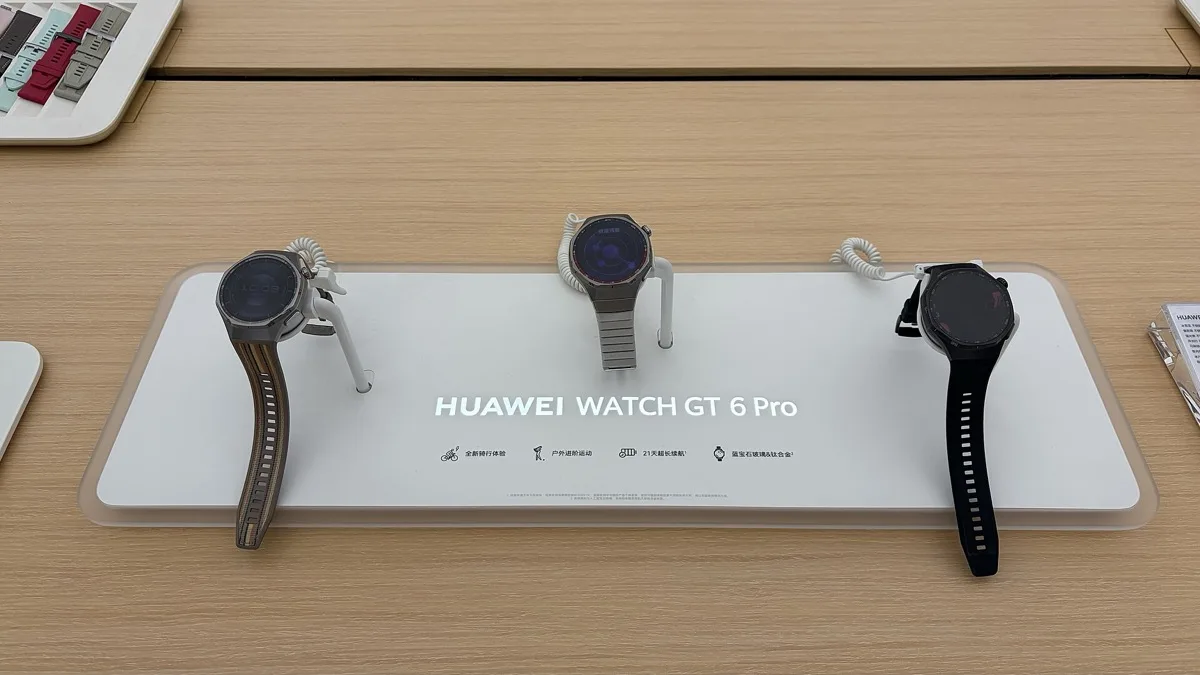
Prices and the three models
Huawei has confirmed Chinese pricing only, quoted here in the currency it was announced in:
- Watch GT 7, 41mm — CNY 1,588
- Watch GT 7, 46mm — CNY 1,688
- Watch GT 7 Pro — CNY 2,688
Buyers outside China should treat those as reference points rather than a guide to what they will pay. Huawei has typically brought the GT series to Europe, the Middle East and parts of Asia some weeks after a Chinese debut, at prices set locally, and nothing about a wider rollout has been confirmed this time.
What is actually new
The headline change is brightness. Both GT 7 sizes and the Pro use a 466 x 466 AMOLED display peaking at 3,000 nits — the 41mm measures 1.32 inches, the 46mm and the Pro 1.47 inches. Case dimensions are close to the previous generation, at roughly 9.9mm thick on the 41mm and 10.9mm on the 46mm.
Materials are where the Pro separates itself. The standard GT 7 keeps a stainless steel front case, while the Pro moves to titanium with sapphire crystal over the display and a ceramic back. Both carry 5ATM water resistance plus an IP69 rating, NFC for contactless payments, onboard GPS, Bluetooth 6.0, and a speaker and microphone for calls.
Battery life, and the caveat attached to it
Huawei's endurance claims are the reason this line sells, and they are unchanged in spirit. The 46mm GT 7 and the Pro are rated for up to 21 days of typical use, which drops to about 7 days with the always-on display enabled. The smaller 41mm is rated at up to 14 days typical, or roughly 5 days with always-on.
GPS endurance is quoted separately: up to 51 hours in trail running mode on the 46mm, and up to 32 hours on the 41mm. As with every manufacturer, these are best-case laboratory figures. Always-on display, frequent workout tracking with GPS, and continuous heart-rate monitoring are what actually decide whether you charge weekly or twice a week.
Health and sports tracking
Every model carries heart rate, SpO2 and skin temperature sensors, with more than 110 sport modes. The Pro adds two pieces of hardware the standard watch does not have: an ECG sensor, and a depth sensor rated for freediving to 40 metres.
On the software side Huawei lists running power metrics, a body readiness score, TrueSleep 5.0 for sleep analysis, and a Pro Ski mode that measures G-force, backed by an upgraded version of the company's Sunflower positioning system for better tracking on slopes. One notable omission: neither watch includes the X-Tap sensor found on Huawei's higher-end Watch models, so the fingertip-based measurements that sensor enables are not part of the GT 7.
The software question for buyers outside China
The GT 7 series runs HarmonyOS rather than Wear OS. In practice that means it pairs with both Android phones and iPhones through Huawei's own Health app, but it does not carry the Google Play services layer — no Google Wallet, no Google Maps on the wrist, and a much smaller third-party app selection than a Wear OS watch offers.
That trade is the entire proposition. You give up an app ecosystem and get battery life a Wear OS device cannot approach; the same tension shows up whenever a phone maker prioritises endurance over everything else, as with the Oppo A7 Pro Max and its 10,000mAh battery. If deep smartphone integration matters more to you than charging once a fortnight, a mainstream platform remains the safer buy — though as a Pixel Watch bug that broke health tracking showed, no ecosystem is trouble-free.
Should you wait?
If you are in China, the calendar is simple: 14 August for the GT 7, 28 August for the Pro. Everywhere else, there is nothing to pre-order and no announced date, so the only sensible move is to watch Huawei's regional channels rather than assume the Chinese prices will carry over.
Frequently Asked Questions
When does the Huawei Watch GT 7 go on sale?
In China, the standard Watch GT 7 goes on sale on 14 August and the Watch GT 7 Pro follows on 28 August. Huawei has not announced a release date for any other market. Previous GT models reached Europe and other regions some weeks after their Chinese debut, but nothing has been confirmed for this generation.
How much does the Huawei Watch GT 7 cost?
Huawei has only confirmed Chinese pricing: CNY 1,588 for the 41mm Watch GT 7, CNY 1,688 for the 46mm, and CNY 2,688 for the Watch GT 7 Pro. International prices have not been announced and are set locally, so they should not be assumed to match a straight conversion of the Chinese figures.
What is the difference between the Watch GT 7 and the GT 7 Pro?
The Pro upgrades the case to titanium with sapphire crystal and a ceramic back, where the standard model uses stainless steel. It also adds an ECG sensor and a depth sensor rated for freediving to 40 metres. Both share the same 466 x 466 AMOLED display technology and 3,000-nit peak brightness.
Does the Huawei Watch GT 7 really last 21 days?
That 21-day figure applies to the 46mm GT 7 and the Pro under light, typical use. Turning on the always-on display cuts it to around 7 days, and the smaller 41mm model is rated at 14 days typical or about 5 days with always-on. Heavy GPS workout tracking will reduce it further.
Does the Watch GT 7 work with Android phones and iPhones?
Yes. The series runs HarmonyOS rather than Wear OS and pairs with both Android phones and iPhones through Huawei's Health app. Because it has no Google Play services layer, you do not get Google Wallet, Google Maps on the wrist, or the wider Wear OS app catalogue.