The ASUS ROG Astral LC GeForce RTX 5090 (model ROG-ASTRAL-LC-RTX5090-32G-GAMING) is the standard, non-OC liquid-cooled member of ASUS's flagship Astral family. It uses NVIDIA's full GB202 Blackwell die — 21,760 CUDA cores, 32GB of GDDR7 on a 512-bit bus — on a slim 2.5-slot board bonded to a sealed 360mm all-in-one cooler, so nearly all of the 600W heat load leaves your case through the radiator rather than soaking into it.
This page covers both liquid-cooled Astral SKUs: the base card above and the higher-binned OC Edition (ROG-ASTRAL-LC-RTX5090-O32G-GAMING), which runs 2,610 MHz in OC Mode and launched at $3,099.99. Jump to the LC vs OC Edition comparison or the OC Edition overclocking results.
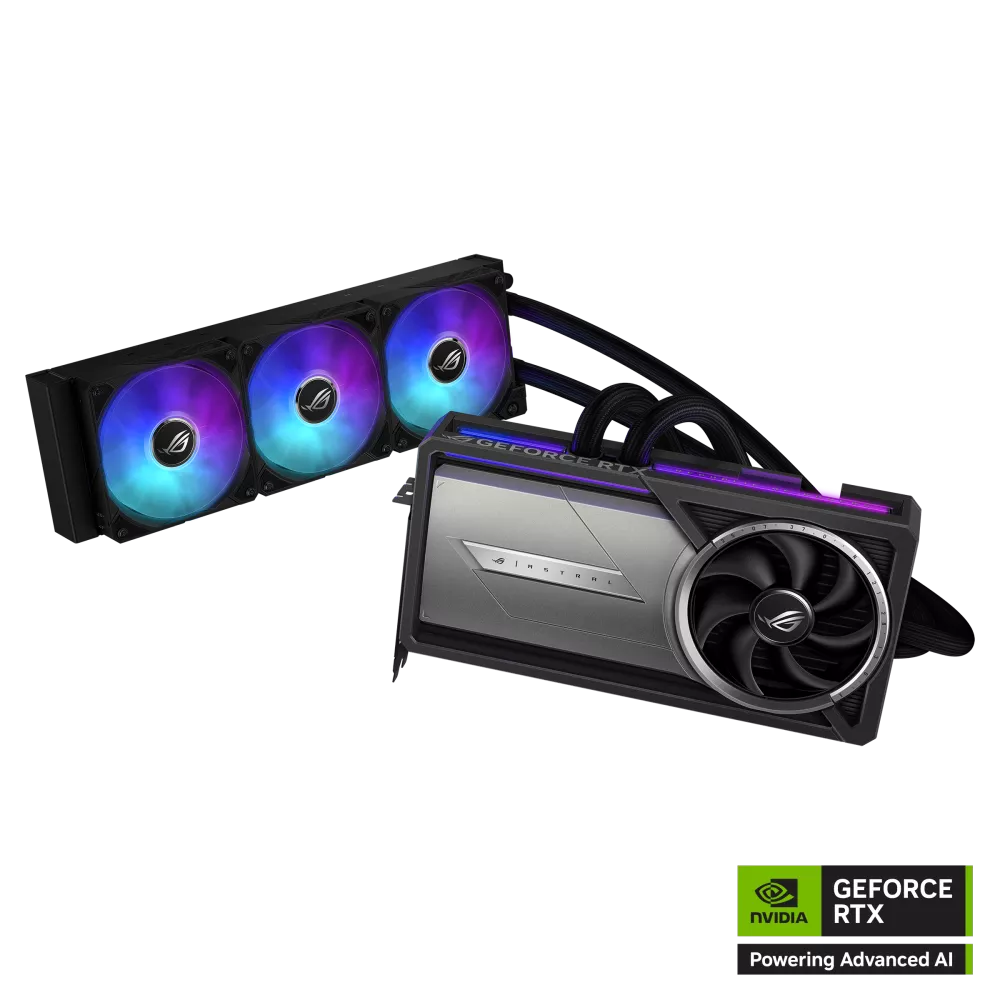
This is the model people usually mean when they search "ROG Astral LC RTX 5090", and it is easy to confuse with its pricier sibling. Per ASUS's own specification page, this base 32G card boosts to 2,437 MHz in Default Mode and 2,467 MHz in OC Mode. The Astral LC OC Edition (O32G) is the one that runs 2,580 / 2,610 MHz. Same cooler, same 600W ceiling, same board — different bin and a meaningfully higher price.
Quick verdict: If you have already decided on an RTX 5090 and can mount a 360mm radiator, the base Astral LC is the sensible way into ASUS's liquid-cooled flagship. The AIO is the strongest 5090 cooler TechPowerUp has measured — 58°C at the full 600W, and 30 dBA on the quiet BIOS — and you keep the 2.5-slot footprint, dual HDMI 2.1b and GPU Guard frame while skipping the OC Edition's premium for roughly 6% more factory clock. The catches are the price, radiator clearance and finding one in stock.
ASUS ROG Astral LC RTX 5090 (32G) full specifications
Every figure below is taken from ASUS's official spec sheet for the ROG-ASTRAL-LC-RTX5090-32G-GAMING and NVIDIA's GB202 reference data. Note the clocks: this is the non-OC SKU.
| Specification | Detail |
|---|---|
| GPU & Architecture | |
| GPU | NVIDIA GeForce RTX 5090 (Blackwell) |
| GPU Chip | GB202-300-A1 |
| Process Node | TSMC 4NP |
| Die Size | 750 mm² |
| Transistors | 92.2 billion |
| CUDA Cores | 21,760 |
| Streaming Multiprocessors | 170 SMs |
| RT Cores | 170 (4th Gen) |
| Tensor Cores | 680 (5th Gen) |
| ROPs | 176 |
| TMUs | 680 |
| AI Performance | 3,352 AI TOPS |
| Memory | |
| Capacity | 32GB GDDR7 |
| Memory Speed | 28 Gbps |
| Bus Width | 512-bit |
| Bandwidth | 1,792 GB/s |
| Clocks & Throughput (base LC, non-OC) | |
| Boost Clock (OC Mode) | 2,467 MHz |
| Boost Clock (Default Mode) | 2,437 MHz |
| Reference Boost (NVIDIA) | 2,407 MHz |
| Reference Base Clock | 2,017 MHz |
| FP32 Compute (at 2,467 MHz) | ~107.4 TFLOPS |
| Pixel Fill Rate | ~434 GPixel/s |
| Texture Fill Rate | ~1,678 GTexel/s |
| Cooling & Power | |
| Cooler Type | 360mm hybrid AIO liquid cooler (pump + coldplate on card) |
| Radiator | 400 x 120 x 65 mm (extra-thick 38mm core) |
| Radiator Fans | 3 x 120mm high-static-pressure |
| Total Graphics Power (TGP) | 600W |
| Power Connector | 1 x 16-pin (12V-2x6 / 600W) |
| Recommended PSU | 1000W |
| BIOS | Dual BIOS (Performance / Quiet) |
| VRM Cooling | Onboard axial fan + heatsink for board components |
| Display & I/O | |
| PCI Express | PCIe 5.0 x16 |
| HDMI | 2 x HDMI 2.1b |
| DisplayPort | 3 x DisplayPort 2.1b |
| Max Simultaneous Displays | 4 |
| Max Digital Resolution | 7680 x 4320 (8K) |
| Media Engine | 3x 9th-gen NVENC, 2x 6th-gen NVDEC, AV1 + 4:2:2 |
| Dimensions & Build | |
| Card Dimensions | 288.46 x 153.7 x 48 mm |
| Slot Width | 2.5 slots |
| Lighting | ARGB (Aura Sync) |
| Structural Frame | GPU Guard alloy backplate/frame |
| Safety | Power Detector+ per-pin 16-pin connector monitoring |
| Warranty | 3-year limited (US) |
ASUS ROG Astral LC RTX 5090 price and availability in 2026
Pricing on this card is genuinely messy, so here is what is actually documented rather than guessed.
- NVIDIA reference MSRP (RTX 5090): $1,999. Every Astral figure below is a premium on top of that.
- ASUS launch pricing: when ASUS published its US price list, the range-topping ROG Astral LC OC Edition was set at $3,099.99 and the air-cooled ROG Astral OC at $2,799.99, per Tom's Hardware. ASUS did not publish a separate US launch price for this non-OC LC (32G) SKU — it is a lower-volume variant that sits below the OC Edition, and in most regions it lands a little under that $3,099.99 figure.
- Street pricing in 2026: far above launch numbers. Liquid-cooled Astral 5090s have been sitting on Micro Center shelves at $3,719, a price point widely reported as buyer resistance, while ASUS's own eShop has listed the LC OC Edition as high as $4,529.99 in mid-2026.
- Stock reality: the base 32G LC is the harder of the two to find. Newegg carries the exact SKU but has shown it out of stock; most listings you will encounter are the O32G OC Edition or marketplace resellers.
What to do about it: treat anything at or under roughly $3,100 for the non-OC LC as a good price, $3,700 as the current shelf reality, and anything past $4,000 as OC-Edition-or-scalper territory. Because the two SKUs share a cooler and a 600W ceiling, if the OC Edition is only $100–$150 more at the moment you are shopping, take the OC Edition; if the gap is $400+, the base card is the better value.
Astral LC vs Astral LC OC Edition: specs, price and which to buy
This is the single most useful comparison for anyone on this page, because the two cards look identical in photos and differ only in silicon bin and firmware.
| Attribute | Astral LC (32G) — this card | Astral LC OC Edition (O32G) |
|---|---|---|
| Model number | ROG-ASTRAL-LC-RTX5090-32G-GAMING | ROG-ASTRAL-LC-RTX5090-O32G-GAMING |
| Default Mode boost | 2,437 MHz | 2,580 MHz |
| OC Mode boost | 2,467 MHz | 2,610 MHz |
| Clock uplift vs reference | +2.5% | +8.4% |
| Power limit | 600W | 600W |
| Cooler | Identical 360mm AIO, 38mm rad | Identical 360mm AIO, 38mm rad |
| Memory | 32GB GDDR7, 28 Gbps, 512-bit | 32GB GDDR7, 28 Gbps, 512-bit |
| US launch MSRP | Not separately published (below OC) | $3,099.99 |
| Availability | Scarce | More widely stocked |
Is the OC Edition worth it? On paper the OC Edition carries roughly a 5.8% higher boost clock. In practice the gap shrinks: both cards hit the same 600W wall, and once a 5090 is power-limited — which it is in any heavy 4K ray-traced scene — the extra rated clock cannot be sustained. Expect low single-digit frame-rate differences, not a tier change. Buy the OC Edition when the price gap is small or when you want the highest guaranteed bin for manual tuning; buy this base LC when you want the same cooler and the same 32GB framebuffer for meaningfully less money. If you do buy the OC Edition, the overclocking section below shows how to get the most from its higher bin.
OC Edition overclocking headroom: the strongest case for the O32G
If there is one reason to choose the OC Edition (O32G) over the base Astral LC or any other RTX 5090, it is this. TechPowerUp's tuning run on the Astral Liquid OC returned +8% real-world performance on top of the factory overclock — the best result in its RTX 5090 group, and notably above the +5% the same site achieved on the air-cooled Astral OC. Same silicon family, same 600W wall; the difference is thermal margin and bin quality.
What actually limits you
- Power, not temperature. The single 12V-2x6 connector caps the card at 600W and there is no higher power slider to unlock. At 58°C the cooler is nowhere near its limit — you run out of watts first. This is the opposite of the usual air-cooled situation and it is why a strong bin pays off here: a chip that does more work per watt converts directly into frames.
- Memory is capped at +375 MHz by NVIDIA on every RTX 5090, GDDR7 chip quality notwithstanding. Take the full +375; it is free performance and the modules are cooled by the same coldplate assembly.
- Voltage/frequency curve tuning beats a flat offset. Because the card is power-limited, an undervolt-plus-offset curve in GPU Tweak III frequently outperforms a raw core offset: the same 600W buys more sustained megahertz.
- The cooler has enormous reserve. Notebookcheck shunt-modded an Astral LC past 800W and the 360mm AIO still kept it under control, with performance climbing beyond stock. That voids your warranty and is not a recommendation — but it establishes how much thermal headroom is sitting unused at the stock 600W limit.
Practical target: enable OC Mode in GPU Tweak III (2,610 MHz), add the full +375 MHz to memory, then tune the V/F curve for stability at the power limit. That combination is what produced TechPowerUp's +8%. Expect a smaller gain in path-traced scenes, where you are hard against 600W from the first frame.
Measured thermals, acoustics and the dual-BIOS switch
The cooler is shared across both LC SKUs, so review data collected on the OC Edition sample applies directly here — if anything, the lower-clocked base card should sit fractionally cooler at the same power limit.
TechPowerUp's Astral LC testing recorded 58°C on the GPU core at the full 600W load, the best result of every RTX 5090 it has tested, and described the Astral LC cooler as the most powerful solution in the entire 5090 field. Out of the box the card measured 36 dBA. Flip the physical BIOS switch to the quiet profile and noise drops to 30 dBA — second-quietest 5090 tested — while temperature rises only to 64°C. That is an unusually cheap trade: 6°C for 6 dBA, which is roughly a halving of perceived loudness.
For context, an air-cooled RTX 5090 shedding 575–600W typically lives in the mid-to-high 70s°C and dumps all of that heat back into the chassis, warming your CPU cooler and drives along with it. The AIO's real-world benefit is as much about the rest of the build as the GPU itself.
Power behaviour and headroom
TGP is fixed at 600W through the single 12V-2x6 connector, and that ceiling — not temperature — is the limiter. Notebookcheck demonstrated the point by shunt-modding an Astral LC to around 800W, at which point the liquid cooler still coped and performance climbed past stock. That is a warranty-voiding experiment, not a recommendation, but it shows how much thermal margin the 360mm AIO holds in reserve. Within normal limits, expect roughly +5% from manual tuning; GDDR7 memory overclocking is capped by NVIDIA at +375 MHz on every RTX 5090.
Gaming and creator performance you should actually expect
Do not buy this card expecting a performance tier above other 5090s. At 2,467 MHz OC Mode it is a 2.5% clock bump over NVIDIA's 2,407 MHz reference, and reviewers measuring factory-overclocked Astral cards against the Founders Edition have found single-digit gains — around 8% in the best-case, clock-limited titles for the much higher-clocked OC bins, and considerably less for a card clocked like this one.
- 4K raster: comfortably the fastest consumer tier available; roughly 40% ahead of an RTX 4090 in 4K rasterisation, matching other stock 5090s within margin of error.
- Ray tracing and DLSS 4: 170 4th-gen RT cores and 680 5th-gen Tensor cores, with DLSS 4 Multi Frame Generation up to 4x. This is the card that makes maxed 4K path tracing playable without compromise.
- 8K and high-refresh: two HDMI 2.1b plus three DisplayPort 2.1b outputs and 8K support give it more display flexibility than the Founders Edition's single HDMI.
- AI and creator work: the full 32GB GDDR7 framebuffer at 1,792 GB/s is the real differentiator for local LLM inference, large-scene 3D and 8K video timelines. The AIO matters more here than in gaming, because these loads sit at 600W for hours rather than minutes.
The honest framing: you are paying for cooling, acoustics, build quality and case footprint. The frames are the same frames every 5090 delivers.
Radiator mounting, case compatibility and PSU requirements
More Astral LC buyers get caught out by physical fit than by anything else. Check all four of these before ordering.
- Radiator clearance: the radiator is 400 x 120 x 65 mm. That 400mm length is longer than a plain 360mm rad, and the 38mm-thick core plus fans needs roughly 65mm of depth. Cases rated for a "360mm AIO" do not automatically clear it — check the listed maximum radiator length and thickness, not just the fan size.
- Mount location: top-mounting is usually cleanest and exhausts heat straight out. Front-mounting works but pushes 600W of warm air over your motherboard and often conflicts with tall RAM or a front-panel drive cage. If your case already has a CPU AIO up top, you need a second 360mm position — this is the most common blocker.
- Tubing reach: the tubes run from a PCIe-slot card to the radiator, so a bottom-mounted or inverted-motherboard layout can leave you short. Dry-fit before screwing anything down.
- The card itself: 288.46mm long and 2.5 slots — genuinely modest by 5090 standards, and far easier to house than the 3.8-slot air Astral. That slot saving is a real benefit if you run a capture card or a second expansion card.
Power supply: ASUS specifies a 1000W minimum. Use a quality ATX 3.x / PCIe 5.1 unit with a native 12V-2x6 cable rather than an adapter octopus, seat the connector until it clicks, and avoid tight bends within ~35mm of the plug. ASUS's Power Detector+ monitors each pin individually and will warn you about an unbalanced connection — a feature worth having on a 600W card. If you also run a 250W+ CPU, step up to 1200W.
How it compares to other flagship RTX 5090 cards
| Card | Cooling | Boost (OC mode) | Power limit | Slot / footprint | Rec. PSU | Price |
|---|---|---|---|---|---|---|
| ASUS ROG Astral LC (32G) | 360mm AIO (400mm rad) | 2,467 MHz | 600W | 2.5-slot, 288mm card | 1000W | Below OC Edition; ~$3,100–$3,700 street |
| ASUS ROG Astral LC OC Edition | 360mm AIO (400mm rad) | 2,610 MHz | 600W | 2.5-slot, 288mm card | 1000W | $3,099.99 MSRP; ~$4,530 on ASUS eShop in 2026 |
| ASUS ROG Astral OC (air) | Quad-fan air | 2,610 MHz | 600W | 3.8-slot, 357.6mm | 1000W | $2,799.99 MSRP |
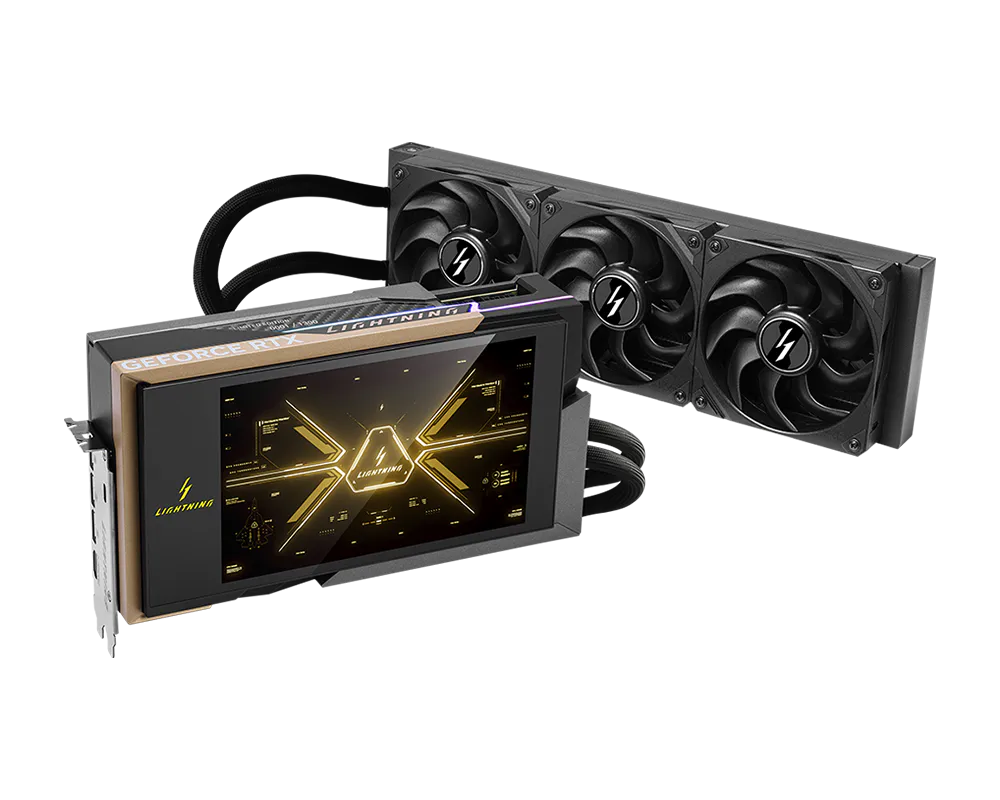
| MSI GeForce RTX 5090 Lightning Z | 360mm AIO | 2,775 MHz | 800–1,000W | Card + 360mm rad | 1600W+ | $5,090.99, lottery allocation |
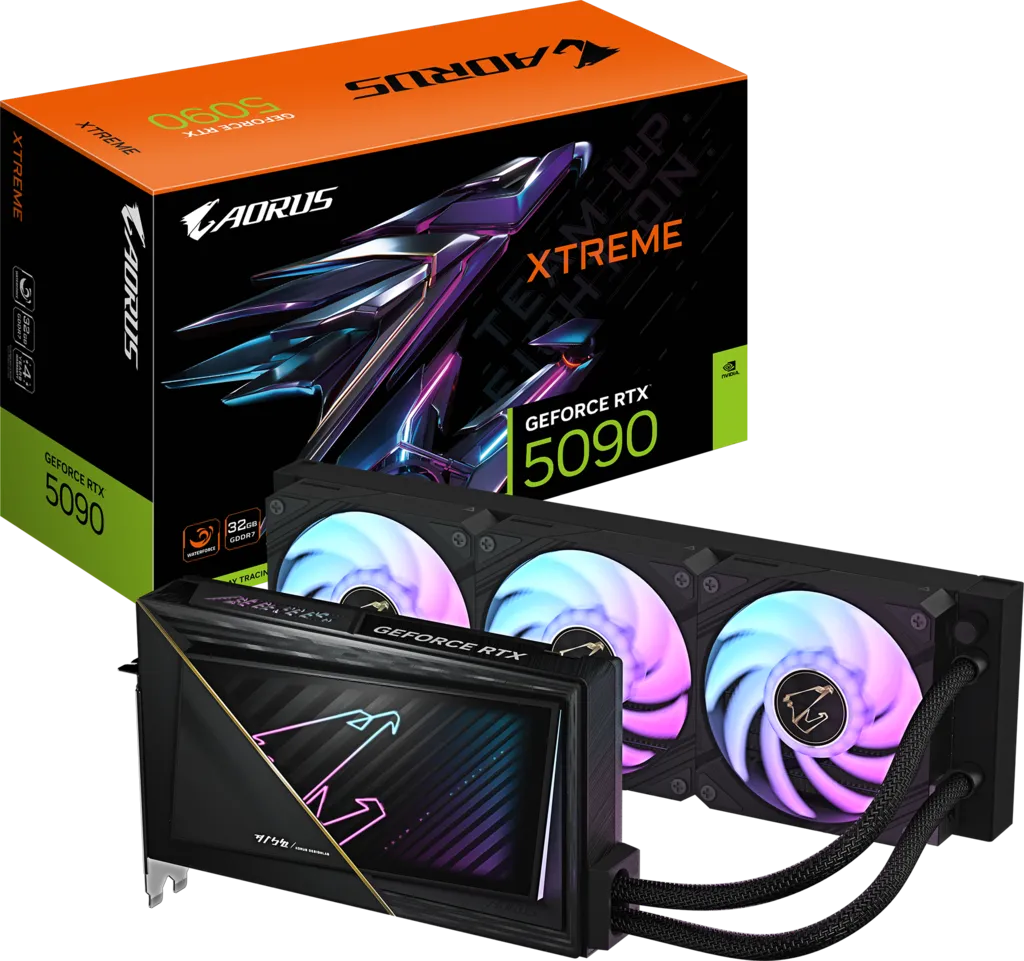
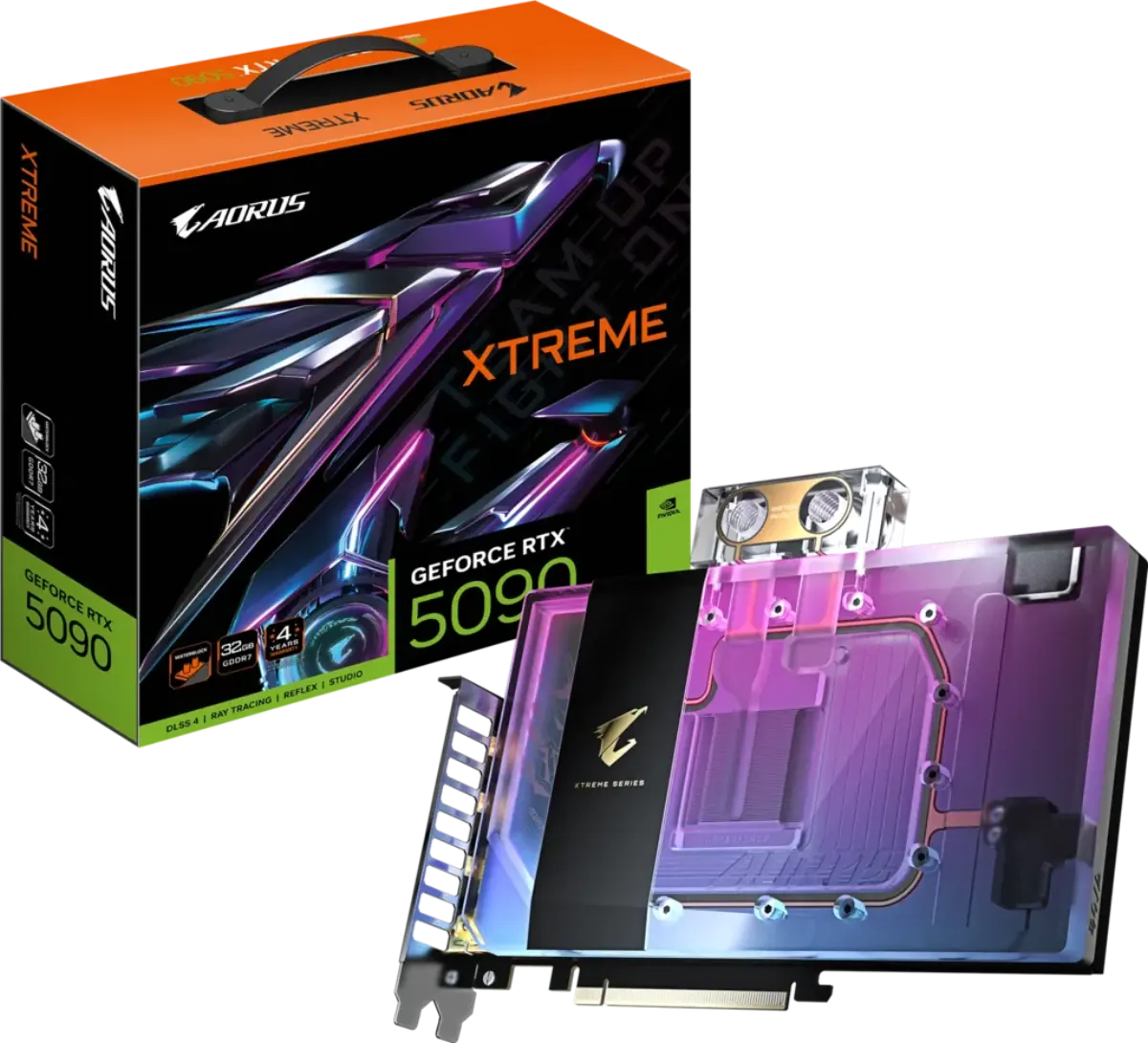
| Gigabyte AORUS RTX 5090 Xtreme Waterforce | 360mm AIO | Factory OC | 600W | Slim card + 360mm rad | 1000W | Above reference, varies |
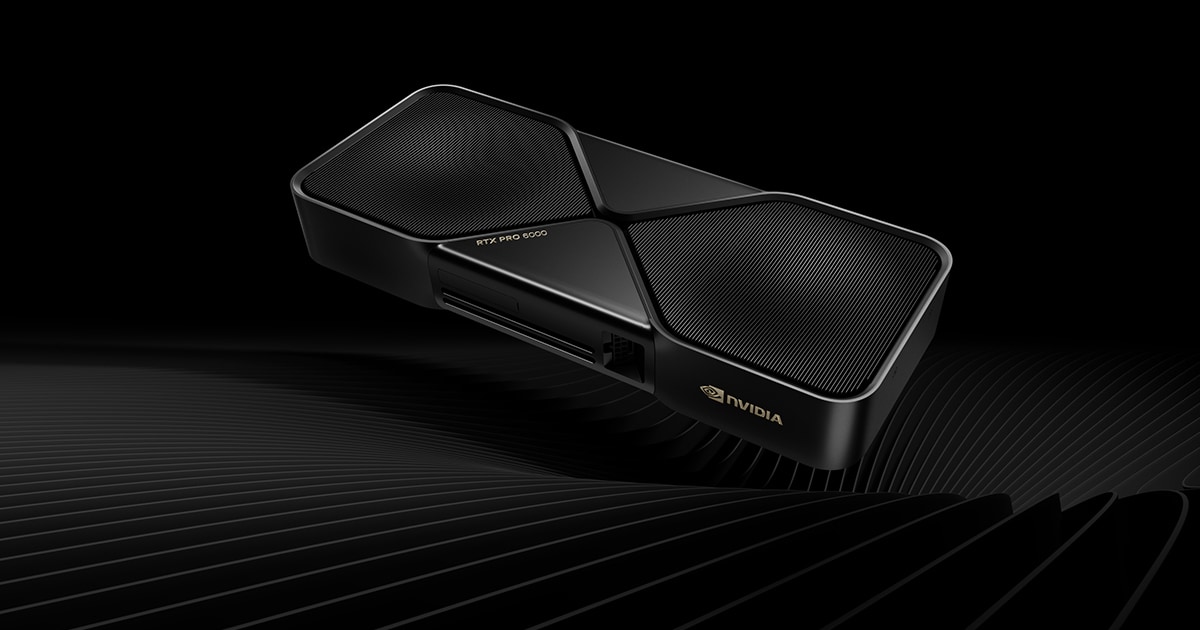
| NVIDIA RTX 5090 Founders Edition | Dual flow-through air | 2,407 MHz | 575W | 2-slot, 304mm | 1000W | $1,999 MSRP |
Read across the row and the positioning is clear. The Founders Edition is the value pick and the only one at MSRP. The MSI Lightning Z is the extremist option — a 1,000W-capable board with a 1,600W PSU demand and a lottery to buy it. The air Astral matches the LC OC's clocks but eats 3.8 slots. This base Astral LC is the balanced liquid-cooled entry: the field's strongest 5090 cooler and the smallest in-case card footprint, without paying the OC Edition or Lightning premium.
Pros, cons and who this card is for
✅ Pros
- Strongest RTX 5090 cooler tested: 58°C at the full 600W load
- Quiet BIOS drops noise to 30 dBA for only ~6°C, one of the best trades in the segment
- Compact 2.5-slot, 288mm card frees case space versus 3.8-slot air 5090s
- Heat is exhausted out of the chassis instead of into your CPU cooler and drives
- Full 32GB GDDR7 at 1,792 GB/s for 8K gaming, local AI and creator workloads
- Power Detector+ per-pin 12V-2x6 monitoring, GPU Guard alloy frame, dual BIOS
- Five outputs including two HDMI 2.1b; 3-year US warranty
- Cheaper than the LC OC Edition for the same cooler, board and framebuffer
❌ Cons
- Still a heavy premium over the $1,999 reference RTX 5090
- Lowest clocks of any Astral 5090 — only +2.5% over reference boost
- Needs clearance for a 400mm-long, 38mm-thick radiator plus fans
- Harder to find in stock than the OC Edition
- 600W draw requires a 1000W ATX 3.x PSU and a native 12V-2x6 cable
- The pump is a long-term failure point an air cooler does not have
- Memory OC capped at +375 MHz by NVIDIA across all 5090s
Buy it if you want the coolest, quietest RTX 5090 platform at the lowest entry point in the LC line, you have a confirmed 360mm radiator mount, and you value low noise and a slim card over the last few percent of clock speed — typical of 4K gaming rigs and AI or creator workstations that sit at 600W for hours.
Skip it if your case cannot take the radiator (get the air-cooled Astral OC), you want the highest factory bin and the price gap is small (get the LC OC Edition), you want maximum extreme-OC headroom (look at the MSI Lightning Z), or you simply want a 5090 for the least money — in which case the Founders Edition at $1,999 delivers the same class of frames.
Frequently Asked Questions
How much does the ASUS ROG Astral LC RTX 5090 cost?
ASUS never published a separate US launch price for the non-OC LC (32G) SKU; it sits below the LC OC Edition, which launched at $3,099.99 against the RTX 5090's $1,999 reference MSRP. In 2026 street pricing is far higher — liquid-cooled Astral 5090s have sat on Micro Center shelves at $3,719, and ASUS's own eShop has listed the LC OC Edition at $4,529.99. Treat anything at or under roughly $3,100 as a good deal.
What is the difference between the Astral LC and the Astral LC OC Edition?
Only the clock bin. The base LC (ROG-ASTRAL-LC-RTX5090-32G-GAMING) boosts to 2,437 MHz in Default Mode and 2,467 MHz in OC Mode; the OC Edition (O32G) runs 2,580 and 2,610 MHz. Cooler, PCB, 600W power limit, 32GB GDDR7 and outputs are identical. That is about a 5.8% clock difference on paper and low single-digit frames in practice, because both cards hit the same 600W wall.
Is the OC Edition worth the extra money over the base Astral LC?
Only if the price gap is small. Both cards are power-limited to 600W, so the OC Edition's higher rated clock cannot be fully sustained in heavy 4K ray-traced scenes. If the OC Edition is $100–$150 more, take it for the better bin; if it costs $400 or more extra, the base LC gives you the same cooler and framebuffer for less.
What boost clock does the non-OC ASUS Astral LC RTX 5090 run?
Per ASUS's official spec sheet, 2,437 MHz in Default Mode and 2,467 MHz in OC Mode (enabled through GPU Tweak III). That is a 2.5% uplift over NVIDIA's 2,407 MHz reference boost — the mildest factory overclock in the Astral 5090 range.
How hot does the ASUS Astral LC RTX 5090 get under load?
TechPowerUp measured 58°C on the GPU core at the full 600W load with the performance BIOS — the best result of any RTX 5090 it has tested. Switching to the quiet BIOS raises that only to about 64°C. Because the base LC is clocked lower than the OC Edition that was tested, it should sit at or slightly below those figures.
How loud is the Astral LC, and what does the quiet BIOS do?
Roughly 36 dBA out of the box. Flipping the physical BIOS switch to the quiet profile drops it to about 30 dBA — the second-quietest RTX 5090 tested — in exchange for around 6°C higher core temperature. That 6 dBA reduction is close to a halving of perceived loudness, so most owners should just use the quiet BIOS.
Will the 360mm radiator fit my case?
Check the numbers, not the marketing. The radiator is 400 x 120 x 65 mm with an extra-thick 38mm core, so it is longer and deeper than a typical 360mm AIO. Your case needs a listed maximum radiator length of at least 400mm and enough depth for the rad plus fans, and you need a free 360mm mount — if a CPU AIO already occupies the top position, this is usually the blocker. Also confirm the tubes reach from the PCIe slot to your chosen mount.
What PSU do I need for the ASUS Astral LC RTX 5090?
ASUS specifies a 1000W minimum. Use a quality ATX 3.x / PCIe 5.1 supply with a native 12V-2x6 cable rather than adapters, seat it fully until it clicks and avoid sharp bends near the plug. If you pair it with a 250W-plus CPU, move up to 1200W. ASUS's Power Detector+ monitors each connector pin individually and flags unbalanced current.
Is liquid cooling actually worth it on an RTX 5090?
For a 600W card, yes — but for cooling and noise, not frames. The AIO exhausts nearly all of that heat out of the chassis instead of into your CPU cooler, drives and VRMs, holds the core in the 50s°C, and lets the card run at 30 dBA. It also shrinks the in-case footprint to 2.5 slots versus 3.8 for the air Astral. It buys you a quieter, cooler, more stable system, not extra performance.
Is the Astral LC a good card for AI and creator workloads?
It is one of the better consumer options. The full 32GB GDDR7 framebuffer at 1,792 GB/s handles large local LLMs, heavy 3D scenes and 8K timelines, and the 3,352 AI TOPS Tensor pipeline accelerates inference. The liquid cooler matters more here than in gaming because these workloads hold the card at its 600W ceiling for hours rather than minutes.
How much overclocking headroom does the Astral LC have?
Around +5% from manual tuning within stock limits — the 600W power ceiling, not temperature, is the wall, and NVIDIA caps GDDR7 memory overclocking at +375 MHz on every RTX 5090. The cooler has far more capacity in reserve: Notebookcheck shunt-modded an Astral LC to roughly 800W and the AIO still kept it under control, though that voids the warranty.
How much does the ASUS ROG Astral LC RTX 5090 OC Edition cost in 2026?
It launched at $3,099.99, the top of ASUS's published US RTX 5090 price list. In 2026 street pricing is far higher: TechPowerUp noted a ~$3,720 US listing, Micro Center has sold liquid-cooled Astral 5090s at about $3,700, and ASUS's own eShop has listed the O32G as high as $4,529.99. Treat anything under $3,200 as an excellent price, $3,200-$3,800 as the realistic market, and above $4,600 as reseller territory.
What is the boost clock of the ASUS ROG Astral LC RTX 5090 OC Edition?
ASUS officially lists 2,580 MHz in Default Mode and 2,610 MHz in OC Mode, enabled through GPU Tweak III. That is 8.4% above NVIDIA's 2,407 MHz reference boost and the highest factory clock in the Astral RTX 5090 range, giving roughly 113.6 TFLOPS of FP32 throughput.
ASUS Astral LC OC vs MSI RTX 5090 Lightning Z - which should I buy?
The Lightning Z is rated higher on paper at 2,775 MHz with an 800-1,000W board, but it costs $5,090.99, was allocated by lottery in very small numbers and demands a 1,600W power supply. The Astral LC OC is the one you can realistically buy, needs only a 1000W PSU, and holds 58 degrees C at its 600W limit. Choose the Lightning Z only for extreme-OC ambitions and if you can actually get one.
Is the ASUS Astral LC OC Edition faster than a standard RTX 5090?
Yes, but by about 5% at 4K versus the Founders Edition in TechPowerUp's rasterisation testing - enough to top the chart, not enough to change what settings you can run. Every RTX 5090 uses the same fully enabled GB202 die and becomes power-limited at 600W in heavy ray-traced scenes. The Astral LC OC's real advantage is sustaining its clocks over hours without heat-soaking, plus the tuning headroom the cooler unlocks.