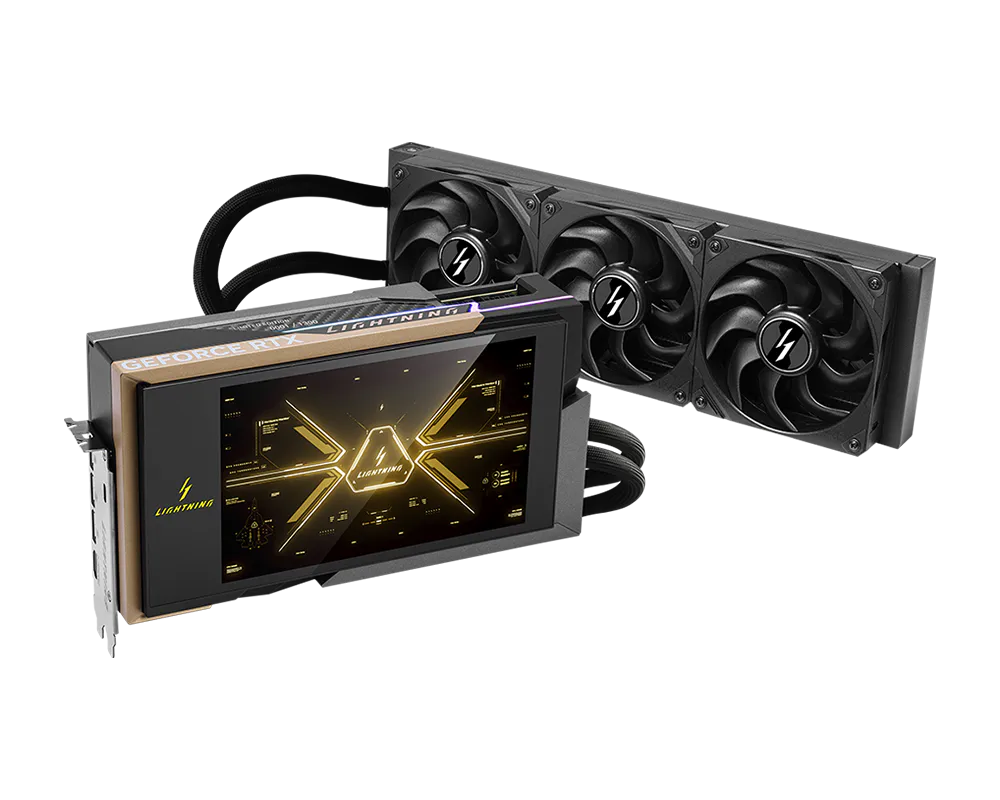
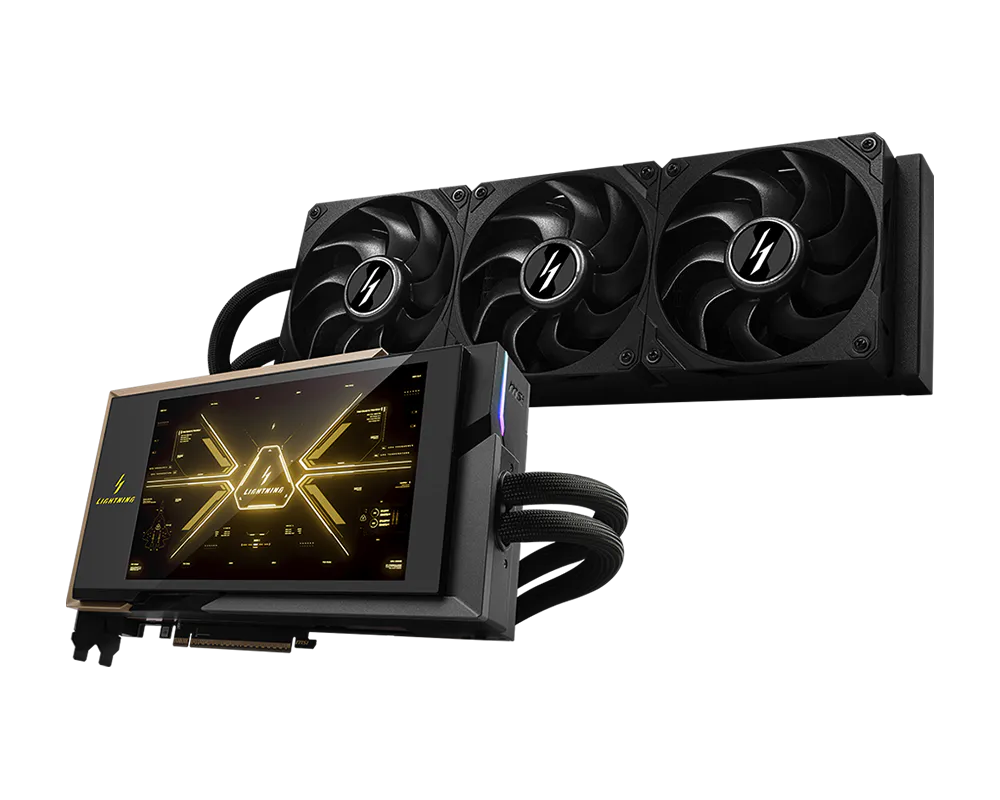
The MSI GeForce RTX 5090 Lightning Z is not a graphics card you add to a cart and check out. It is a halo, limited-edition (just 1,300 serialized units), lottery-purchase showpiece built on NVIDIA's flagship Blackwell GB202 silicon. The GPU die is the same chip found in every RTX 5090 — what changes is everything around it: a 40-phase VRM on a 3oz-copper PCB, two 600W 12V-2x6 power inputs, a factory 360mm AIO liquid cooler, the highest out-of-the-box clocks of any RTX 5090, and an industry-first 8-inch onboard display. Tom's Hardware nicknamed it “the RTX 5090 Ti.”
Quick verdict: The Lightning Z is the most over-built consumer GPU money can (barely) buy, and the best-cooling RTX 5090 ever measured — TechPowerUp recorded it running 31°C cooler than the Founders Edition at a matched 35 dBA. But its $5,090.99 MSRP is roughly 2.5× a standard RTX 5090 for about 10–11% more 4K gaming performance, and it sold out through a one-off draw in February 2026. It's a collector / record-chaser's trophy, not a sensible gaming purchase. Score: 82/100.
MSI RTX 5090 Lightning Z Price & Availability (July 2026)
This is the question almost everyone searching for this card is actually asking, so let's answer it plainly and honestly.
Official MSRP: $5,090.99 USD. MSI confirmed that price when it opened sales, as reported by VideoCardz. That is not a typo or a scalper figure — MSI deliberately priced the card at “5090” dollars as a nod to the model number.
You could not simply buy one. MSI produced only 1,300 serialized units worldwide and, in the United States, sold them through a lottery draw on the MSI US store rather than open retail. Entrants registered an email address on the MSI store draw page, and the entry window closed on 13 February 2026 at 10:00 AM PST. Winners were then invited to purchase at the $5,090.99 MSRP. Other regions received small allocations through selected partners and distributors rather than general stock.
Status as of July 2026: sold out, with no restock announced. The card is listed as unavailable at major US retailers that briefly carried it (Best Buy shows it as no longer available in new condition), MSI's own store page no longer takes orders, and MSI has not announced a second production run. Because the units are serialized and capped at 1,300, a genuine restock at MSRP is unlikely.
What it actually costs today. The only realistic route is the secondary market, and that market is brutal. Tom's Hardware documented eBay listings approaching $27,000 — roughly a 500% premium over MSRP. More grounded sold listings for sealed, new cards have generally landed in the $6,700–$8,800 range, with plenty of asks between $6,800 and $8,000. In other words: expect to pay somewhere between 1.3× and 5× MSRP depending on how patient you are, with no manufacturer warranty guarantees on a resold serialized unit.
| Channel | Price | Status (July 2026) |
|---|---|---|
| MSI official MSRP | $5,090.99 | Draw closed 13 Feb 2026 — sold out |
| US retail (Best Buy / Micro Center) | $5,090.99 when listed | No longer available new |
| eBay — typical sold price | ~$6,700–$8,800 | Available, no MSI warranty transfer guarantee |
| eBay — peak asking price | up to ~$27,000 | Speculative reseller listings |
| Standard RTX 5090 (reference) | $1,999 MSRP | Retail, widely available |
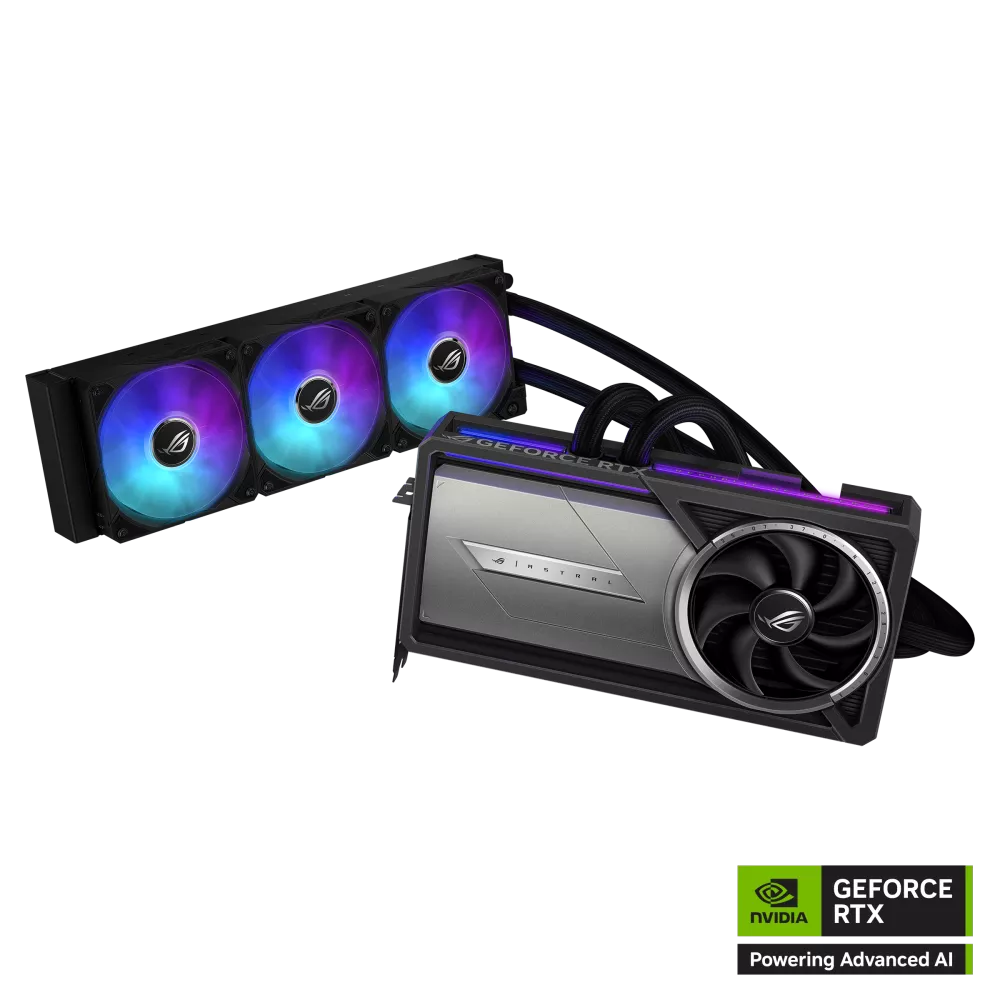
Our buying advice: at anything above MSRP you are paying purely for scarcity. If you want the performance rather than the trophy, a normal RTX 5090 gives you roughly 90% of the frame rate for under half the price, and a premium liquid-cooled AIB card like the ASUS ROG Astral LC RTX 5090 OC Edition delivers nearly the same thermals for well under $4,000.
MSI RTX 5090 Lightning Z — Full Specifications
Here is the complete, cross-checked spec sheet, verified against MSI’s official specification page, NVIDIA, TechPowerUp, VideoCardz and TweakTown. Figures MSI does not publish as a single fixed value are marked accordingly.
| Specification | Detail |
|---|---|
| GPU & Architecture | |
| GPU chip | NVIDIA GB202 (Blackwell) |
| Process node | TSMC 4NP (4nm-class) |
| Transistors | 92.2 billion |
| Streaming Multiprocessors | 170 SMs |
| CUDA cores | 21,760 |
| RT cores | 170 (4th gen) — 318 RT TFLOPS |
| Tensor cores | 680 (5th gen) — 3,352 AI TOPS |
| Clocks (highest of any RTX 5090) | |
| Reference base clock | 2,017 MHz |
| Reference boost clock | 2,407 MHz |
| MSI factory boost | 2,730 MHz |
| MSI “Extreme Performance” profile (MSI Center) | 2,775 MHz |
| Memory | |
| Memory size | 32 GB GDDR7 |
| Memory speed | 28 Gbps |
| Memory bus | 512-bit |
| Memory bandwidth | 1,792 GB/s |
| Power & Cooling | |
| Default power limit (“OC” BIOS) | 800 W |
| Max power limit (“Extreme” BIOS) | 1,000 W (requires both 12V-2x6 cables connected) |
| XOC BIOS (warranty-voiding) | up to ~2,500 W ceiling |
| VRM | 40-phase, on a 3oz-copper PCB |
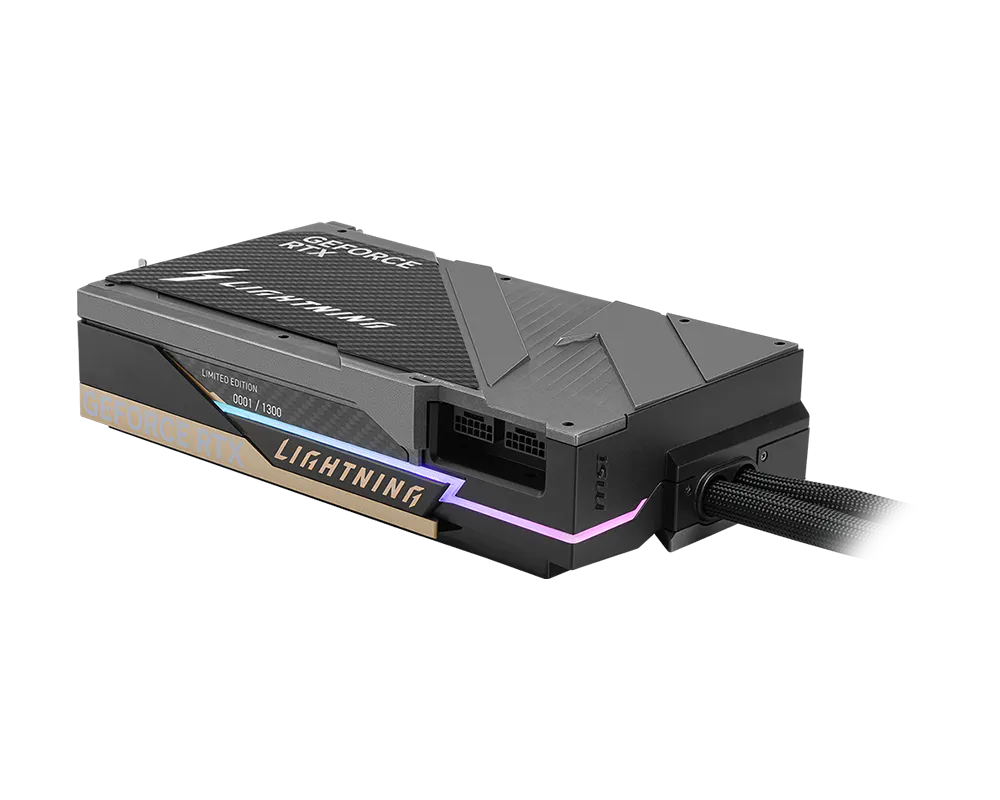
| Power connectors | 2× 16-pin 12V-2x6 (600 W each) |
| Recommended PSU (MSI official) | 1,600 W, with two native 12V-2x6 cables |
| Cooling | Custom 360mm AIO, full-coverage copper baseplate over GPU + VRM + memory, 3× radiator fans |
| Connectivity & Display | |
| Interface | PCIe 5.0 x16 |
| Display outputs | 3× DisplayPort 2.1b (UHBR20) + 1× HDMI 2.1b |
| Max resolution | 4K @ 480 Hz / 8K @ 165 Hz (with DSC) |
| DLSS | DLSS 4 with Multi Frame Generation (up to 4×) |
| Media engine | 3× 9th-gen NVENC, 2× 6th-gen NVDEC, AV1 encode + decode |
| Physical & Extras | |
| Card dimensions | 260 × 151 × 61 mm (3-slot) |
| Radiator dimensions | 394 × 120 × 56 mm (360mm class, 3× 120 mm fans) |
| Weight | 2,955 g (card) / 4,094 g (card + radiator) |
| Onboard display | 8-inch panel, usable as a secondary monitor (MSI Lightning Hub telemetry/media) |
| Availability & Price | |
| Launch | February 2026 — 1,300 serialized units, US lottery draw |
| Price (MSRP) | $5,090.99 (≈2.5× the RTX 5090's $1,999) |
What Actually Makes the Lightning Z Different
Because the die is identical to every other RTX 5090, the Lightning Z's value lives entirely in its board, power delivery and cooling:
- Class-leading power delivery: a 40-phase VRM on a 3oz-copper PCB, fed by two 600 W 12V-2x6 connectors — against a ~575 W ceiling on the Founders Edition. TechPowerUp’s hands-on teardown confirmed the 40-phase count and the 2,500 W XOC BIOS.
- Huge power-limit headroom: an 800 W default BIOS, a 1,000 W “Extreme” BIOS that requires both cables, and an enthusiast ~2,500 W XOC BIOS intended for LN2-class record runs.
- Highest factory clocks of any 5090: 2,730 MHz boost out of the box, rising to 2,775 MHz on the “Extreme Performance” profile in MSI Center — roughly 15% above NVIDIA's 2,407 MHz reference boost.
- 360mm AIO liquid cooling with a copper baseplate covering GPU, VRM and memory — the single biggest reason this card behaves like an “RTX 5090 Ti” rather than a throttling space heater.
- 8-inch onboard display that Windows treats as a genuine secondary monitor, not just a gimmick LCD.
- Collector exclusivity: 1,300 serialized units, sold by draw.
Gaming Performance & Benchmarks
Reviewers converged on a consistent number: the Lightning Z lands roughly 10–11% ahead of the RTX 5090 Founders Edition in 4K gaming. TweakTown measured an average 11.4% uplift at 4K, with a best case of 19.8% in DOOM: The Dark Ages with ray tracing — a title heavy enough to actually exploit the extra power budget. TechPowerUp concluded the card “delivers what we'd expect from a hypothetical RTX 5090 Ti.”
Two caveats matter a lot for buyers:
- The 1,000 W BIOS barely helps in games. Tech-Critter measured only 0–1% variance in synthetic tests and ±1.5% in 4K gaming between the 800 W and 1,000 W profiles. Blackwell simply runs into voltage and frequency walls long before it runs out of watts. The extra 200 W is there for sub-ambient overclocking, not for Cyberpunk.
- The underlying silicon is the same GB202. An RTX 5090 is roughly 50% faster than an RTX 4090 in 4K rasterization and around 33% faster in 4K ray tracing, with 32 GB of GDDR7 against the 4090's 24 GB. The Lightning Z inherits that, then adds its ~10%.
With DLSS 4 Multi-Frame Generation in a path-traced 4K title like Cyberpunk 2077, the card jumps from roughly 30 FPS native to the 280–290 FPS range (three AI-generated frames per rendered frame). Read that number carefully: MFG multiplies visual smoothness, not input latency. A “280 FPS” reading that is mostly generated does not feel like true native 280 FPS.
Thermals, Noise & Overclocking
This is where the Lightning Z genuinely has no rival, and where the price starts to look at least defensible.
TechPowerUp’s normalized cooler comparison — every card set to the same 35 dBA noise output — put the Lightning Z:
- 31°C cooler than the NVIDIA RTX 5090 Founders Edition
- 15°C cooler than a typical “good” air-cooled RTX 5090
- 5°C cooler than other premium liquid-cooled RTX 5090 models
On acoustics it is equally emphatic. In the default 800 W OC BIOS the card measures 29 dBA under a full load — quieter than nearly every RTX 5090 TechPowerUp has tested, despite dissipating 40% more heat than a reference card. Switch to the 1,000 W Extreme BIOS and it rises to 36 dBA, still audibly quieter than the Founders Edition at its stock 575 W. Testing at Tech-Critter also found the 12V-2x6 connectors holding steady at around 42°C under sustained load, which is reassuring given the connector melting saga that followed the 4090.
| Metric | Lightning Z (800 W BIOS) | Lightning Z (1,000 W BIOS) | RTX 5090 Founders Edition |
|---|---|---|---|
| Noise under full load | 29 dBA | 36 dBA | Louder than both |
| Cooling at matched 35 dBA | Best of any RTX 5090 tested | 31°C hotter than Lightning Z | |
| Power connector temp | ~42°C sustained | — | |
| Board power | 800 W | 1,000 W | 575 W |
Overclocking headroom. Out of the box the Lightning Z is already the most aggressively clocked RTX 5090 on the market at 2,730–2,775 MHz, so the easy gains are pre-banked. Adding the 1,000 W BIOS on top buys you almost nothing in games (see above) because Blackwell is frequency- and voltage-limited rather than power-limited on ambient cooling. The real headroom only opens up on sub-ambient cooling, which is exactly what the ~2,500 W XOC BIOS exists for — MSI used the platform to break a series of world records. That BIOS voids the warranty, and it is genuinely risky: Notebookcheck reported a Lightning Z cracking from thermal shock during a 2,500 W BIOS test session. Unless you own an LN2 pot and know how to use it, leave the card on its 800 W profile.
Lightning Z vs Other Flagship RTX 5090 Cards
The honest comparison isn't Lightning Z versus the Founders Edition — it's Lightning Z versus the other liquid-cooled AIB flagships you can actually walk into a store and buy.
| Spec | MSI RTX 5090 Lightning Z | ASUS ROG Astral LC OC | Gigabyte AORUS 5090 XTREME WATERFORCE | Gigabyte AORUS 5090 Master | RTX 5090 Founders Edition |
|---|---|---|---|---|---|
| Factory boost | 2,730 MHz (2,775 MHz profile) | 2,610 MHz | 2,655 MHz | 2,617 MHz | 2,407 MHz |
| Power limit | 800 W / 1,000 W | 600 W | 600 W | 600 W | 575 W |
| VRM | 40-phase, 3oz copper PCB | Premium (80A MOSFETs) | Premium AORUS design | Premium AORUS design | Reference |
| Cooling | 360mm AIO (GPU+VRM+VRAM block) | 360mm AIO | 360mm AIO | Triple-fan air | Dual flow-through air |
| Power connectors | 2× 12V-2x6 | 1× 12V-2x6 | 1× 12V-2x6 | 1× 12V-2x6 | 1× 12V-2x6 |
| Recommended PSU | 1,600 W | 1,000 W | 1,000 W | 1,000 W | 1,000 W |
| Extra features | 8-inch secondary display, 2,500 W XOC BIOS | Per-pin connector monitoring | LCD panel | LCD panel | — |
| Availability | 1,300 units, draw only — sold out | Limited retail | Retail | Retail | Retail |
| Typical price | $5,090.99 MSRP (~$6,700+ resale) | ≈$3,100–$3,400 | ~$2,900–$3,300 | ≈$2,499–$2,899 | $1,999 MSRP |
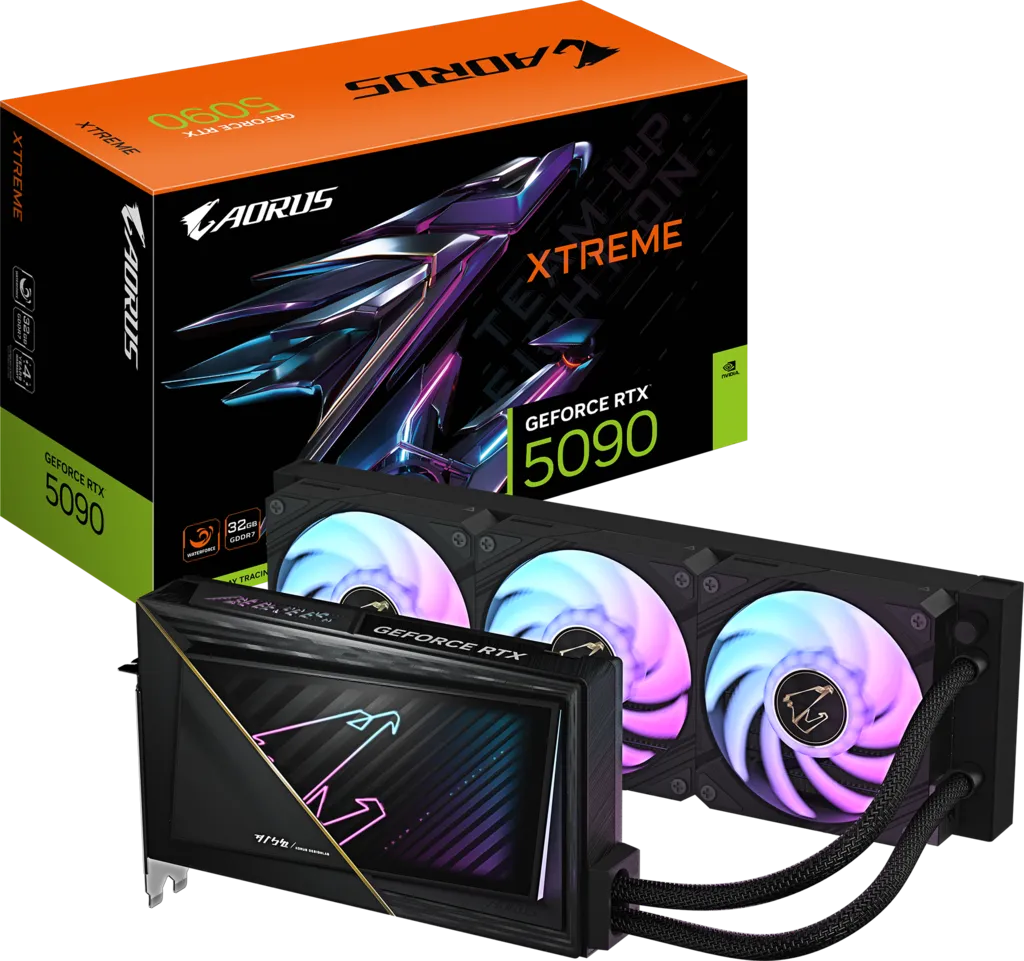
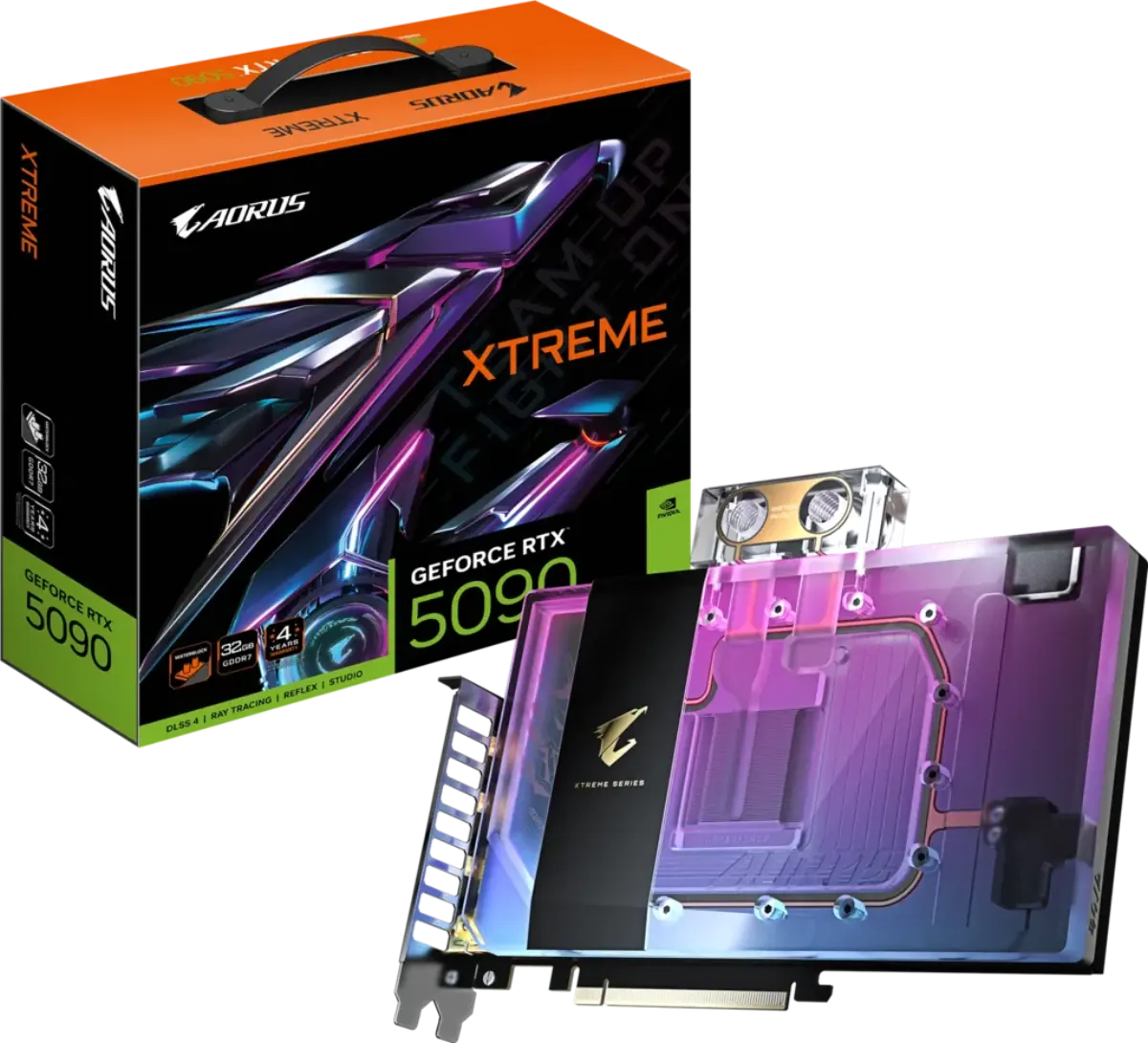
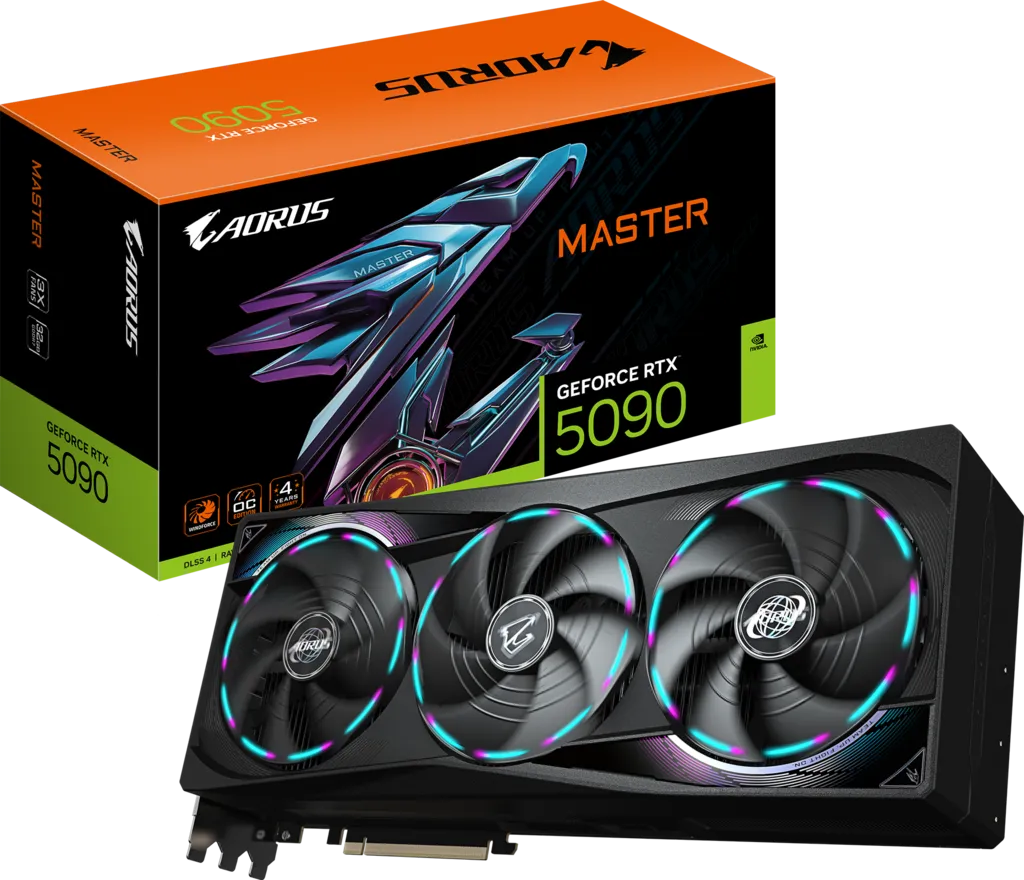
Read across that table and the picture is clear. The Lightning Z wins outright on clocks, power headroom, VRM and cooling — but the ASUS ROG Astral LC OC Edition gets you within a few degrees on thermals for roughly $1,700 less and no lottery, and the AORUS RTX 5090 Master is the best pure air-cooled option if you don't want a radiator in your case at all. If you specifically want a liquid-cooled AORUS, the AORUS RTX 5090 XTREME WATERFORCE occupies similar ground.
PSU & Case-Fit Requirements
The Lightning Z is one of the few consumer GPUs that can invalidate an otherwise excellent PC build. Check all of the following before chasing one.
Power supply
- MSI officially recommends a 1,600 W PSU — not a suggestion you can shave. A 1,000 W unit that happily runs a reference RTX 5090 is not adequate here.
- You need two native 12V-2x6 (16-pin) cables from the PSU. Daisy-chained or double-headed adapters off a single rail are not appropriate at 600 W per connector.
- An ATX 3.1 / PCIe 5.1-compliant unit is strongly preferred for its transient-spike tolerance; Blackwell flagships produce very sharp millisecond-scale power excursions.
- One cable is enough for normal operation on the 800 W BIOS. The second connector is mandatory to unlock the 1,000 W Extreme BIOS.
- Practical note: at 800 W GPU plus a high-end CPU, a single 15 A / 120 V household circuit is close to its comfortable continuous limit. In North America, do not share the circuit with a space heater or kettle.
Case fit
- The card body is 260 × 151 × 61 mm and occupies three slots — shorter than most air-cooled 5090s, so the PCB itself is the easy part.
- The hard part is the radiator: 394 × 120 × 56 mm. You need a case with a genuine 360mm radiator mount with clearance for a 56 mm-thick rad plus fan thickness. Many mid-towers advertise 360mm support in the front only, which then conflicts with a front-mounted CPU AIO.
- Plan for two 360mm radiators if you're also liquid-cooling the CPU. In practice that means a full tower or a large mid-tower with top and front 360mm mounts.
- Total assembly weight is 4,094 g across card and radiator. Use the supplied support bracket, and route the tubing so the pump block isn't pulling on the PCIe slot.
- Airflow matters even with an AIO: the 40-phase VRM and the 8-inch display assembly still dump heat into the chassis.
Is the Lightning Z Worth It?
Split the question in two, because the answer differs completely.
As an engineering artifact: yes, unreservedly. It is the coolest-running, quietest, highest-clocked RTX 5090 ever measured, with power delivery that no other consumer card approaches. TechPowerUp's “RTX 5090 Ti” framing is fair.
As a purchase: no, for almost everyone. You pay 2.5× the $1,999 reference MSRP — more like 3.5× on the resale market — for 10–11% more frames, and you also inherit a 1,600 W PSU requirement and a 360mm radiator mounting problem. The price-per-frame is among the worst in PC hardware.
Buy it if you are a collector or extreme overclocker, you have the sub-ambient gear to use the XOC BIOS, and price genuinely is not a factor. Skip it if you want the fastest gaming card for the money — a standard RTX 5090, or a liquid-cooled AIB like the ASUS ROG Astral LC, delivers roughly 90% of the performance for a fraction of the cost and none of the hassle.
Pros and Cons
✅ Pros
- Highest factory clocks of any RTX 5090 (2,730 MHz, up to 2,775 MHz profile)
- Best-measured RTX 5090 cooling — 31°C cooler than the FE at matched 35 dBA
- Remarkably quiet: 29 dBA at a full 800 W load
- 40-phase VRM on 3oz copper with dual 600 W 12V-2x6 inputs
- 800 W default / 1,000 W Extreme headroom, plus a ~2,500 W XOC BIOS for record runs
- Full 32 GB GDDR7, DisplayPort 2.1b, HDMI 2.1b, DLSS 4 MFG
- 8-inch onboard display that works as a real secondary monitor
- Serialized 1,300-unit run — genuine collector value
❌ Cons
- $5,090.99 MSRP — ~2.5× the RTX 5090's $1,999, and far more on resale
- Only ~10–11% faster than a standard 5090 at 4K
- The 1,000 W BIOS adds almost nothing in games (±1.5%)
- Draw-only availability; sold out since February 2026 with no restock
- Requires a 1,600 W PSU with two native 12V-2x6 cables
- Needs a case with a free 360mm radiator mount (394 mm rad, 4.1 kg assembly)
- The 2,500 W XOC BIOS voids the warranty and has caused a documented thermal-shock failure
The Bottom Line
As an engineering showpiece the Lightning Z is close to flawless — the most powerful, most over-built consumer GPU available, with cooling and power delivery designed for record-chasing rather than for gaming. As a purchase it only makes sense for collectors and extreme overclockers, and in July 2026 it isn't really a purchase at all: it's a secondary-market hunt at multiples of an already extreme $5,090.99 MSRP. For everyone else, a standard RTX 5090 — or the ASUS ROG Astral LC RTX 5090 if you want premium liquid cooling you can actually buy — is the smarter card. Our score: 82/100.
Related reading
Gallery
Images: MSI
Frequently Asked Questions
How much does the MSI RTX 5090 Lightning Z cost?
MSI set the official MSRP at $5,090.99 — roughly 2.5 times the RTX 5090's $1,999 reference MSRP. Because the card sold out, the only route today is the secondary market, where sealed units typically sell for about $6,700 to $8,800 and speculative eBay listings have reached nearly $27,000.
Can you still buy the RTX 5090 Lightning Z in 2026?
Not at retail. MSI built only 1,300 serialized units and sold the US allocation through a lottery draw whose entry window closed on 13 February 2026. As of July 2026 the card is listed as unavailable at retailers such as Best Buy, MSI has announced no restock, and the only realistic source is resale.
How much faster is the Lightning Z than a normal RTX 5090?
About 10–11% faster at 4K. TweakTown measured an 11.4% average uplift over the RTX 5090 Founders Edition, with a best case of 19.8% in DOOM: The Dark Ages with ray tracing. The GPU die is the same GB202 chip used in every RTX 5090 — the gain comes from clocks and power headroom.
What power supply do I need for the RTX 5090 Lightning Z?
MSI officially recommends a 1,600W PSU with two native 12V-2x6 (16-pin) cables. One connector is enough for the default 800W OC BIOS, but both are required to unlock the 1,000W Extreme BIOS. An ATX 3.1 / PCIe 5.1-compliant unit is strongly preferred for transient-spike tolerance.
Will the RTX 5090 Lightning Z fit in my case?
The card body is 260 x 151 x 61 mm and occupies three slots, which is shorter than most air-cooled RTX 5090s. The constraint is the 360mm radiator, which measures 394 x 120 x 56 mm and needs a dedicated mount — plan for a full tower or a large mid-tower if you also run a CPU AIO. The full assembly weighs about 4.1 kg.
How cool and quiet is the Lightning Z?
It is the best-cooling RTX 5090 measured to date. In TechPowerUp's noise-normalized 35 dBA comparison it ran 31°C cooler than the Founders Edition, 15°C cooler than a good air-cooled RTX 5090 and 5°C cooler than other premium liquid-cooled models. It measures 29 dBA under a full 800W load and 36 dBA on the 1,000W BIOS.
Is the Lightning Z better than the ASUS ROG Astral LC RTX 5090?
On paper yes — higher factory clocks (2,730 MHz vs 2,610 MHz), a much larger power ceiling (800–1,000W vs 600W) and a 40-phase VRM. But the ROG Astral LC OC Edition costs roughly $3,100–$3,400, is buyable at retail, needs only a 1,000W PSU, and lands within a few degrees on thermals. For most buyers the Astral LC is the better card.
Lightning Z vs Gigabyte AORUS RTX 5090 Master — which should I get?
The AORUS Master is the best pure air-cooled RTX 5090, boosting to 2,617 MHz at a 600W limit for roughly $2,499–$2,899, with no radiator to mount. Choose it if you want flagship build quality without liquid cooling. The Lightning Z only makes sense if you want the absolute extreme and can find one.
How much overclocking headroom does the Lightning Z have?
Less than the 1,000W BIOS suggests. Tech-Critter measured only 0–1% variance in synthetic tests and about ±1.5% in 4K gaming between the 800W and 1,000W profiles, because Blackwell hits voltage and frequency walls before it runs out of power. Real headroom only opens up on sub-ambient cooling with the ~2,500W XOC BIOS.
Is the RTX 5090 Lightning Z worth the premium?
For gaming, no. You pay about 2.5x the reference MSRP for 10–11% more frames, plus a 1,600W PSU requirement and a 360mm radiator mounting problem. It is worth it only for collectors and extreme overclockers who value the serialized 1,300-unit run and the XOC platform, and for whom price is not a consideration.