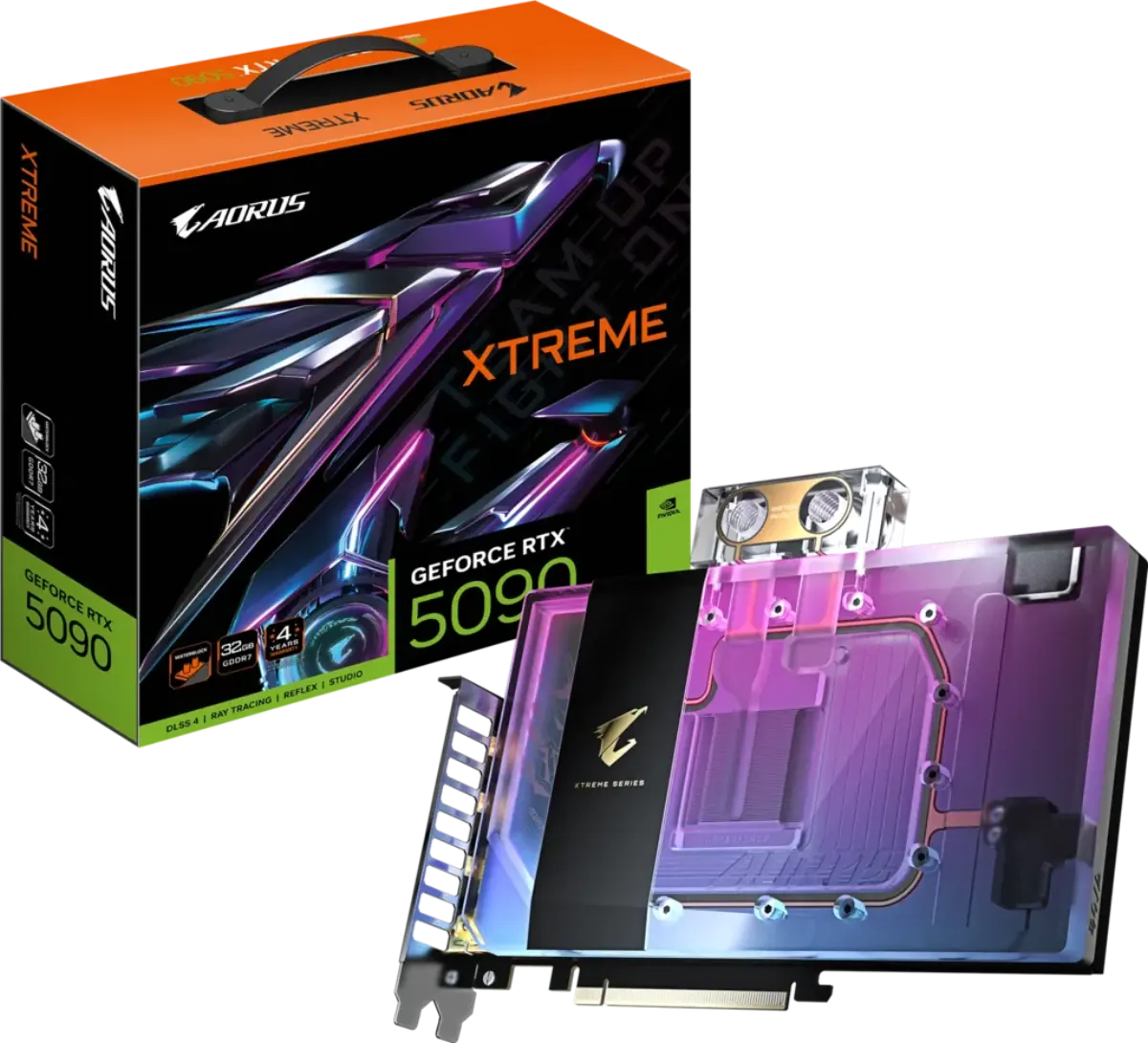
The Gigabyte AORUS GeForce RTX 5090 Master 32G (model GV-N5090AORUS M-32GD) is the air-cooled flagship of Gigabyte's RTX 5090 range and, for most buyers, the one of the four AORUS cards that actually makes sense. It drops NVIDIA's fully-enabled GB202 Blackwell die — 21,760 CUDA cores, 170 SMs and a 512-bit GDDR7 bus — under a 360 mm triple-fan WINDFORCE cooler with a vapor chamber, and ships at a 2,655 MHz boost clock against the 2,407 MHz reference figure, per Gigabyte's official specification sheet.
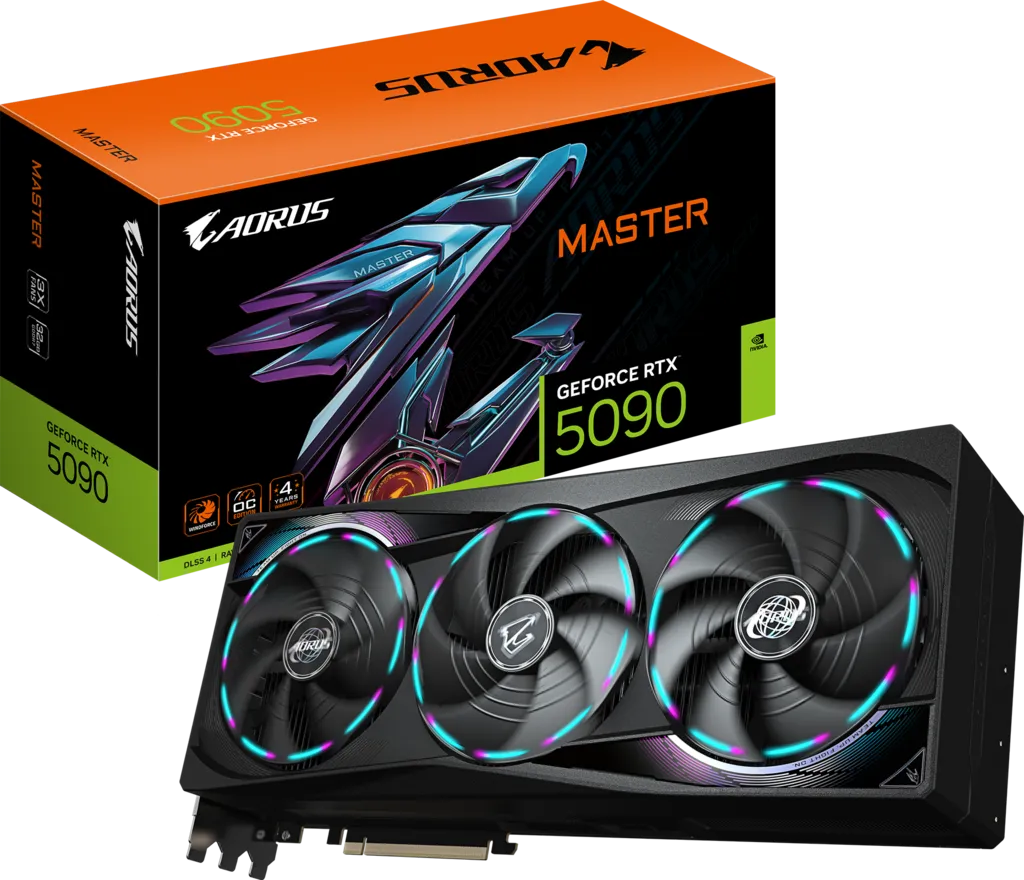
Unlike the XTREME WATERFORCE it needs no radiator mount, and unlike the WATERFORCE WB it needs no custom loop. You unbox it, seat one 12V-2x6 cable, and you have the fastest consumer GPU on the market running in the mid-60s°C. The price you pay for that convenience is physical: 360 × 150 × 75 mm is a genuinely enormous card that will not fit a large share of mid-tower cases.
Quick verdict: The AORUS RTX 5090 Master is the best air-cooled RTX 5090 package you can buy — a huge vapor-chamber cooler, a Dual BIOS with a genuine Silent mode, an LCD Edge View screen and a 4-year registered warranty. Its weaknesses are size (360 mm, ~4 slots), a power limit that reviewers found completely unadjustable, and a 2026 street price that has drifted far above its original positioning because of the GDDR7 supply crunch. If you want flagship air cooling and your case can take it, it is a 9/10 card.
AORUS RTX 5090 Master full specifications
Every figure below is from Gigabyte's published spec sheet or NVIDIA's GB202 reference data unless noted.
| Specification | Detail |
|---|---|
| GPU & Architecture | |
| GPU | NVIDIA GB202-300-A1 (Blackwell) |
| Process Node | TSMC 4N |
| Die Size | 750 mm² |
| CUDA Cores | 21,760 |
| Streaming Multiprocessors | 170 |
| Tensor Cores | 680 (5th Gen) |
| RT Cores | 170 (4th Gen) |
| Interface | PCI-E 5.0 |
| Memory | |
| Capacity | 32 GB GDDR7 |
| Memory Bus | 512-bit |
| Memory Clock | 28 Gbps |
| Bandwidth | 1.79 TB/s |
| Clocks & Power | |
| Boost Clock (this card) | 2,655 MHz |
| Reference Boost Clock | 2,407 MHz |
| Base Clock | 2,017 MHz |
| FP32 Compute | ≈115.5 TFLOPS |
| Total Graphics Power | 575 W |
| Measured Peak Draw | ≈615 W (Overclockers.com) |
| Power Connector | 1× 16-pin (12V-2x6) |
| Adapter Included | 1× 12V-2x6 to 4× PCIe 8-pin |
| Recommended PSU | 1,000 W |
| Cooling & Build | |
| Cooler | WINDFORCE: Hawk fans with alternate spinning, large vapor chamber, superconducting heat pipes |
| Thermal Interface | Composite metal grease on GPU, server-grade conductive gel on VRAM/MOSFETs |
| BIOS | Dual BIOS — Performance (default) / Silent |
| Card Size | L=360 × W=150 × H=75 mm |
| Slot Width | ≈3.7–4 slots (75 mm thick) |
| Display / Lighting | LCD Edge View screen, RGB Halo through-line lighting |
| Structure | Reinforced metal backplate tied to I/O bracket, die-cast metal frame |
| Outputs & Support | |
| DisplayPort | 3× DisplayPort 2.1b |
| HDMI | 1× HDMI 2.1b |
| Max Resolution | 7680 × 4320 |
| Multi-view | Up to 4 displays |
| In the box | Quick guide, 12V-2x6 adapter, AORUS stickers, versatile VGA holder |
| Warranty | 4 years (online registration required) |
AORUS RTX 5090 Master price and availability (July 2026)
This is the single most important section on the page, because RTX 5090 pricing in 2026 bears no relationship to 2025 MSRPs. The GDDR7 supply crunch driven by AI datacentre demand has pushed board prices up repeatedly through the year — TechPowerUp reported NVIDIA preparing an RTX 5090 price hike on the back of rising GDDR7 costs, and street prices have followed.
| Where | Price | Status |
|---|---|---|
| Newegg (last tracked, July 2026) | $4,159.99 | Out of stock |
| AORUS Official Store (EU) | €4,535.78 incl. VAT | Listed |
| Original sibling MSRP (Master ICE, 2025) | $2,499.99 | Historical reference |
| RTX 5090 Founders Edition MSRP | $1,999 | Historical reference |
Newegg pricing is per TrackaLacker's Newegg listing tracker; the EU figure is Gigabyte's own AORUS Official Store listing; the $2,499.99 MSRP data point comes from Overclockers.com's Master ICE review. Practically: budget around $4,000–$4,300 in the US, treat anything under $3,500 as an excellent deal, and use a stock tracker rather than refreshing retailer pages, because these cards sell through in minutes when they land.
What the WINDFORCE cooler actually does differently
The Master's cooler is the reason to buy it over a cheaper 5090, so it is worth being specific about the parts Gigabyte lists:
- Hawk fans with alternate spinning. The centre fan rotates opposite the outer two, which reduces the turbulence where adjacent fan edges meet and lets the stack move more air at a given RPM.
- Large vapor chamber plus superconducting heat pipes. The vapor chamber spreads heat off the 750 mm² die before the heat pipes carry it into the fin stack — the standard approach for 500W-plus boards.
- Composite metal grease on the GPU and server-grade thermal conductive gel on VRAM and MOSFETs, rather than ordinary pads.
- Screen cooling plus — airflow routed around the LCD module so the display does not create a dead zone in the fin stack.
- Dual BIOS. A physical switch selects Performance (default) or Silent. Silent mode is the reason this card can be genuinely quiet in a closed case; it is a feature the WATERFORCE models do not have.
4K gaming and AI performance
The Master is a fully-enabled GB202 board, so it delivers the fastest consumer gaming performance available, with a large lead over the RTX 4090 at 4K that widens further once DLSS 4 Multi Frame Generation is enabled. Vortez benchmarked it across STALKER 2, Silent Hill 2 Remake, Indiana Jones and the Great Circle, Black Myth: Wukong, TEKKEN 8 and Horizon Forbidden West, alongside 3DMark Speed Way and Steel Nomad, plus PugetBench for DaVinci Resolve and Procyon AI Image Generation.
The honest caveat: the 2,655 MHz factory clock buys you very little over a reference 5090. Every RTX 5090 runs into the same 575W power ceiling long before it runs out of clock headroom, so the gap between this card and a cheap 5090 is low single digits in real games. What you are buying is the thermal and acoustic behaviour, not extra frames.
For AI and creator work the important numbers are the ones shared across the whole 5090 family: 32GB of GDDR7 on a 512-bit bus at 1.79 TB/s. That is enough VRAM to run sizeable local LLMs and large Stable Diffusion / video-generation workloads without offloading, and the bandwidth is what makes the 5090 disproportionately fast at memory-bound inference compared to a 24GB card.
Temperatures, noise and power draw
Testing the identical-cooler Master ICE, Overclockers.com measured a peak of nearly 615 W with the default power limit untouched — comfortably above the 575W figure NVIDIA lists for Founders Edition cards. That is the number to size your PSU around, not 575W.
The same review recorded that boost clocks ran roughly 200 MHz above the 2,655 MHz rating depending on load and temperature, which is exactly what you would expect from a card whose cooler is keeping the die well inside its thermal limit. In practice, expect sustained gaming temperatures in the mid-to-high 60s°C in a well-ventilated case, several degrees below a Founders Edition at the same wattage.
Acoustically, the Master benefits from three large fans running slowly rather than two small ones running fast, plus fan-stop at idle. Flipping the Dual BIOS switch to Silent trades a few degrees for a noticeably lower fan curve. A minority of owners across all 5090 models report coil whine; that is silicon lottery, not a design fault specific to this board.
Case fit, PSU and installation checklist
Do not skip this. The Master is 360 mm long, 150 mm tall and 75 mm thick. Before ordering, check all four of these:
- GPU clearance ≥ 370 mm. You need headroom beyond 360 mm for the 12V-2x6 cable bend. Many popular mid-towers stop around 350–360 mm, and front-mounted radiators or fans eat further into that.
- Four free expansion slots. At 75 mm thick the card occupies roughly 3.7–4 slots, which on most ATX boards means every slot below the primary PCIe x16 is unusable.
- Side-panel clearance ≥ 155 mm from the motherboard tray, or the card will foul a tempered-glass panel.
- Support. Gigabyte includes a versatile VGA holder in the box precisely because a card this heavy will sag a PCIe slot over time. Fit it.
On power, Gigabyte recommends a 1,000 W PSU. Given the ~615W measured peak, use an ATX 3.1 / PCIe 5.1 unit with a native 12V-2x6 cable rather than the bundled 4× 8-pin adapter where possible, and seat the connector until it clicks — partially-inserted 16-pin connectors remain the most common cause of melted plugs on this generation.
Overclocking headroom: effectively none
This is a genuine limitation buyers should know before paying a premium. In Overclockers.com's testing of the same board, no GPU overclocking application allowed the power limit to be adjusted. With the power slider locked and the factory clock already at 2,655 MHz, core and memory offsets return only marginal gains. If manual tuning is the point of the purchase for you, the Master is the wrong card — a board designed for extreme OC, or the liquid-cooled variants with more thermal margin, will be more rewarding.
Which AORUS RTX 5090 should you buy?
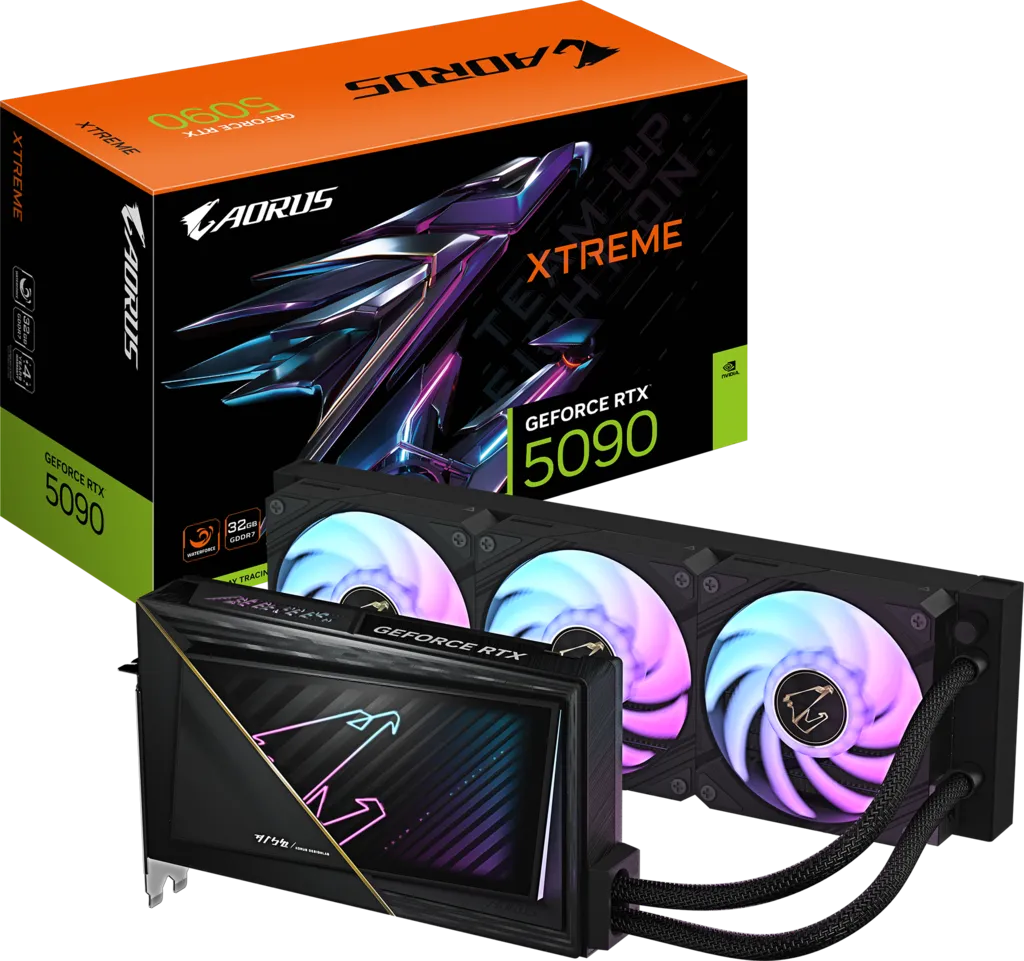
Gigabyte sells four AORUS-branded RTX 5090s and they use the exact same GB202 silicon and the exact same 2,655 MHz boost clock. Nothing separates them on raw performance — the choice is entirely about cooling method, size and finish.
| Model | AORUS Master (this card) | AORUS Master ICE | XTREME WATERFORCE | XTREME WATERFORCE WB |
|---|---|---|---|---|
| Cooling | Triple-fan WINDFORCE air | Triple-fan WINDFORCE air (white) | 360 mm all-in-one liquid | Water block only — custom loop required |
| Boost clock | 2,655 MHz | 2,655 MHz | 2,655 MHz | 2,655 MHz |
| Memory | 32GB GDDR7 / 512-bit | 32GB GDDR7 / 512-bit | 32GB GDDR7 / 512-bit | 32GB GDDR7 / 512-bit |
| Card size (L×W×H) | 360 × 150 × 75 mm | 360 × 150 × 75 mm | 245 × 146 × 36 mm | 235 × 172 × 29 mm |
| Extra hardware in the box | VGA anti-sag holder | VGA anti-sag holder | 360mm radiator, 3×120mm ARGB fans, 460mm tubes | Thermal grease, install guide (no fans, pump or radiator) |
| LCD Edge View screen | Yes | Yes | No | No |
| Finish | Black shroud, RGB Halo | White shroud, RGB | Smoky-black transparent, gold trim | Translucent iridescent, gilded circuit |
| Power connector | 1× 16-pin 12V-2x6 | 1× 16-pin 12V-2x6 | 1× 16-pin 12V-2x6 | 1× 16-pin 12V-2x6 |
| Recommended PSU | 1,000 W | 1,000 W | 1,000 W | 1,000 W |
| Last tracked US price | $4,159.99 (Newegg) | $4,159.99 (Newegg) | $5,699.00 (Newegg) | $5,099.00 (Newegg) |
| Best for | The default flagship air build | All-white showcase builds | Best thermals with zero loop-building | An existing custom water loop |
The Master is the one most people should buy: it is the cheapest of the four, it needs no radiator space and no loop parts, and it is still one of the coolest air-cooled RTX 5090s on the market. Step away from it only if you have a specific reason — a white build, a case with a spare 360 mm mount, or an existing custom loop.
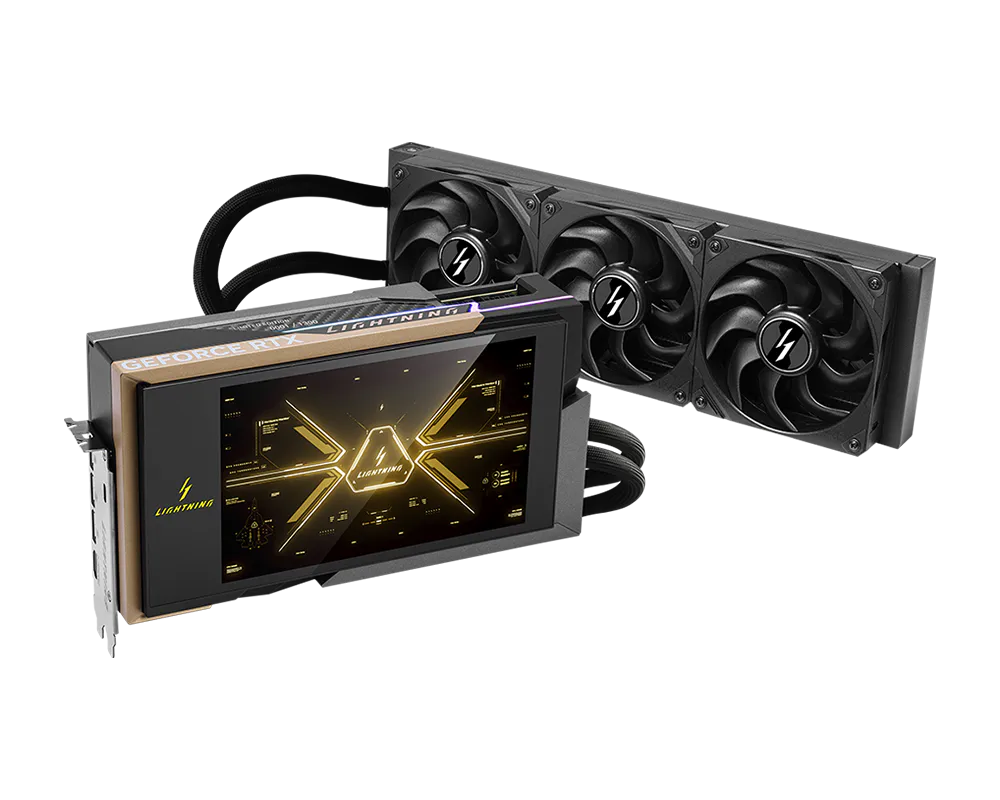
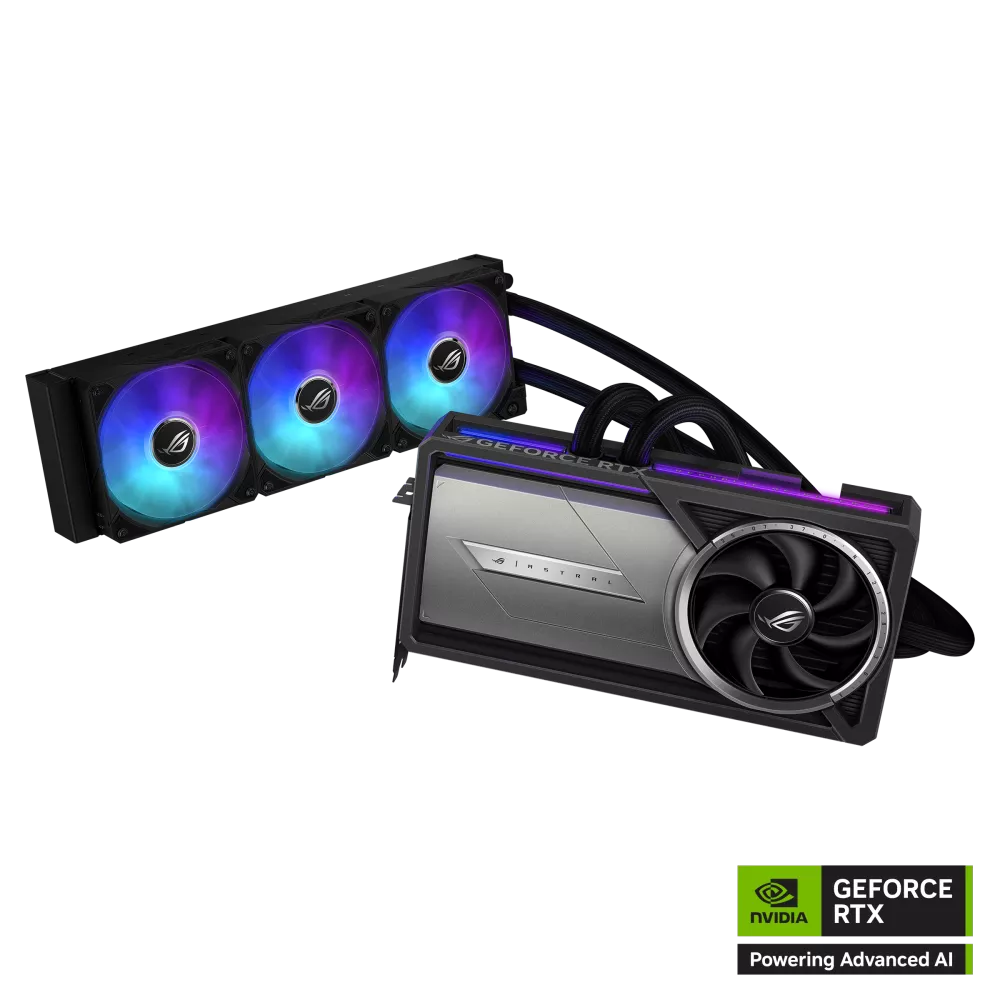
Outside the AORUS family, the two other liquid-cooled flagships worth cross-shopping are the ASUS ROG Astral LC RTX 5090 and the MSI GeForce RTX 5090 Lightning Z.
AORUS RTX 5090 Master ICE: the white version
The AORUS GeForce RTX 5090 Master ICE 32G (GV-N5090AORUSM ICE-32GD) is the white version of this card. Gigabyte publishes identical specification sheets for the two: the same 2,655 MHz boost clock, 32GB of GDDR7, WINDFORCE cooler, 360 × 150 × 75 mm size, 1,000 W PSU recommendation and 4-year registered warranty. It launched at $2,499.99, and in 2026 it tracks the black Master's street price (about $4,160 at Newegg, roughly $4,100 at B&H), usually out of stock.
Master ICE vs Master: what actually differs
| Specification | AORUS RTX 5090 Master ICE | AORUS RTX 5090 Master |
|---|---|---|
| Finish | White shroud, white backplate, RGB-tipped fans | Black shroud, RGB Halo |
| Boost Clock | 2,655 MHz | 2,655 MHz |
| Memory | 32GB GDDR7 / 512-bit / 28 Gbps | 32GB GDDR7 / 512-bit / 28 Gbps |
| Card Size | L=360 × W=150 × H=75 mm | L=360 × W=150 × H=75 mm |
| Cooler | WINDFORCE, Hawk fans, vapor chamber | WINDFORCE, Hawk fans, vapor chamber |
| LCD Edge View | Yes | Yes |
| Power Connector | 1× 16-pin 12V-2x6 | 1× 16-pin 12V-2x6 |
| Recommended PSU | 1,000 W | 1,000 W |
| VGA holder included | Yes | Yes |
| Warranty | 4 years (registration required) | 4 years (registration required) |
That is the whole difference: colour. Anyone telling you the ICE is binned differently, clocked differently or cooled differently is guessing — Gigabyte publishes the same numbers for both.
Building an all-white PC around the Master ICE
The ICE treatment is more thorough than a repainted shroud. Per Overclockers.com's hands-on review, the card combines a white chassis, RGB-tipped fans and the small LCD monitor at the end of the shroud. The metal backplate is finished to match, so the card reads as white from both the glass side panel and from underneath in a vertical mount.
Practical notes for a white build:
- The 12V-2x6 cable will be black unless you buy a white custom cable. On a 360 mm card sitting front and centre behind glass, that cable is the single most visible thing that will break the theme. Budget for a white 12V-2x6 or a white cable extension from the outset.
- Vertical mounting is tempting but risky. At 75 mm thick this card will crowd or block a side-panel vertical bracket in most cases, and vertical mounts starve triple-fan coolers of intake air. A horizontal mount with the included white-friendly VGA holder is the safer choice.
- Match the RGB, do not fight it. The ICE keeps RGB Halo lighting and the LCD Edge View screen; both are configurable in GIGABYTE CONTROL CENTER, so you can set them to a single cool-white tone if you want a monochrome build rather than a rainbow one.
- White plastics yellow. Over several years, UV and heat can shift white shrouds slightly. It is a cosmetic risk unique to this variant and worth knowing before you pay a premium for it.
Master vs Founders Edition vs Gaming OC
| Specification | AORUS RTX 5090 Master | RTX 5090 Founders Edition | Gigabyte RTX 5090 Gaming OC |
|---|---|---|---|
| Boost Clock | 2,655 MHz | 2,407 MHz | 2,520 MHz |
| CUDA Cores | 21,760 | 21,760 | 21,760 |
| Memory | 32GB GDDR7 / 512-bit | 32GB GDDR7 / 512-bit | 32GB GDDR7 / 512-bit |
| TGP | 575 W | 575 W | 575 W |
| Cooler | Triple-fan vapor chamber, ~4-slot | Dual flow-through, 2-slot | Triple-fan WINDFORCE |
| Length | 360 mm | 304 mm | 340 mm |
| LCD screen | Yes | No | No |
| Dual BIOS | Yes (Performance / Silent) | No | Yes |
| Original MSRP | ≈$2,499 | $1,999 | Below Master |
The Founders Edition is dramatically easier to fit — 304 mm and two slots — and it costs less, but it runs hotter and louder because it is dissipating the same 575W through a fraction of the fin area. The Gaming OC splits the difference. The Master is the choice when case volume is not a constraint and you want the coolest, quietest air-cooled result.
Strengths and trade-offs
Strengths
- Among the coolest and quietest air-cooled RTX 5090s — large vapor chamber, alternate-spinning Hawk fans
- Dual BIOS with a real Silent mode, which neither WATERFORCE model offers
- 2,655 MHz factory boost vs 2,407 MHz reference
- Full 32GB GDDR7 / 512-bit / 1.79 TB/s for gaming and local AI
- LCD Edge View screen, RGB Halo lighting and a reinforced metal backplate
- Anti-sag VGA holder in the box; 4-year warranty with online registration
Trade-offs
- 360 × 150 × 75 mm — incompatible with a large share of mid-tower cases
- Power limit was not adjustable in any tested overclocking utility, so tuning headroom is minimal
- 2026 street pricing has drifted far above the original ~$2,499 positioning
- ~615 W measured peak demands a 1,000 W-class ATX 3.1 PSU
- Buys only a few percent over a much cheaper RTX 5090 in raw frames
Should you buy the AORUS RTX 5090 Master?
Buy it if you want the fastest consumer GPU with the best air cooling available, you have a full-tower or a large mid-tower with 370 mm-plus of clearance, and you value low noise and a showpiece build. It is the default recommendation among the four AORUS RTX 5090s and the cheapest of the group in 2026.
Skip it if your case cannot swallow a 4-slot, 360 mm board (take the Founders Edition or a compact 5090 instead), if you want an all-white build (the Master ICE is the identical card in white), if you want the lowest temperatures achievable out of the box (the XTREME WATERFORCE and its 360 mm radiator), or if you already run a custom loop (the WATERFORCE WB).
Specifications on this page are taken from Gigabyte's official product pages; measured power, temperature and pricing figures are attributed inline to the outlets that recorded them. Prices in the RTX 5090 market move weekly — always check the retailer before you buy.
Frequently Asked Questions
How much does the AORUS RTX 5090 Master cost in 2026?
The last tracked Newegg price in July 2026 was $4,159.99, and Gigabyte's own AORUS Official Store lists it at €4,535.78 including VAT in Europe. That is far above the roughly $2,499 the AORUS Master family launched at, and well above the RTX 5090 Founders Edition's $1,999 MSRP. The cause is the GDDR7 and DRAM supply crunch driven by AI datacentre demand, which has pushed every RTX 5090 board price up through 2026.
Is the AORUS RTX 5090 Master in stock anywhere?
Availability is intermittent. At the time of writing the Newegg listing was out of stock, which is typical for RTX 5090 boards in 2026. Rather than refreshing retailer pages, use a stock tracker such as TrackaLacker or HotStock with alerts enabled, because these cards sell through within minutes of restocking.
What are the AORUS RTX 5090 Master's exact dimensions, and will it fit my case?
Gigabyte lists it as L=360 × W=150 × H=75 mm. That is roughly a 3.7–4 slot card. You want at least 370 mm of GPU clearance to allow for the 12V-2x6 cable bend, four free expansion slots, and about 155 mm of clearance from the motherboard tray to the side panel. Many mid-towers rated for 350–360 mm will not take it once front fans or a radiator are installed.
What PSU does the AORUS RTX 5090 Master need?
Gigabyte recommends a 1,000 W power supply. That recommendation is well founded: Overclockers.com measured the identical-hardware Master ICE peaking at nearly 615 W with the stock power limit, above NVIDIA's 575 W rating. Use an ATX 3.1 / PCIe 5.1 unit with a native 12V-2x6 cable rather than the bundled 4× 8-pin adapter, and make sure the connector is fully seated.
How hot and how loud does the Master get?
In a well-ventilated case expect sustained gaming temperatures in the mid-to-high 60s °C, several degrees cooler than a Founders Edition dissipating the same 575 W through a two-slot cooler. Noise is low for the wattage because three large Hawk fans run slowly rather than two small fans running fast, and fan-stop keeps it silent at idle. Flipping the Dual BIOS switch to Silent mode lowers the fan curve further.
Can I overclock the AORUS RTX 5090 Master?
Barely. Overclockers.com found that no GPU overclocking application allowed the power limit to be adjusted on this board. With the power ceiling locked and the factory boost already at 2,655 MHz, core and memory offsets deliver only marginal gains. If manual overclocking is your priority, this is the wrong RTX 5090.
How is the Master different from the Master ICE?
Only in appearance. Gigabyte's spec sheets for the two cards are identical — same 2,655 MHz boost, same 360 × 150 × 75 mm size, same WINDFORCE cooler, same 1,000 W PSU recommendation. The ICE is the white-shrouded version for all-white builds. If colour does not matter to you, buy whichever is cheaper or actually in stock.
Should I buy the Master or the XTREME WATERFORCE?
Buy the Master unless you specifically want liquid cooling. The XTREME WATERFORCE ships with a factory-sealed 360 mm radiator and three 120 mm ARGB fans, which delivers lower temperatures and quieter GPU acoustics, but it costs substantially more (last tracked at $5,699 versus $4,159.99) and requires a free 360 mm radiator mount in your case. The Master needs neither.
Does the Master include an anti-sag bracket?
Yes. Gigabyte bundles its versatile VGA holder and the accompanying manual in the box, alongside the quick guide, warranty registration card, a 12V-2x6 to 4× PCIe 8-pin adapter and AORUS stickers. Given the card's mass, fitting the holder is strongly recommended rather than optional.
What warranty does the AORUS RTX 5090 Master carry?
Gigabyte lists a 4-year warranty on the AORUS RTX 5090 Master, conditional on completing online product registration. All four AORUS RTX 5090 variants — Master, Master ICE, XTREME WATERFORCE and WATERFORCE WB — carry the same 4-year registered term.
How much does the AORUS RTX 5090 Master ICE cost in 2026?
It launched at an MSRP of $2,499.99, but July 2026 tracked retail prices were $4,159.99 at Newegg and $4,099.95 at B&H Photo, both out of stock. Third-party marketplace listings run higher still, into the $5,000–$6,000 range. The increase is driven by the GDDR7 and DRAM shortage caused by AI datacentre demand, which has raised every RTX 5090 board price through 2026.
Is the Master ICE fully white, including the backplate?
Yes. Overclockers.com's review describes a white chassis with RGB-tipped fans and the LCD screen at the end of the shroud, and the metal backplate is finished to match. The one part that will not be white is your 12V-2x6 power cable — the bundled adapter and most stock PSU cables are black, so budget for a white custom cable if the theme matters.
Will the white shroud turn yellow over time?
It is a known long-term risk with white PC plastics generally rather than a defect specific to this card. Prolonged UV exposure and sustained heat can shift white finishes slightly over several years. Keeping the system out of direct sunlight and maintaining good case airflow reduces the risk, and it is a cosmetic issue only — it has no effect on cooling or performance.