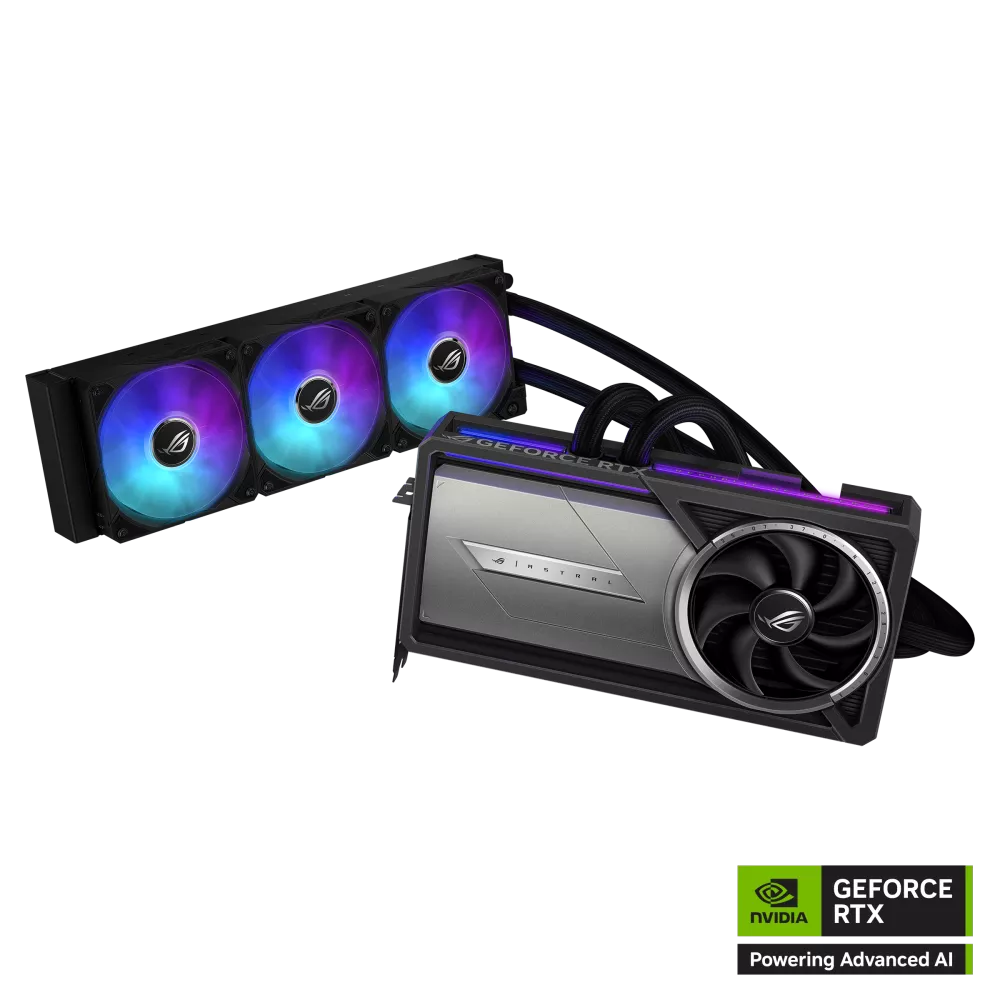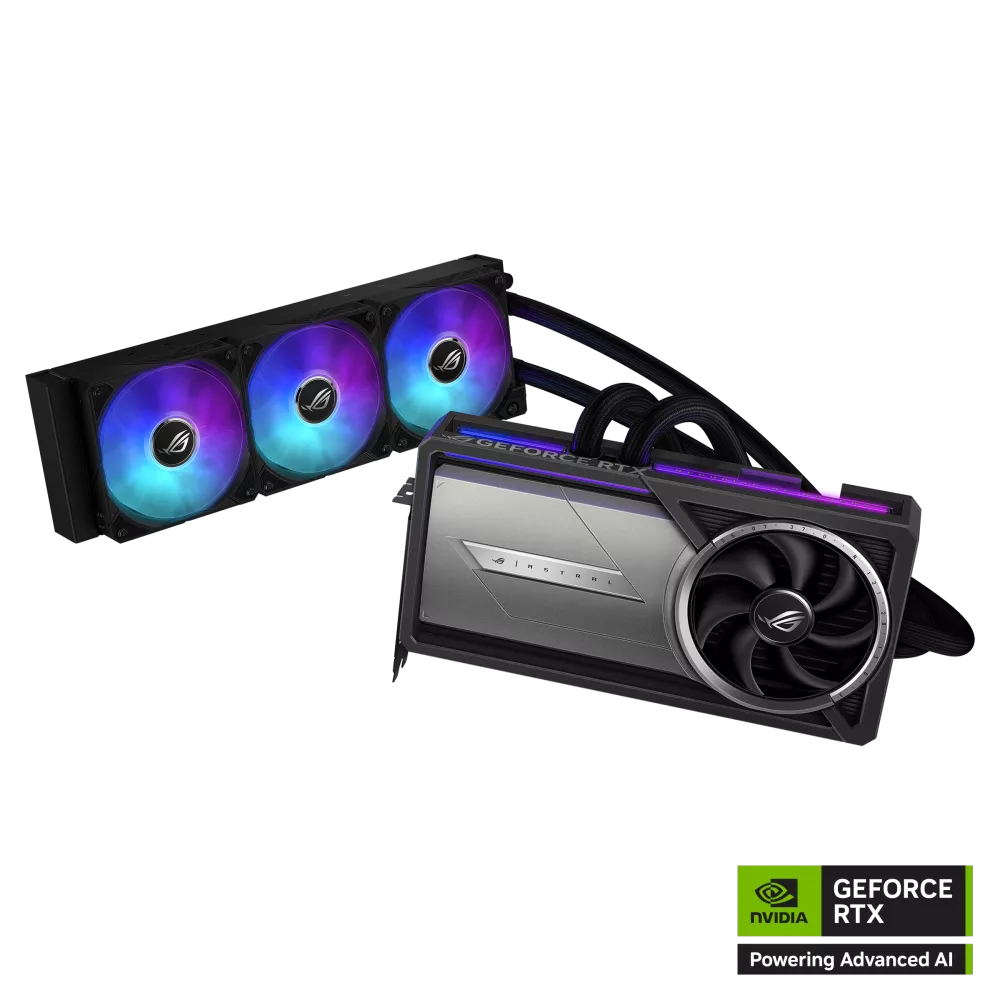
The ASUS ROG Astral LC GeForce RTX 5090 OC Edition — model ROG-ASTRAL-LC-RTX5090-O32G-GAMING — is the range-topping card of ASUS's entire Blackwell line, and the fastest, coolest RTX 5090 that has been put through a full review bench. It pairs NVIDIA's complete GB202 die (21,760 CUDA cores, 32GB of GDDR7 on a 512-bit bus) with a sealed 360mm all-in-one cooler and the highest factory bin ASUS ships: 2,610 MHz in OC Mode, per ASUS's own specification sheet.
Read the model number carefully before you buy, because ASUS sells two near-identical liquid-cooled Astral 5090s. The O in O32G is the whole difference: this OC Edition runs 2,580 MHz Default / 2,610 MHz OC Mode, while the plain 32G card — covered separately in our base ASUS ROG Astral LC RTX 5090 review — runs 2,437 / 2,467 MHz. Identical cooler, identical 600W ceiling, identical board and framebuffer; different silicon bin, different price. Photos of the two are indistinguishable, and retailer listings routinely mix them up.
Quick verdict: This is the halo RTX 5090. TechPowerUp measured 58°C at the full 600W — the coolest 5090 it has tested — 30 dBA on the quiet BIOS, and +8% real-world performance from manual overclocking on top of the factory OC, the best headroom of any 5090 in its database. The card block is only 2.5 slots and 288mm. What stops it being a straight recommendation is money: $3,099.99 at launch, and roughly $3,700–$4,500 in 2026. Our score: 93/100.
ASUS ROG Astral LC RTX 5090 OC Edition (O32G) full specifications
Clocks, dimensions and cooler figures below come from ASUS's official O32G spec page; die, core counts and reference clocks from NVIDIA's GB202 data. Compute figures are derived from the published OC Mode clock.
| Specification | Detail |
|---|---|
| GPU & Architecture | |
| Model number | ROG-ASTRAL-LC-RTX5090-O32G-GAMING |
| GPU chip | NVIDIA GB202-300-A1 (Blackwell) |
| Process node | TSMC 4NP |
| Die size / transistors | 750 mm² / 92.2 billion |
| CUDA cores | 21,760 (170 SMs) |
| RT cores | 170 (4th gen) |
| Tensor cores | 680 (5th gen) — 3,352 AI TOPS |
| ROPs / TMUs | 176 / 680 |
| Clocks & Throughput (highest Astral bin) | |
| Boost clock — OC Mode | 2,610 MHz |
| Boost clock — Default Mode | 2,580 MHz |
| Reference boost (NVIDIA) | 2,407 MHz (+8.4% for this card) |
| Reference base clock | 2,017 MHz |
| FP32 compute (at 2,610 MHz) | ~113.6 TFLOPS |
| Pixel fill rate | ~459 GPixel/s |
| Texture fill rate | ~1,775 GTexel/s |
| Memory | |
| Capacity | 32GB GDDR7 |
| Memory speed | 28 Gbps |
| Bus width | 512-bit |
| Bandwidth | 1,792 GB/s |
| Memory OC cap | +375 MHz (NVIDIA-imposed on all RTX 5090s) |
| Cooling & Power | |
| Cooler | 360mm sealed AIO — copper coldplate and pump on the card |
| Radiator | 400 x 120 x 65 mm (extra-thick 38mm core) |
| Radiator fans | 3 x 120mm, magnetic daisy-chainable |
| VRM cooling | Onboard axial fan + heatsink for board components |
| Total Graphics Power | 600W |
| Power connector | 1 x 16-pin (12V-2x6, 600W) |
| Recommended PSU | 1000W |
| BIOS | Dual BIOS switch (Performance / Quiet) |
| Display & I/O | |
| Interface | PCI Express 5.0 x16 |
| DisplayPort | 3 x DisplayPort 2.1b (native) |
| HDMI | 2 x HDMI 2.1b (native) |
| Max simultaneous displays | 4 |
| Max digital resolution | 7680 x 4320 (8K) |
| Media engine | 3x 9th-gen NVENC, 2x 6th-gen NVDEC, AV1 + 4:2:2 |
| Build & Features | |
| Card dimensions | 288.46 x 153.7 x 48 mm |
| Slot width | 2.5 slots |
| VRM | 80A power stages, military-grade capacitors |
| Safety | Power Detector+ per-pin 12V-2x6 monitoring |
| Structural | GPU Guard alloy frame, ARGB (Aura Sync) |
| Software | GPU Tweak III (OC Mode toggle, per-pin telemetry) |
| Warranty | 3-year limited (US) |
One correction worth flagging, because aggregator sites get it wrong constantly: the 357.6mm, 3.8-slot dimension you will see attached to "ROG Astral RTX 5090 OC" belongs to the air-cooled Astral. The LC OC Edition's card body is 288.46mm and 2.5 slots; the bulk lives in the separate 400mm radiator.
ASUS ROG Astral LC RTX 5090 OC Edition price and availability (July 2026)
This is the most expensive consumer graphics card ASUS sells, and the gap between its launch price and its 2026 shelf price is large enough that it changes the buying advice. Here is the documented trail.
| Reference point | Price | Notes |
|---|---|---|
| NVIDIA RTX 5090 reference MSRP | $1,999 | The baseline every premium below is measured against |
| ASUS launch MSRP (LC OC Edition) | $3,099.99 | Range-topping price in ASUS's published US list |
| ASUS ROG Astral OC (air) launch MSRP | $2,799.99 | Same 2,610 MHz bin, no AIO |
| TechPowerUp review-time US listing | ~$3,720 | Card described as "the most expensive GPU I've ever tested" |
| Micro Center shelf price (LC line) | ~$3,700–$3,720 | ~20% over ASUS MSRP; units sat unsold before clearing |
| ASUS eShop USA, mid-2026 | up to $4,529.99 | Listed, frequently out of stock |
The $3,099.99 launch figure comes from ASUS's own US price list, reported at the time by VideoCardz. The $3,700-class street price is documented by Tom's Hardware, which covered Micro Center's $3,700 Astral 5090s finally selling after a long stretch of buyer resistance, and matches the Micro Center listing for the Astral LC OC. ASUS's own eShop page for the O32G has carried the highest number of all and is regularly out of stock.
How to read the number in front of you in July 2026:
- Under $3,200 — effectively launch MSRP. Buy without hesitating; this price has been rare since 2025.
- $3,200–$3,800 — the realistic market. This is what Micro Center and most US retail has charged.
- $3,800–$4,600 — ASUS eShop / scarcity pricing. You are paying roughly 2.2x reference MSRP for a card whose frame rate is within a few percent of a $1,999 Founders Edition.
- Above $4,600 — marketplace resellers. Walk away.
Availability is the other half of the story. The O32G is the better-stocked of the two LC SKUs — the non-OC 32G is genuinely hard to find — but "better stocked" still means intermittent. Set a stock alert rather than paying a reseller premium.
Measured performance: what the top bin actually buys you
Be clear-eyed about this. Every RTX 5090 uses the same fully enabled GB202 die and every one of them slams into a power ceiling long before it runs out of clock. The Astral LC OC is the fastest 5090 on TechPowerUp's bench, but the margin is measured in single digits, not tiers.
- Versus the RTX 5090 Founders Edition: around 5% faster at 4K in TechPowerUp's rasterisation suite — enough to top the chart, not enough to feel in a game.
- Versus the RTX 4090: roughly +38% in 4K ray tracing and a similar order of gain in 4K raster, plus 32GB of GDDR7 instead of 24GB of GDDR6X.
- Why the gap is small: at 600W a 5090 is power-limited in any heavy 4K ray-traced scene. The 2,610 MHz rating is a ceiling the card touches in light scenes, not a sustained frequency under path tracing.
- Where the bin does pay off: in sustained, thermally comfortable clocks. Because the AIO holds the core at 58°C, this card does not down-bin the way an air-cooled 5090 does after twenty minutes in a warm case — the benefit shows up in hour-long sessions and in render or inference jobs, not in a 60-second benchmark run.
- Creator and AI work: 32GB at 1,792 GB/s runs large local LLMs, 8K timelines and heavy 3D scenes; 3,352 AI TOPS from 680 5th-gen Tensor cores drives DLSS 4 Multi Frame Generation up to 4x and local inference alike. These loads sit at the 600W ceiling for hours, which is exactly where liquid cooling earns its money.
Thermals and acoustics: the coolest RTX 5090 tested
This is where the OC Edition genuinely separates from every air-cooled flagship, and the numbers are unambiguous. All figures below are TechPowerUp's, measured on this exact Astral Liquid OC sample.
| Metric | Performance BIOS | Quiet BIOS |
|---|---|---|
| GPU core temperature at 600W | 58°C | 64°C |
| Noise | 36 dBA | 30 dBA |
| Rank among tested RTX 5090s | Coolest of all | 2nd quietest of all |
58°C while dissipating 600W is roughly 26°C cooler than the Founders Edition under the same load. The dual-BIOS trade is one of the best in the segment: flipping the physical switch to Quiet costs 6°C and returns 6 dBA, and a 6 dBA reduction is close to a halving of perceived loudness. Most owners should simply run the quiet BIOS — 64°C is still cooler than almost any air-cooled 5090 at full tilt.
The second-order benefit matters as much as the headline. An air-cooled 5090 dumps its entire 600W back into the chassis, warming your CPU cooler, VRMs and drives; the Astral LC exports nearly all of it through the radiator. In a closed case that is often worth several degrees on the CPU and a meaningful drop in system fan speed — noise you never hear from the GPU at all.
Overclocking headroom: the strongest case for this SKU
If there is one reason to choose the OC Edition over any other RTX 5090, it is this. TechPowerUp's tuning run on the Astral Liquid OC returned +8% real-world performance on top of the factory overclock — the best result in its RTX 5090 group, and notably above the +5% the same site achieved on the air-cooled Astral OC. Same silicon family, same 600W wall; the difference is thermal margin and bin quality.
What actually limits you
- Power, not temperature. The single 12V-2x6 connector caps the card at 600W and there is no higher power slider to unlock. At 58°C the cooler is nowhere near its limit — you run out of watts first. This is the opposite of the usual air-cooled situation and it is why a strong bin pays off here: a chip that does more work per watt converts directly into frames.
- Memory is capped at +375 MHz by NVIDIA on every RTX 5090, GDDR7 chip quality notwithstanding. Take the full +375; it is free performance and the modules are cooled by the same coldplate assembly.
- Voltage/frequency curve tuning beats a flat offset. Because the card is power-limited, an undervolt-plus-offset curve in GPU Tweak III frequently outperforms a raw core offset: the same 600W buys more sustained megahertz.
- The cooler has enormous reserve. Notebookcheck shunt-modded an Astral LC past 800W and the 360mm AIO still kept it under control, with performance climbing beyond stock. That voids your warranty and is not a recommendation — but it establishes how much thermal headroom is sitting unused at the stock 600W limit.
Practical target: enable OC Mode in GPU Tweak III (2,610 MHz), add the full +375 MHz to memory, then tune the V/F curve for stability at the power limit. That combination is what produced TechPowerUp's +8%. Expect a smaller gain in path-traced scenes, where you are hard against 600W from the first frame.
Radiator mounting, case fit and PSU guidance
More Astral LC returns come from physical fit than from anything else. Confirm all five points below before ordering.
- Radiator envelope: 400 x 120 x 65 mm. That 400mm length is longer than a generic 360mm radiator, and the 38mm-thick core plus fans needs about 65mm of depth. A case advertised as "360mm AIO compatible" does not automatically clear it — check the manufacturer's stated maximum radiator length and thickness.
- You need a free 360mm mount. If a CPU AIO already occupies the top position, you need a second location that fits 400mm. This is the single most common blocker, and it is why plenty of otherwise-large cases cannot take this card.
- Top-mount if you can. Top exhaust sends the GPU heat straight out. Front-mounting works but pushes 600W of warmed air across the motherboard, and often conflicts with tall RAM or a drive cage.
- Check tubing reach. The tubes run from the PCIe slot to the radiator. Inverted-motherboard layouts, bottom mounts and very wide cases can leave you short. Dry-fit before you screw anything down.
- The card is the easy part. 288.46mm and 2.5 slots is modest by 5090 standards — over a slot narrower than the 3.8-slot air Astral, which frees a real expansion slot for a capture card or NIC.
Power supply: ASUS specifies 1000W minimum. Use a quality ATX 3.x / PCIe 5.1 unit with a native 12V-2x6 cable rather than an adapter, seat it until it clicks, and keep bends at least ~35mm away from the plug. Pair it with a 250W-plus CPU and step up to 1200W. Power Detector+ monitors each of the six 12V pins independently and warns you in GPU Tweak III if current is unbalanced — a genuinely useful feature on a 600W connector given this generation's history.
ASUS Astral LC OC vs the other flagship RTX 5090s
| Card | Cooling | Boost (OC mode) | Power limit | Footprint | Rec. PSU | Price |
|---|---|---|---|---|---|---|
| ASUS ROG Astral LC OC (O32G) | 360mm AIO, 38mm rad | 2,610 MHz | 600W | 2.5-slot, 288mm card + 400mm rad | 1000W | $3,099.99 MSRP; ~$3,700–$4,530 in 2026 |
| ASUS ROG Astral LC (32G, non-OC) | Identical 360mm AIO | 2,467 MHz | 600W | 2.5-slot, 288mm card + 400mm rad | 1000W | Below OC Edition; scarce |
| ASUS ROG Astral OC (air) | Quad-fan air | 2,610 MHz | 600W | 3.8-slot, 357.6mm | 1000W | $2,799.99 MSRP |
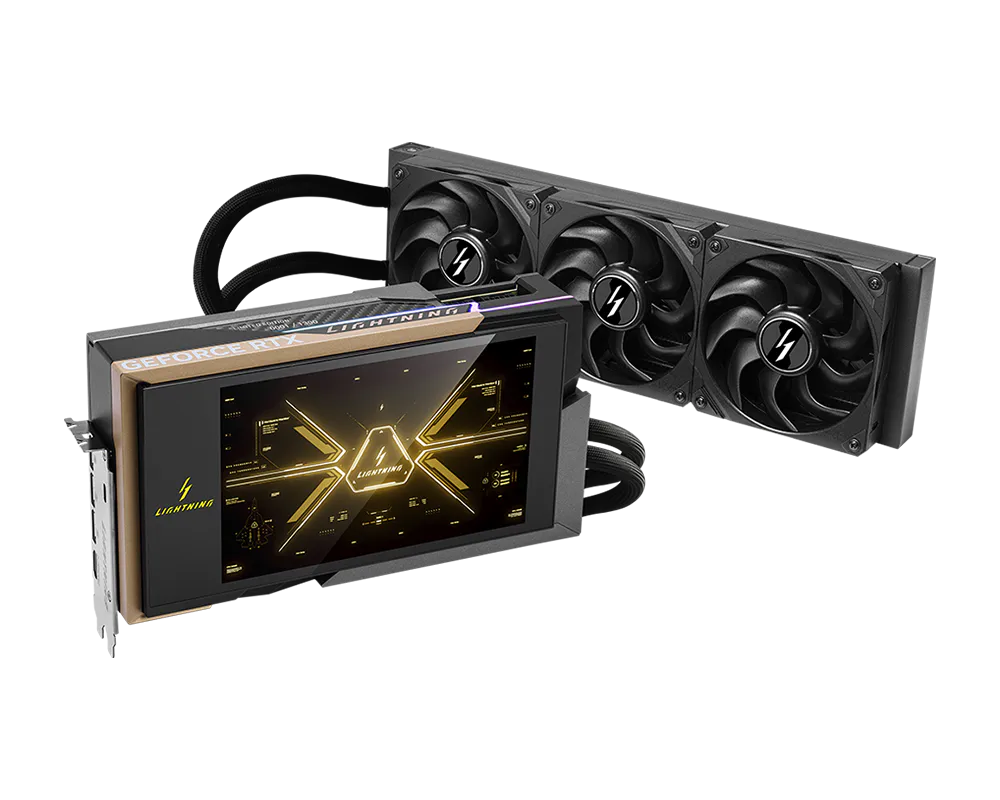
| MSI GeForce RTX 5090 Lightning Z | 360mm AIO | 2,775 MHz | 800–1,000W | Card + 360mm rad | 1600W+ | $5,090.99, lottery allocation |
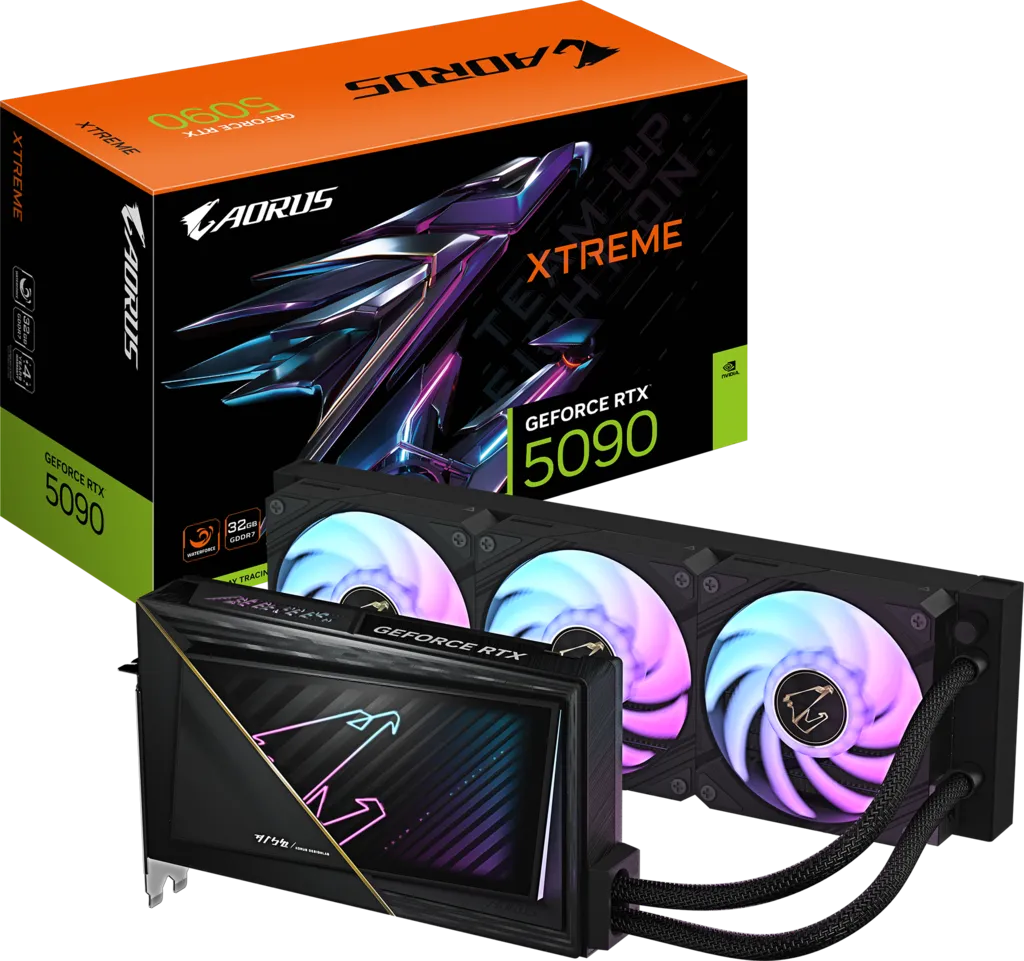
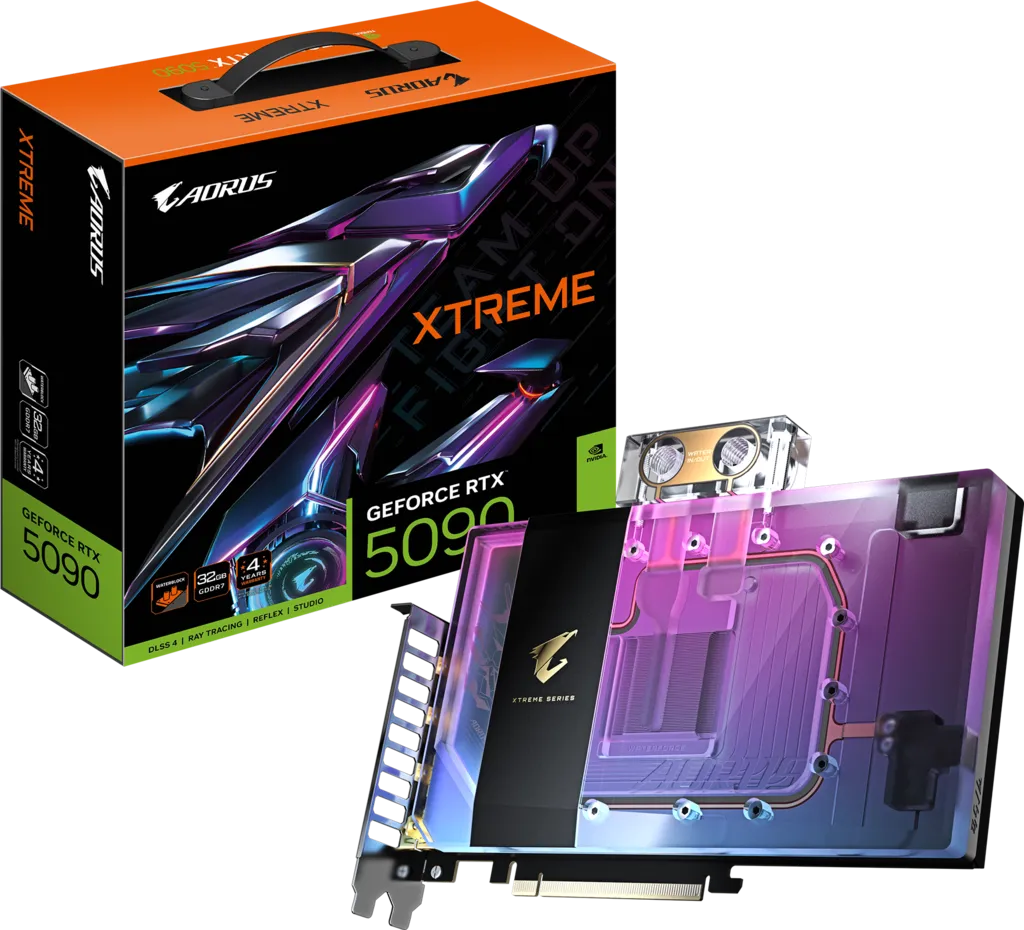
| Gigabyte AORUS RTX 5090 XTREME WATERFORCE | 360mm AIO | 2,655 MHz | 600W | Slim card + 360mm rad | 1000W | Above reference, varies |
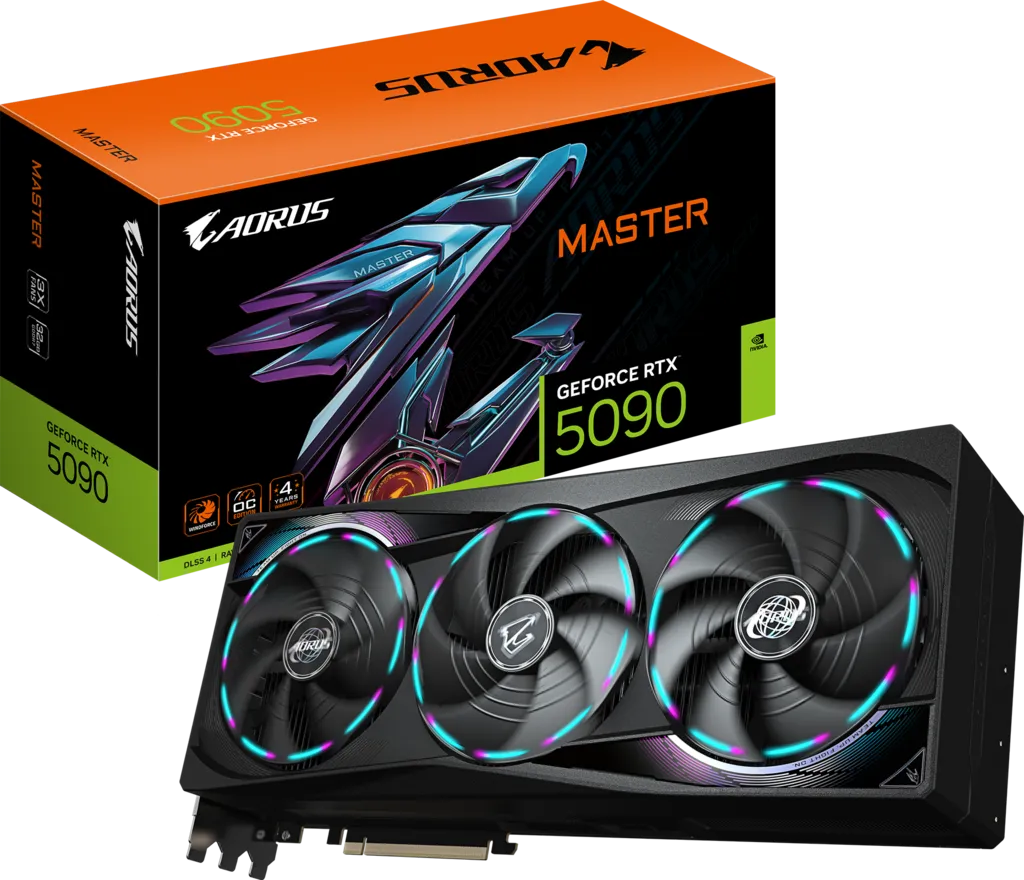
| Gigabyte AORUS RTX 5090 Master | Triple-fan air | 2,520 MHz | 600W | 4-slot air | 1000W | Below Astral LC |
| NVIDIA RTX 5090 Founders Edition | Dual flow-through air | 2,407 MHz | 575W | 2-slot, 304mm | 1000W | $1,999 MSRP |
Read across and the positioning is clear. The MSI Lightning Z is the only card with a higher rating on paper — 2,775 MHz and an 800–1,000W board — but it demands a 1,600W PSU, costs $5,090.99, and was sold by lottery in tiny numbers. It is a halo product you mostly cannot buy. The AORUS XTREME WATERFORCE is the closest genuine rival: 2,655 MHz on the same 600W ceiling with its own 360mm AIO, and the one card that can beat the Astral on rated clock at a comparable power budget. Against air-cooled flagships like the AORUS Master, the Astral LC OC wins on temperature, noise and slot count and loses on price and installation simplicity. The Founders Edition remains the value answer: within about 5% of this card's frame rate for roughly a third to a half of the money.
Pros, cons and the verdict
✅ Pros
- Coolest RTX 5090 tested: 58°C at the full 600W, ~26°C below the Founders Edition
- 30 dBA on the quiet BIOS for only ~6°C — second-quietest 5090 measured
- Highest Astral factory bin: 2,610 MHz OC Mode, +8.4% over NVIDIA reference boost
- Best overclocking headroom in its class: +8% real-world on top of the factory OC
- Compact 2.5-slot, 288mm card frees a slot versus 3.8-slot air 5090s
- Exports 600W of heat out of the chassis instead of into your CPU cooler
- Power Detector+ per-pin 12V-2x6 monitoring, GPU Guard frame, dual BIOS, 80A stages
- Five outputs including two native HDMI 2.1b; full 32GB GDDR7 at 1,792 GB/s
❌ Cons
- Brutally expensive — $3,099.99 MSRP and $3,700–$4,530 in 2026, up to 2.2x reference
- Only about 5% faster than a $1,999 Founders Edition at 4K
- Needs a free mount for a 400mm-long, 38mm-thick radiator — many cases cannot
- The pump is a long-term failure point an air cooler does not have
- 1000W ATX 3.x PSU with a native 12V-2x6 cable is effectively mandatory
- Easily confused at retail with the cheaper non-OC 32G SKU
- Memory OC capped at +375 MHz by NVIDIA regardless of bin
- Stock is intermittent and reseller pricing is unpredictable
Buy it if you want the definitive RTX 5090 — the coolest, quietest, highest-binned card with the most overclocking headroom — you have a confirmed 400mm radiator mount and a 1000W ATX 3.x supply, and you intend to actually use the headroom by tuning it. It is also the strongest choice for creator and local-AI workstations that hold 600W for hours, where the thermal margin translates into sustained clocks rather than a benchmark number.
Skip it if your case cannot take the radiator (buy the air-cooled Astral OC at $2,799.99), you will never touch GPU Tweak III and the price gap to the non-OC LC is $400 or more, or you simply want 5090-class frames for the least money — in which case the Founders Edition at $1,999 delivers within about 5% of this card. As an engineering exercise it is near-flawless; as a purchase it is a luxury item priced like one. Our score: 93/100.
Frequently Asked Questions
How much does the ASUS ROG Astral LC RTX 5090 OC Edition cost in 2026?
It launched at $3,099.99, the top of ASUS's published US RTX 5090 price list. In 2026 street pricing is far higher: TechPowerUp noted a ~$3,720 US listing, Micro Center has sold liquid-cooled Astral 5090s at about $3,700, and ASUS's own eShop has listed the O32G as high as $4,529.99. Treat anything under $3,200 as an excellent price, $3,200-$3,800 as the realistic market, and above $4,600 as reseller territory.
What is the difference between the Astral LC OC Edition (O32G) and the base Astral LC (32G)?
Only the silicon bin and firmware. The OC Edition boosts to 2,580 MHz in Default Mode and 2,610 MHz in OC Mode; the base 32G card runs 2,437 and 2,467 MHz. Cooler, radiator, PCB, 600W power limit, 32GB GDDR7 and display outputs are identical. On paper that is a 5.8% clock gap; in practice both cards hit the same 600W wall, so in-game it is low single digits.
Is the OC Edition premium worth it over the base Astral LC?
It is worth it if you plan to overclock or the price gap is small. Because both SKUs share a 600W ceiling, the extra factory clock alone returns only a few percent. What you are really buying is the better bin, which is why TechPowerUp extracted +8% from manual tuning on this card. If you will never open GPU Tweak III and the OC Edition costs $400 more, take the base LC; if the gap is $100-$150, take the OC Edition.
How much overclocking headroom does the Astral LC OC Edition have?
TechPowerUp gained +8% in real-world performance on top of the factory overclock, its best RTX 5090 result and above the +5% it managed on the air-cooled Astral OC. Power is the limiter, not heat: the card is capped at 600W by its single 12V-2x6 connector while the core sits at just 58 degrees C. Take the full +375 MHz NVIDIA allows on memory and tune the voltage/frequency curve rather than applying a flat core offset.
What is the boost clock of the ASUS ROG Astral LC RTX 5090 OC Edition?
ASUS officially lists 2,580 MHz in Default Mode and 2,610 MHz in OC Mode, enabled through GPU Tweak III. That is 8.4% above NVIDIA's 2,407 MHz reference boost and the highest factory clock in the Astral RTX 5090 range, giving roughly 113.6 TFLOPS of FP32 throughput.
How hot and how loud is the ASUS Astral LC RTX 5090 OC Edition?
TechPowerUp measured 58 degrees C on the GPU core at the full 600W load with the performance BIOS - the coolest RTX 5090 it has tested, about 26 degrees cooler than the Founders Edition - at 36 dBA. The physical quiet-BIOS switch drops noise to 30 dBA, the second-quietest 5090 measured, while temperature rises only to 64 degrees C. Most owners should just run the quiet BIOS.
Will the 360mm radiator fit my case?
Check the exact numbers. The radiator is 400 x 120 x 65 mm with an extra-thick 38mm core, so it is longer and deeper than a typical 360mm AIO and a case rated for 360mm radiators may still not clear it. You need a listed maximum radiator length of at least 400mm, a free 360mm mounting position (a CPU AIO in the top slot is the usual blocker), and enough tubing reach from the PCIe slot. The card itself is easy at 288.46mm and 2.5 slots.
What PSU do I need for the Astral LC RTX 5090 OC Edition?
ASUS specifies 1000W minimum for the 600W card. Use a quality ATX 3.x / PCIe 5.1 supply with a native 12V-2x6 cable rather than adapters, seat the connector until it clicks and avoid sharp bends within about 35mm of the plug. Move up to 1200W if you pair it with a 250W-plus CPU. Power Detector+ monitors each connector pin individually and flags unbalanced current.
ASUS Astral LC OC vs MSI RTX 5090 Lightning Z - which should I buy?
The Lightning Z is rated higher on paper at 2,775 MHz with an 800-1,000W board, but it costs $5,090.99, was allocated by lottery in very small numbers and demands a 1,600W power supply. The Astral LC OC is the one you can realistically buy, needs only a 1000W PSU, and holds 58 degrees C at its 600W limit. Choose the Lightning Z only for extreme-OC ambitions and if you can actually get one.
Is the ASUS Astral LC OC Edition faster than a standard RTX 5090?
Yes, but by about 5% at 4K versus the Founders Edition in TechPowerUp's rasterisation testing - enough to top the chart, not enough to change what settings you can run. Every RTX 5090 uses the same fully enabled GB202 die and becomes power-limited at 600W in heavy ray-traced scenes. The Astral LC OC's real advantage is sustaining its clocks over hours without heat-soaking, plus the tuning headroom the cooler unlocks.