15 Best Reading Apps in 2026: Free eBook & Audiobook Apps, Tested
The best reading apps in 2026 are Libby (completely free with a library card), Amazon Kindle (the biggest eBook store), Google Play Books (the best built-in option for Android), and Audible (the deepest audiobook catalog). If you only download one, make it Libby for free books or Kindle if you want to buy and own them.
Below we break down 15 reading apps we actually tested, what each one is best for, real pricing checked in July 2026, and how to choose the right app for the way you read, whether that's eBooks, audiobooks, manga, saved articles, or tracking your reading habit. Every price and app status here was re-verified this month, including the apps that have quietly shut down.
In a hurry? Jump to: Quick picks · Types of apps · The best apps tested · Read-it-later apps · Apps that shut down · How we picked · Comparison table · Bottom line
Best reading apps in 2026 at a glance
- Best free reading app overall: Libby (free with a library card)
- Best free library app with no waitlists: Hoopla
- Best eBook app for buying books: Amazon Kindle
- Best book reading app for Android: Google Play Books
- Best Kindle alternative (open EPUB): Kobo
- Best audiobook app: Audible
- Best audiobooks with your music: Spotify (15 hours/month on Premium)
- Best all-in-one eBook + audiobook subscription: Everand (formerly Scribd)
- Best free audiobook app for classics: LibriVox
- Best completely ad-free offline reader: ReadEra
- Best for advanced customization & text-to-speech: Moon+ Reader
- Best for free web fiction: Wattpad
- Best read-it-later app now Pocket is gone: Instapaper (or Readwise Reader for power users)
- Best reading tracker & community: The StoryGraph and Goodreads
- Best reading habit tracker: Bookly
The single biggest change since our last update: Mozilla shut Pocket down on 8 July 2025, so if you're still looking for it, jump to the apps that shut down section for what to use instead.
Why reading apps are worth it in 2026
Print books keep getting more expensive, and a single hardcover can now cost more than a month of unlimited reading on most apps. A good reading app puts thousands of titles in your pocket, syncs your place across your phone, tablet and laptop, and lets you switch between reading and listening without losing your spot.
Modern apps also adjust to how you read. You get adjustable fonts, dark mode, a built-in dictionary, offline downloads, and text-to-speech that turns any eBook into an audiobook. The lines are blurring too: in 2026 Spotify bundles audiobooks with its music plans, Kindle and Audible sync seamlessly with Whispersync, and Libby pushes library books straight to your Kindle. Whether you're a casual reader, a student, or someone trying to build a daily reading habit, there's an app built for it, and most of the best ones are free.
The 3 types of reading apps (and which one you need)
1. eBook readers
These are the most common reading apps, built for people who like to read text on a screen. They let you buy or borrow books, adjust font size and brightness, bookmark pages, highlight, and look up words instantly. The best eBook reading apps for Android are Google Play Books, Kindle, Kobo, Moon+ Reader, and ReadEra. On iPhone, Apple Books and Kindle lead the pack.
Pros
- Carry thousands of books on one device and start reading anywhere.
- Adjust font size, color, and brightness to suit your eyes.
- Built-in dictionary lets you tap any word for a definition.
- Highlight, take notes, and sync them across devices.
Cons
- No physical feel of holding a book or turning pages.
- Long sessions on an LCD phone screen can cause eye strain (a dedicated e-reader helps).
- You depend on battery life and a charged device.
2. Audiobook apps
Audiobook apps let you listen instead of read, which is perfect for commuting, exercising, cooking, or resting your eyes. They offer professionally narrated libraries and, increasingly in 2026, realistic AI narration for books that were never recorded. The top audiobook apps are Audible, Spotify, Libby, and LibriVox for free classics.
Pros
- Hands-free reading while you drive, walk, or work out.
- Skilled narrators bring stories to life.
- A genuine help for visually impaired and struggling readers.
- Adjustable playback speed and sleep timers.
Cons
- No visuals, which matters for illustrated or technical books.
- Some people retain less from listening than from reading.
- Premium narration libraries usually require a subscription.
3. Literacy & educational apps
These apps are built for learning to read and reading to learn, which makes them ideal for kids, students, and self-improvement readers. They mix books with games, quizzes, and progress tracking. Popular picks include Epic!, Starfall, and Headsprout. For more, see our guide to the best educational apps for kids and productivity apps for students.
Pros
- Games and quizzes make reading fun for young readers.
- Personalized reading levels and recommendations.
- Huge libraries of educational material in one place.
Cons
- Can reduce time spent with physical school books.
- Phone notifications create distractions.
- The best features often sit behind a subscription.
The best reading apps in 2026, tested
Before you download anything, ask yourself: do you want to buy and own books, borrow them free, mostly listen, or track what you read? Your answer points straight to the right app. Here are our top picks for 2026.
1. Amazon Kindle - the best eBook app overall
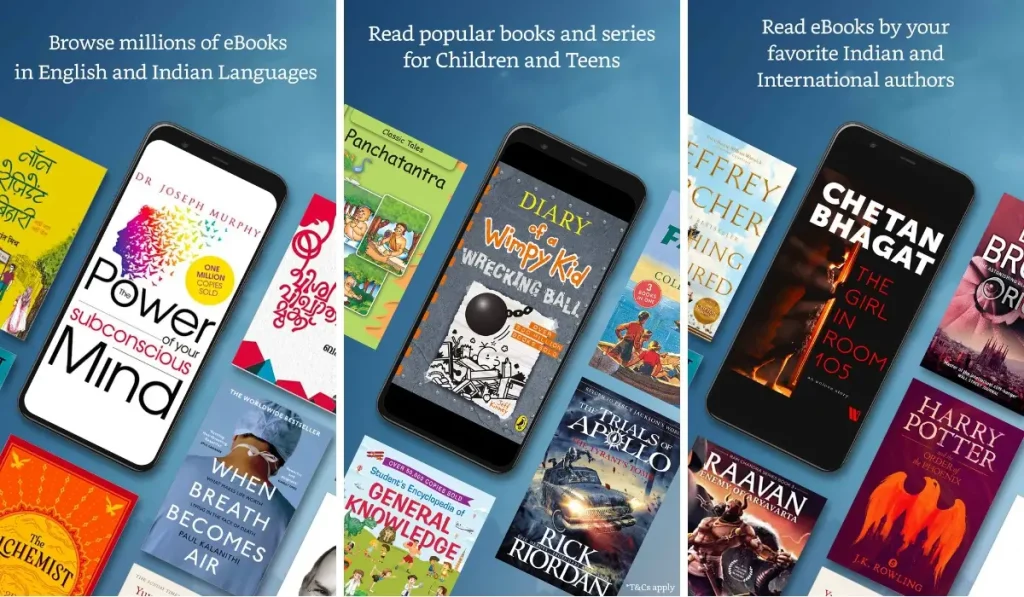
Kindle is the most popular and best-stocked eBook app, with millions of titles, top sellers, and indie books you can buy and keep forever. The free app works on Android, iPhone, Mac, PC, and Kindle e-readers, so you don't need to own a Kindle device to use it.
Kindle includes a built-in dictionary and Wikipedia lookup, customizable fonts and dark mode, and Whispersync, which lets you switch between reading an eBook and listening to its Audible audiobook without losing your place.
One change worth knowing before you commit: on 26 February 2025 Amazon removed the "Download & Transfer via USB" option from your Kindle content library. You can no longer download a purchased Kindle book to a computer and sideload it, so backing up or moving your purchases off Amazon is now much harder. Books are delivered over Wi-Fi to registered devices and the app instead.
Kindle is also now the home of comics and manga on Amazon. The standalone ComiXology app was shut down on 4 December 2023 and its entire catalogue, including ComiXology Unlimited, moved into the Kindle app, which is where you read Amazon comics and manga in 2026.
What it is: Amazon's flagship eBook app and store, free on every platform.
Key features
- Millions of eBooks plus Kindle Unlimited for all-you-can-read access.
- Comics, graphic novels, and manga from the former ComiXology store, now built in.
- Customizable fonts, size, background color, dark mode, and brightness.
- Works on Android, iOS, Mac, PC, and Kindle devices with one login.
- Syncs your last page, bookmarks, and notes across every device.
- Built-in dictionary and instant Wikipedia lookups.
Best for: Anyone who wants to buy and own books from the largest catalog on the web.
Pros
- The largest eBook store anywhere, including bestsellers and classics.
- Deeply customizable reading display.
- Seamless sync between phone, tablet, and e-reader.
- Switch from reading to listening with Whispersync.
- Kindle Unlimited gives flat-fee access to a huge catalog.
Cons
- Locked into Amazon's format, so books don't transfer to other apps.
- "Download & Transfer via USB" was removed in February 2025, so you can't sideload or back up your purchases anymore.
- Many bestsellers aren't included in Kindle Unlimited.
- Buying books individually adds up fast.
Pricing (2026)
The Kindle app is free. Kindle Unlimited costs $11.99/month for unlimited access to a rotating catalog of over a million titles. The entry-level Kindle e-reader is $109.99 and the Kindle Paperwhite lists at $159.99, though both drop during Amazon sales. You can also just buy individual eBooks with no subscription at all.
2. Libby - the best free reading app
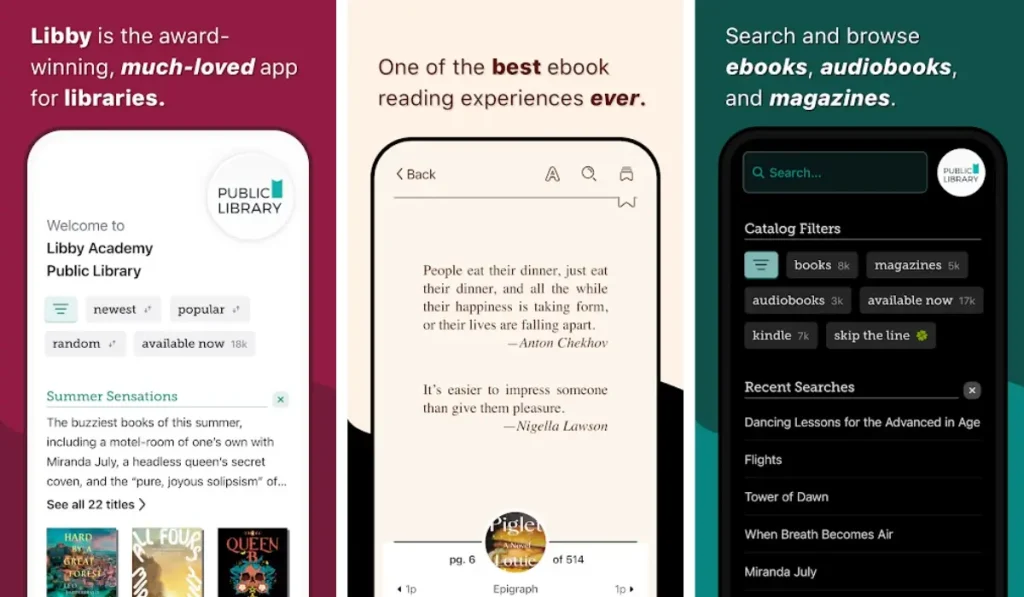
Libby is hands-down the best free reading app in 2026. With a free library card, it gives you instant access to your local library's full digital collection: eBooks, audiobooks, and magazines, all at no cost. Built by OverDrive, it works on Android, iOS, and the web, and is used by more than 90% of public libraries in North America, in 78 countries worldwide.
You borrow titles just like at a physical library, download them for offline reading, and place holds on popular books to get notified when they're available. It supports Android Auto and Apple CarPlay for audiobooks in the car, and can even send your library eBooks to your Kindle. Everything syncs automatically across your devices.
What it is: A free app that unlocks your public library's entire digital catalog.
Key features
- Free eBooks, audiobooks, and magazines with a library card.
- Clean, beginner-friendly interface with customizable fonts and dark mode.
- Offline downloads so you can read or listen without data.
- Place holds and get notified when a title frees up.
- Send borrowed eBooks to your Kindle, and listen in the car via CarPlay/Android Auto.
Best for: Readers who want bestsellers and audiobooks for free and already have (or can get) a library card.
Pros
- Completely free, with no ads, no in-app purchases, and no late fees.
- Bestsellers, classics, and audiobooks all in one app.
- Simple enough for first-time digital readers.
- Offline access for travel.
Cons
- Popular titles can have long waitlists.
- You need a valid library card.
- Catalogs vary by library and region.
Pricing (2026)
Libby is 100% free. The only requirement is a library card, which most public libraries issue at no cost (some let you sign up right inside the app using your phone number). If the waitlists frustrate you, install Hoopla alongside it, covered below, because Hoopla has no holds queue at all.
3. Audible - the best audiobook app

Audible has the deepest catalog of professionally narrated audiobooks, making it the top choice for anyone who'd rather listen. It's ideal for commuters, gym-goers, and readers with visual impairments or reading difficulties. You get speed control, sleep timers, offline downloads, and Whispersync with Kindle so you can switch between reading and listening on the fly.
What it is: Amazon's premium audiobook service with the biggest commercial narration catalog.
Key features
- Massive library of audiobooks with high-quality, often celebrity, narration.
- Adjustable playback speed and sleep timer.
- Offline downloads for listening anywhere.
- Whispersync to move between Kindle eBooks and Audible audiobooks.
Best for: Heavy listeners who want the widest selection and best narration quality.
Pros
- The biggest commercial audiobook catalog.
- Professional, often celebrity, narrators.
- Excellent for accessibility and hands-free reading.
- Fine-grained speed control.
Cons
- The Premium Plus plan gives only one credit per month.
- Beyond your credits, extra audiobooks cost more.
- The best value requires a subscription.
Pricing (2026)
| Plan | Audible Standard | Premium Plus |
|---|---|---|
| Price (monthly) | $8.99 | $14.95 |
| Credits / month | 1 (Standard catalog) | 1 (any title) |
| Free trial | 30 days | 30 days |
| Offline listening | Yes | Yes |
Audible added a cheaper entry tier in March 2026, largely as an answer to Spotify's audiobook hours. The line-up is now Standard ($8.99/month), which gives one monthly title but no Plus Catalog and, importantly, you lose the title when you cancel, and Premium Plus ($14.95/month), which adds a credit a month for any title including new releases, unlimited Plus Catalog streaming, and 30% off extra purchases. A Premium Plus 2-credit plan ($22.95/month) and an annual option ($149.50/year for 12 credits) are also available, and any audiobook you buy with a credit is yours to keep.
4. Google Play Books - the best book reading app for Android
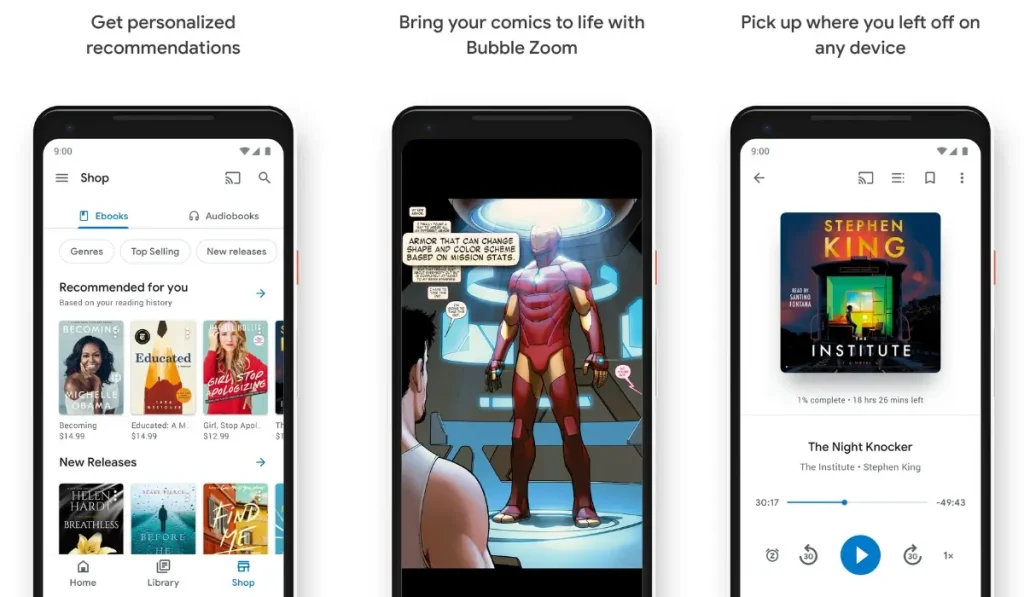
Google Play Books is the best book reading app for Android because it comes built in and asks for no subscription. You buy eBooks and audiobooks à la carte, upload your own PDFs and EPUBs, and use the Read Aloud feature to have any book read to you. It's a great fit for anyone already living in the Google ecosystem, and it works on iPhone too.
What it is: Android's default reader and store with strong support for your own files.
Key features
- Buy eBooks and audiobooks with no subscription required.
- Upload your own PDF and EPUB files to read in the app.
- Read Aloud turns any eBook into a hands-free listen.
- Syncs reading position, bookmarks, and notes across devices.
- Auto-adjusts brightness and color at night to reduce eye strain.
Best for: Android users and students who want to read their own PDFs and EPUBs without paying a subscription.
Pros
- No subscription, pay only for what you buy.
- Best support for your own PDF and EPUB files.
- Tight integration with your Google account.
- Read Aloud built in for free.
Cons
- Smaller audiobook catalog than Audible.
- Buying frequently gets pricey.
- Fewer exclusive titles than Amazon.
Pricing (2026)
The app is free with no subscription. You only pay for books you buy, and prices are set by the publisher. This makes it one of the best free reading apps for students who want to load their own course PDFs.
5. Spotify - the best way to get audiobooks with your music
Spotify is the surprise audiobook story of 2026. If you already pay for Spotify Premium, you get 15 hours of audiobook listening every month at no extra cost from a catalog of well over 400,000 titles, alongside your music and podcasts in one app. For most casual readers that's roughly one to two books a month for free with a subscription you already have.
Spotify has been expanding fast: there's a standalone Audiobooks Access plan for non-Premium users, an Audiobooks+ add-on that doubles your hours, and a new Page Match feature that uses your phone camera to find your place in the audiobook from a photo of the physical page.
What it is: A music and podcast app that now bundles a generous monthly audiobook allowance.
Key features
- 15 hours of audiobook listening per month included with Spotify Premium.
- Music, podcasts, and audiobooks in a single app.
- Audiobooks+ add-on for an extra 15 hours; family and duo members can add hours too.
- Page Match jumps to your spot from a photo of a printed page.
Best for: Existing Spotify Premium subscribers who want audiobooks without paying for a second service.
Pricing (2026)
The 15 monthly hours come free with any Spotify Premium plan. A standalone Audiobooks Access subscription runs $9.99/month for the same 15 hours (with ad-supported music rather than full Premium). If you burn through the allowance, a 10-hour top-up costs about $12.99, or the Audiobooks+ add-on runs roughly $11.99/month for another 15 hours. Unused hours don't roll over to the next month, so use them or lose them.
6. Kobo - the best Kindle alternative
Kobo is the app to pick if you don't want everything you read locked to Amazon. Rakuten's free Kobo app reads standard EPUB files, syncs with Kobo e-readers, and, unlike Kindle, still lets you bring in DRM-free books you own. It also works directly with OverDrive, so US and Canadian library borrowers can send library eBooks to Kobo the same way they send them to a Kindle.
Kobo's subscription is genuinely competitive in 2026 and it is split into three tiers rather than one, so you only pay for the format you actually use.
What it is: A free EPUB-friendly reading app with an optional all-you-can-read subscription.
Key features
- Open EPUB support, so your library isn't trapped in a proprietary format.
- Kobo Plus subscription for unlimited eBooks, audiobooks, or both.
- Syncs across the phone app, the web, and Kobo e-readers.
- OverDrive integration for public-library borrowing.
- Instapaper is now the built-in read-it-later service on Kobo e-readers, replacing Pocket.
Best for: Readers who want a big store and a subscription without buying into Amazon's ecosystem.
Pricing (2026)
The Kobo app is free. Kobo Plus Read is $7.99/month, Kobo Plus Listen is $7.99/month, and Kobo Plus Read & Listen is $9.99/month for roughly 1.3 million eBooks and 100,000+ audiobooks. New subscribers get a 30-day free trial. That makes the combined tier cheaper than Kindle Unlimited, which doesn't bundle audiobooks at all.
7. Hoopla - free library books with no waitlists
Hoopla is the library app people forget about, and it solves Libby's single biggest weakness: the queue. Hoopla licenses per checkout rather than per copy, so there are no holds and no waitlists at all. If your library carries a title, you can borrow it right now, even if fifty other people are reading it.
It's also the widest-ranging library app: eBooks, audiobooks, comics, graphic novels, manga, magazines, music albums, and films all sit in the same app. By 2026 Hoopla works with around 27,000 partner libraries and roughly 6.5 million active cardholders.
What it is: A free public-library app with instant borrowing and a mixed media catalogue.
Key features
- No waitlists, ever: borrow any available title instantly.
- eBooks, audiobooks, comics, manga, magazines, music, and movies in one app.
- Offline downloads for reading and listening without data.
- Works on Android, iOS, the web, and most TV platforms.
Best for: Anyone tired of three-month Libby holds, and comics or manga readers who don't want to pay Amazon.
Pricing (2026)
Hoopla is free with a library card. The catch is a monthly borrow limit set by your library, usually somewhere between 5 and 20 borrows a month, because your library pays per checkout. Not every library subscribes to Hoopla, so check yours before you count on it.
8. Everand (formerly Scribd) - one subscription for eBooks and audiobooks
If you've been searching for Scribd, it was rebranded to Everand and that's still the name in 2026. It's the closest thing to a Netflix for reading: one subscription covering audiobooks, eBooks, magazines, podcasts, documents, and even sheet music, more than 1.5 million titles in total.
The important thing to understand is that Everand is not truly unlimited. Plans are built around monthly unlocks for premium titles, with a large curated selection you can read anytime without spending one.
What it is: A multi-format reading and listening subscription with a credit-style unlock system.
Key features
- Audiobooks and eBooks under one subscription, no separate services needed.
- Magazines, podcasts, documents, and sheet music included.
- A large no-unlock-needed catalogue you can read freely.
- Offline downloads and cross-device sync.
Best for: Readers who switch between reading and listening and want a single bill.
Pricing (2026)
Standard is $11.99/month (1 unlock), Plus is $16.99/month (3 unlocks), and Deluxe is $28.99/month (5 unlocks). There's a 30-day free trial. Worth knowing: titles you unlock stay available while you subscribe, not forever, which is the main difference from an Audible credit.
9. ReadEra & Librera - the best ad-free offline readers
If all you want is to open EPUB, PDF, MOBI, DJVU, FB2, or DOCX files from your own phone storage without ads, accounts, or a store trying to sell you something, these two are the answer, and both are genuinely free.
ReadEra is completely free with no ads and no sign-up, supports a dozen-plus formats, keeps a proper library of everything on your device, and includes text-to-speech. Librera Reader is the power-user sibling: no ads, no tracking, deep layout controls, and it's available on F-Droid for people who avoid Google Play. Neither sells books, which is exactly the point.
Best for: Students with course PDFs, DRM-free eBook collectors, and anyone who wants a reader that isn't also a shop.
Pricing (2026)
ReadEra is free with no ads (a paid ReadEra Premium adds extras). Librera is free. Neither requires an account.
10. Wattpad - the best app for free web fiction
Wattpad is a different kind of reading app: instead of a bookstore, it's a huge community library of stories written by other users, spanning romance, fantasy, fanfiction, and serialised originals. Millions of stories are free to read, and plenty of Wattpad titles have gone on to become published books and films.
The free tier is ad-supported and locks some Originals behind Coins. Premium removes the ads and adds unlimited offline reading.
Best for: Readers who want endless free fiction and don't care about bestsellers.
Pricing (2026)
Free with ads. Wattpad Premium is $6.99/month for ad-free, unlimited offline reading, with a 7-day free trial. Premium+ adds 200 bonus Coins a month plus a curated bundle of Originals.
11. The StoryGraph & Goodreads - the best reading trackers
If you want to track what you read, find your next book, and connect with other readers, The StoryGraph and Goodreads are the two apps to know in 2026. Goodreads (owned by Amazon) has the largest community and the most reviews. The StoryGraph is the fast-growing independent alternative with better stats, mood-based recommendations, and a cleaner, ad-free interface.
Neither app is an eBook reader, they're companions to whatever app you read in. Use them to set a yearly reading goal, log finished books, and get smart recommendations.
Best for: Readers who want to set goals, log books, and discover their next read.
Key features
- Set and track annual reading goals.
- Detailed reading stats by mood, pace, genre, and page count (StoryGraph).
- Massive review database and friend activity (Goodreads).
- Personalized recommendations for your next read.
Pricing (2026)
Goodreads is free. The StoryGraph has a generous free tier plus an optional Plus subscription for advanced stats. Either works alongside Kindle, Libby, or Google Play Books.
12. Moon+ Reader & LibriVox - the best free Android extras
Two more apps every Android reader should know. Moon+ Reader is the most customizable eBook reader on Android, supporting EPUB, PDF, MOBI, and more, with built-in text-to-speech that turns your eBooks into audiobooks. The free version is ad-supported; Moon+ Reader Pro is a separate one-time purchase (listed at $11.99 on Google Play in 2026, and frequently discounted) that strips the ads and adds PDF options, extra themes, and shelf sync.
LibriVox is a free goldmine of human-narrated public-domain classics, with tens of thousands of titles recorded by volunteers. If you love Jane Austen, Sherlock Holmes, or other out-of-copyright books, it's completely free with no catch. For AI-narrated reading of any text, apps like Speechify and ElevenReader are the standout 2026 newcomers.
Best for: Power users who want total control over formatting and text-to-speech (Moon+ Reader), and classics lovers who want free human narration (LibriVox).
13. Bookly - the best reading habit tracker
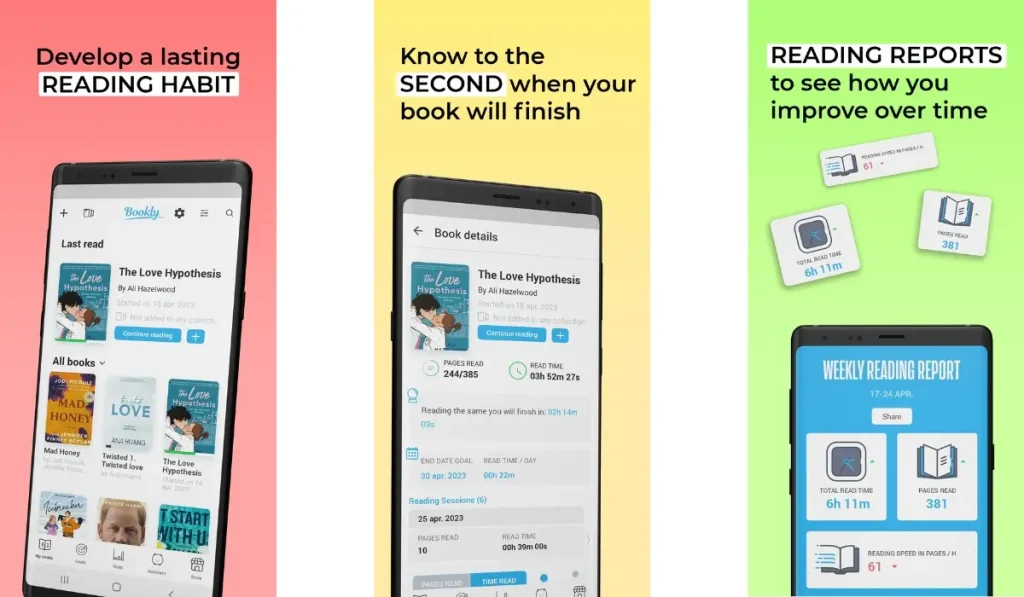
Bookly isn't an eBook reader, it's a habit tracker that helps you read more. It times your reading sessions, tracks pages and speed, sets daily and monthly goals, and gamifies the whole experience with stats and achievements. It's perfect for goal-oriented readers and students who want to stay consistent.
What it is: A reading habit and session tracker, not a book source.
Key features
- Track reading time, pages, and speed per session.
- Set daily and monthly reading goals.
- Reminders to keep you consistent.
- Detailed stats, quotes, and achievements.
Best for: Readers who want to build a daily habit and measure their progress.
Pros
- Builds a consistent reading habit.
- Clear statistics on your progress.
- Motivating goals and streaks.
Cons
- No books, it's a tracker only.
- Full features need a subscription.
- The timer can feel like pressure for some readers.
Pricing (2026)
Bookly has a free version. Premium runs roughly $19.99 every six months to unlock unlimited tracking and all stats.
The best read-it-later apps in 2026 (14 and 15)
Not all reading is books. If you save long articles, newsletters and blog posts to read properly later, you need a read-it-later app, and the landscape changed completely when Pocket closed. These are the two worth your time now.
14. Instapaper - the simple Pocket replacement
Instapaper strips any web page down to clean text, saves it for offline reading, and gets out of the way. It's the most direct like-for-like replacement for Pocket, it absorbed a wave of Pocket refugees in 2025, and Kobo picked Instapaper as the built-in read-it-later service on its e-readers after Pocket was retired.
The free tier covers unlimited saves and offline reading for most people. Instapaper Premium is $3.99/month (raised from $2.99, its first increase in four years) and adds full-text search, unlimited notes, text-to-speech playlists, and no ads.
15. Readwise Reader - the power-user option
Readwise Reader is the heavyweight: articles, PDFs, EPUBs, email newsletters, YouTube transcripts and RSS all land in one inbox, with highlighting that syncs into note apps like Notion and Obsidian and a spaced-repetition review of everything you've highlighted. It's the best choice if you read to learn and actually revisit your notes.
It costs $9.99/month as part of Readwise, which is a lot next to Instapaper, and it's more app than most casual readers need. There's a free trial, and a discounted student rate.
Reading apps that shut down (don't waste your time looking)
Half the reading-app guides online still recommend software that no longer exists. Here's what's actually gone as of July 2026:
- Pocket - shut down 8 July 2025. Mozilla announced the closure in May 2025, switched Pocket to export-only in July, and permanently deleted all user data on 8 October 2025. Annual subscribers were refunded pro rata. If you still have an old export file, import it into Instapaper or Readwise Reader.
- ComiXology - shut down 4 December 2023. Amazon folded the app into Kindle. Your purchases and any ComiXology Unlimited subscription still work, just inside the Kindle app now.
- Scribd - renamed, not closed. The subscription is now called Everand. Same company, same login, new name, so don't go hunting for a Scribd app.
- Kindle "Download & Transfer via USB" - removed 26 February 2025. Not an app, but a feature people still look for. You can no longer download purchased Kindle books to a PC for sideloading or backup. If keeping local copies matters to you, buy from Kobo or Google Play Books instead.
How we picked and tested these reading apps
We approached this guide the way a real reader shops for an app, not the way a press release describes one. We installed each app on Android phones and tablets and used them for everyday reading and listening rather than a quick demo. Here is what we weighed:
- Catalog and value: We compared library size, what's free versus paid, and how far each subscription actually stretches.
- Reading experience: We tested font and theme controls, dark mode, dictionary lookups, and how comfortable long sessions felt.
- Sync and offline: We checked that our place, highlights, and downloads carried across phone, tablet, and the web.
- Audiobook quality: For listening apps we compared narration, speed controls, sleep timers, and Android Auto / CarPlay support.
- Current 2026 pricing: We verified every price against the official store or service page in July 2026, including Audible's new Standard tier, Kobo Plus's three-way split, Everand's unlock plans, and Spotify's audiobook hours.
- Is it still alive? We re-checked that every app we recommend still exists and still works, which is how Pocket and ComiXology ended up in the shutdown list instead of the picks.
We re-check these picks whenever pricing or plans change, which is why Audible's revamped tiers, Kobo Plus, Hoopla, and the post-Pocket read-it-later apps all made this July 2026 edition. Looking for more great apps to round out your phone? See our picks for the best Android apps in 2026. To keep a library of purchased and DRM-free books safe, it's also worth setting up one of the best cloud storage and backup apps.
How to choose the right reading app for you
With thousands of apps available, picking one comes down to a few simple questions. Work through these and you'll land on the right app fast:
- Buy or borrow? Want to own books? Use Kindle, Kobo, or Google Play Books. Want them free? Use Libby and Hoopla with a library card.
- Hate waitlists? Hoopla has none. Libby has the bigger catalogue but the holds queue.
- Read or listen, or both? Audible for the deepest narration catalogue, Spotify if you already subscribe, Kobo Plus Read & Listen ($9.99) or Everand if you want one bill for both formats.
- Already pay for Spotify? Use the 15 free monthly audiobook hours before paying for another service.
- Want to keep your files? Avoid Kindle for anything you need to back up, since USB downloads ended in February 2025. Kobo, Google Play Books, ReadEra, and Librera all handle your own EPUBs and PDFs.
- Free or subscription? Libby, Hoopla, LibriVox, ReadEra, Librera, and Google Play Books all cost nothing to start.
- Saving articles, not books? Pocket is gone. Use Instapaper, or Readwise Reader if you take notes seriously.
- Just want to read more? Pair any reading app with a tracker like Bookly or The StoryGraph.
Best reading apps in 2026 compared
| App | Best for | eBooks | Audiobooks | Price (2026) | Platforms |
|---|---|---|---|---|---|
| Amazon Kindle | Buying eBooks | Yes | Via Audible | Free app; Unlimited $11.99/mo | Android, iOS, PC, Mac |
| Libby | Free library books | Yes | Yes | Free (library card) | Android, iOS, Web |
| Hoopla | Free, no waitlists | Yes | Yes | Free (library card) | Android, iOS, Web, TV |
| Audible | Audiobooks | No | Yes | $8.99–$14.95/mo | Android, iOS |
| Google Play Books | Android readers | Yes | Yes | Free (buy per book) | Android, iOS, Web |
| Kobo | Kindle alternative, EPUB | Yes | Yes | Free; Kobo Plus $7.99–$9.99/mo | Android, iOS, Web, e-reader |
| Everand | One sub for both formats | Yes | Yes | $11.99–$28.99/mo | Android, iOS, Web |
| Spotify | Audiobooks with music | No | Yes | Free 15 hrs w/ Premium; Access $9.99/mo | Android, iOS, Web |
| The StoryGraph | Tracking & recs | No | No | Free + Plus | Android, iOS, Web |
| Moon+ Reader | Customization & TTS | Yes | TTS | Free / $4.99 Pro | Android |
| LibriVox | Free classics | No | Yes | Free | Android, iOS |
| ReadEra | Ad-free offline files | Yes | TTS | Free (no ads) | Android, iOS |
| Wattpad | Free web fiction | Yes | No | Free / $6.99 Premium | Android, iOS, Web |
| Instapaper | Saved articles | Articles | TTS | Free / $3.99 mo | Android, iOS, Web |
| Readwise Reader | Articles + highlights | Yes | TTS | $9.99/mo | Android, iOS, Web |
| Bookly | Reading habit | No | No | Free / $19.99 per 6 mo | Android, iOS |
The bottom line
For 2026, the smartest setup for most readers is Libby plus Hoopla for free borrowing, one covering the big catalogue and the other covering the waitlists, plus Kindle, Kobo, or Google Play Books for books you want to own. Pick Kobo over Kindle if it matters to you that Amazon removed USB downloads in February 2025. If you listen a lot, get Audible for the deepest catalog, lean on Spotify's 15 free monthly hours if you already subscribe, or take Kobo Plus Read & Listen at $9.99 for both formats on one bill. For articles rather than books, Instapaper has taken Pocket's place. Add The StoryGraph or Bookly to track your progress and you've got a complete reading toolkit, most of it free. Start with one app that matches how you read, and build from there.
Frequently Asked Questions
What is the best reading app in 2026?
For most people it's Libby, because it's completely free with a library card and carries eBooks, audiobooks and magazines from your local library. If you'd rather buy and own books, Amazon Kindle has the largest catalogue, and Kobo is the best alternative if you don't want to be locked into Amazon. In practice the best setup is one free library app plus one store app.
What happened to Pocket? Is it still available?
No. Mozilla shut Pocket down on 8 July 2025 and permanently deleted all user data on 8 October 2025, after announcing the closure in May 2025. Annual subscribers received prorated refunds. The closest replacement is Instapaper, which is free with a $3.99/month Premium tier and is now the built-in read-it-later service on Kobo e-readers. Readwise Reader ($9.99/month) is the better choice if you highlight and take notes.
What are the best free reading apps?
Libby and Hoopla are the best free apps overall because they unlock your public library's digital catalogue at no cost. LibriVox is free for human-narrated public-domain classics, ReadEra and Librera are free and completely ad-free for reading your own EPUB and PDF files, Google Play Books is free to use with no subscription, and Wattpad has millions of free community-written stories.
Is Libby or Hoopla better?
Use both, they solve different problems. Libby has the far bigger catalogue including current bestsellers, but popular titles have holds queues that can run for weeks or months. Hoopla has no waitlists at all, so anything in its catalogue is available instantly, but your library caps how many titles you can borrow each month, usually between 5 and 20. Both are free with a library card.
How much is Kindle Unlimited in 2026?
Kindle Unlimited costs $11.99 a month for unlimited access to a rotating catalogue of over a million titles, and Amazon offers a free trial. The Kindle app itself is free, and you can buy individual eBooks without any subscription. Note that many bestsellers are not included in Kindle Unlimited, and it doesn't include Audible audiobooks.
Can I still download Kindle books to my computer over USB?
No. Amazon removed the "Download & Transfer via USB" option from Kindle content libraries on 26 February 2025, so you can no longer download a purchased Kindle book to a PC and sideload or back it up. Books are delivered over Wi-Fi to registered devices and apps instead. If keeping local copies matters, buy from Kobo or Google Play Books, which handle standard files.
What is the cheapest way to get audiobooks?
The cheapest option is free: Libby and Hoopla both lend audiobooks with a library card, and LibriVox has tens of thousands of free public-domain recordings. If you already pay for Spotify Premium you get 15 audiobook hours a month at no extra cost. Paid options in 2026 are Kobo Plus Listen at $7.99/month, Audible Standard at $8.99, Spotify Audiobooks Access at $9.99, Everand from $11.99, and Audible Premium Plus at $14.95.
Is Scribd still around?
Yes, but it's called Everand now. The subscription was rebranded from Scribd and keeps the same accounts and catalogue of over 1.5 million audiobooks, eBooks, magazines, podcasts and sheet music. Plans in 2026 are Standard at $11.99/month (1 unlock), Plus at $16.99 (3 unlocks) and Deluxe at $28.99 (5 unlocks), with a 30-day free trial. Unlocked titles stay readable while you subscribe, not permanently.
Which reading app is best for reading my own PDFs and EPUBs?
ReadEra is the best free choice: no ads, no account, and support for EPUB, PDF, MOBI, DOCX, FB2, DJVU and more, with text-to-speech built in. Librera is a good alternative with no tracking and an F-Droid build. Google Play Books also lets you upload your own PDFs and EPUBs and syncs them across devices, and Moon+ Reader is the pick if you want deep font, margin and gesture customisation.
What reading app is best for comics and manga?
The Kindle app, because the standalone ComiXology app shut down on 4 December 2023 and its entire catalogue, including ComiXology Unlimited, moved into Kindle. For a free option, Hoopla carries a large comics, graphic novel and manga collection through your library with no waitlists.